
Culture
LSD Could Be the Key to Alleviating the Mental Health Crisis—if Government Allows It
Given the success of the early research into LSD, as well as the growing body of anecdotal evidence confirming its safety and efficacy, it is extremely likely that the various clinical trials currently in the pipeline will produce life-changing medicines.


On April 16, 1943, a Swiss chemist by the name of Albert Hofmann accidentally ingested a drug he created five years earlier while working at Sandoz Laboratories (now a subsidiary of Novartis) and began to experience very unusual sensations and hallucinations. He later described this altered state of mind as “a not unpleasant, intoxicated-like condition characterized by an extremely stimulated imagination.”
While I am sure Dr. Hofmann realized that he discovered something worthy of further investigation, he could not have possibly imagined that his drug—lysergic acid diethylamide, popularly known as LSD or acid—would eventually become our best hope for solving the opioid epidemic and the global mental health crisis.
When most of us think of LSD, we are immediately transported to the 1960s—the era of the proverbial sex, drugs, and rock ’n’ roll. Indeed, it is difficult to imagine the 60s without the freedom-loving hippie counterculture that challenged an otherwise extraordinarily conservative nation. However, few people know that during the 50s and 60s, scientists began to explore the potential uses of psychedelic substances, including LSD, for therapeutic purposes.
What eventually came to be known as psychedelic or psychedelic-assisted therapy was first pioneered in Canada by Abram Hoffer and Humphrey Osmond roughly a decade after Dr. Hofmann’s accidental LSD trip. Humphrey Osmond initially speculated that, by giving a high dose of LSD to individuals suffering from alcoholism, he could frighten them to the point where they would want to quit drinking. However, much to Osmond’s surprise, all of the patients’ experiences on LSD were pleasant and, most importantly, transformative. Between 1954 and 1960, Osmond and Hoffer treated about 2,000 alcoholics with LSD and reported that 40-45 percent of them did not return to drinking after a year. Similar positive results were achieved by a Czech-born psychiatrist by the name of Stanislov Grof, who used LSD to treat heroin addicts in Prague (During this same timeframe, the CIA conducted hundreds of cruel and unethical experiments on unwitting subjects using LSD in the attempt to develop a “truth serum” for interrogations).
The groundbreaking research in the nascent field of psychedelic therapy came to a halt in 1970 with the introduction of the Controlled Substances Act, which not only made the manufacturing, sale, and possession of LSD illegal, but categorized it as a Schedule I controlled substance, meaning that it had no “currently accepted medical use in the United States, a lack of accepted safety for use under medical supervision, and a high potential for abuse.”
In June of 1971, President Nixon declared a “war on drugs,” which further vilified LSD and other psychedelic substances to the point where most people considered them to be as addictive and deadly as heroin (In actuality, heroin is currently ranked as the second most harmful drug after alcohol, while LSD and psychedelic mushrooms occupy the eighteenth and the last spot, respectively, in a list of twenty drugs).
The 80s weren’t any better. They brought us Nancy Reagan’s “Just Say No” campaign and the infamous “This Is Your Brain on Drugs” public service announcements. With billions of dollars of government money being pumped into the War on Drugs, the number of people being imprisoned for drug law violations ballooned from 50,000 in 1980 to more than 400,000 by the mid 1990s.
At the same time, the rates of opioid addiction and overdose have continued to rise year after year. Today, roughly 1 percent of our nation’s adult population—2.4 million people—has an opioid-use disorder. Further, virtually every statistic on mental health points to the fact that the US is facing a mental health crisis of unprecedented scale, and yet we have not seen any more breakthrough medicines in the psychiatric-drug industry since Prozac arrived on the market more than 30 years ago.
It is clear that we are desperately in need of something better, and it may as well be LSD.
So what makes LSD, and psychedelics in general, so special? Increasing evidence suggests that psychedelic medicines, such as LSD, MDMA, and psilocybin (the main psychoactive compound in magic mushrooms), can serve as a sort of “reset button” for the brain that gives individuals the tools they need to face and address their struggles in a constructive way. As Julie Holland M.D. points out in her book, Good Chemistry: The Science of Connection, from Soul to Psychedelics,
[Psychedelics] are growth promoters and life shifters, in part because they’re meaning makers. The resetting is part of a resettling. First, the default mode network is quieted, then there is a hyperconnection of nearly every other area of the brain. After all these areas communicate, things are never quite the same. The brain may have been “shaken up” a bit, and old ruts and trenches may have been smoothed over in the process. The most impressive resetting occurs with some of the strongest psychedelics.
More recently, Silicon Valley has started a trend of microdosing LSD and other psychedelic substances (i.e. taking less than a tenth of a recreational dose of a drug). Those who partake in this practice have reported an increase in energy and creativity, improved overall well-being, reduced stress and anxiety, and improved sleep without adverse side effects. The vast array of prescription medications currently on the market still cannot consistently accomplish this.
During the last decade, a number of biopharmaceutical start-ups, such as COMPASS Pathways PLC and Mind Medicine Inc. (MindMed), have been working on developing psychedelic-inspired medicines through clinical trials. Presently, MindMed is collaborating with the University Hospital of Basel on a Phase 2 Clinical Trial of LSD for cluster headaches and the Maastricht University in Netherlands on a Phase 2 LSD Microdosing Trial for adult ADHD. (In addition to LSD, other psychedelic substances currently are or have been tested in clinical trials, including 18-MC for treatment of opioid addiction, MDMA for treatment of severe PTSD, psilocybin for alleviating depression and anxiety in patients with terminal cancer, and many others).
Given the success of the early research into LSD, as well as the growing body of anecdotal evidence confirming its safety and efficacy, it is extremely likely that the various clinical trials currently in the pipeline will produce life-changing medicines. It is also clear that the general public is starting to warm up to the idea that psychedelics, just like marijuana, should be legalized, or, at the very least, removed from the Schedule I list.
Albert Hofmann used to call LSD his “problem child.” But shortly before his death in 2008, Dr. Hofmann learned that a medical trial of LSD was approved in his native Switzerland. He was truly overjoyed that, after three and a half decades, LSD was once again being recognized for its tremendous potential as a medicine. Eager to share his excitement with his friends, he told one of them that his “problem child had come home, [and] had become a wonder child.”
Indeed, it seems it has.


Culture
‘White People, You Are The Problem’: AT&T’s Internal ‘Racial Reeducation Program’ Leaked
I think I found the “systemic racism” we’ve been told so much about!

“AT&T Corporation has created a racial reeducation program that promotes the idea that ‘American racism is a uniquely white trait’ and boosts left-wing causes such as ‘reparations,’ ‘defund police,’ and ‘trans activism,'” Christopher Rufo reports.
From City Journal:
I have obtained a cache of internal documents about the company’s initiative, called Listen Understand Act, which is based on the core principles of critical race theory, including “intersectionality,” “systemic racism,” “white privilege,” and “white fragility.” CEO John Stankey launched the program last year and, subsequently, has told employees that private corporations such as AT&T have an “obligation to engage on this issue of racial injustice” and push for “systemic reforms in police departments across the country.”
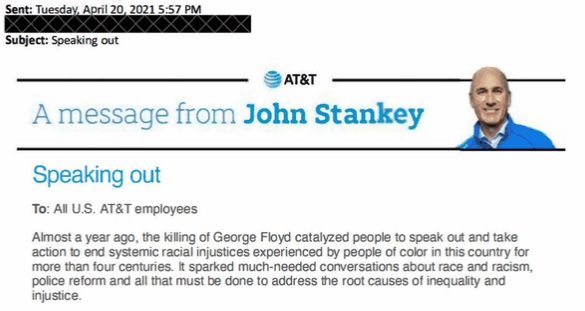

According to a senior employee, who agreed to speak on condition of anonymity, managers at AT&T are now assessed annually on diversity issues, with mandatory participation in programs such as discussion groups, book clubs, mentorship programs, and race reeducation exercises. White employees, the source said, are tacitly expected to confess their complicity in “white privilege” and “systemic racism,” or they will be penalized in their performance reviews. As part of the overall initiative, employees are asked to sign a loyalty pledge to “keep pushing for change,” with suggested “intentions” such as “reading more about systemic racism” and “challenging others’ language that is hateful.” “If you don’t do it,” the senior employee says, “you’re [considered] a racist.” AT&T did not respond when asked for comment.
On the first page of AT&T’s Listen Understand Act internal portal, the company encourages employees to study a resource called “White America, if you want to know who’s responsible for racism, look in the mirror.” The article claims that the United States is a “racist society” and lays out its thesis plainly: “White people, you are the problem. Regardless of how much you say you detest racism, you are the sole reason it has flourished for centuries.” The author, Dahleen Glanton, writes that “American racism is a uniquely white trait” and that “Black people cannot be racist.” White women, she claims, “have been telling lies on black men since they were first brought to America in chains,” and, along with their white male counterparts, “enjoy the opportunities and privileges that white supremacy affords [them].”


[…] In the “Act” section of the training program, AT&T encourages employees to participate in a “21-Day Racial Equity Habit Challenge” that relies on the concepts of “whiteness,” “white privilege,” and “white supremacy.” The program instructs AT&T employees to “do one action [per day for 21 days] to further [their] understanding of power, privilege, supremacy, oppression, and equity.” The challenge begins with a series of lessons on “whiteness,” which claims, among other things, that “white supremacy [is] baked into our country’s foundation,” that “Whiteness is one of the biggest and most long-running scams ever perpetrated,” and that the “weaponization of whiteness” creates a “constant barrage of harm” for minorities. The 21-Day Challenge also directs employees to articles and videos promoting fashionable left-wing causes, including “reparations,” “defund police,” and “trans activism,” with further instruction to “follow, quote, repost, and retweet” organizations including the Transgender Training Institute and the National Center for Transgender Equality.
Rufo reported earlier this month that Walmart is training white employees that “white is not right.”
Coca-Cola is training white employees to “try to be less white.”
I think I found the “systemic racism” we’ve been told so much about!
Culture
COVID Baby Bust Accelerates Nine Months After Lockdowns
Bloomberg shows a shocking chart that when factoring all the deaths in 2020 and into 1Q21, including virus-related deaths, U.S. births only exceeded deaths by 45,000 in February and March.

In a previous note last month, we said one of the biggest deflationary threats looms over the U.S. economy, that is, birth rates have fallen to their lowest level in a generation. Diving deeper into the baby bust, new Centers for Disease Control and Prevention data shows nine months after the virus pandemic was first declared a national emergency, U.S. births plunged 8% in December, according to Bloomberg.
CDC data showed an acceleration in birth declines for the second half of 2020. Full-year data shows that the number of babies born countrywide fell 4% to 3.6 million, the most significant decline since 1973, the start of the stagflation of the 1970s.
The latest CDC data disproves the mainstream media’s narrative of a “COVID Baby Boom” as much of the nation was cooped up in their homes during lockdowns.
The data appears to show millennials were not in the ‘mood’ to have a child during the global health catastrophe. The declines in births have been occurring for several years as the younger generation, trapped in insurmountable debts, can barely afford rent and groceries, nevertheless raise a child.
On a state-by-state basis, California in December led the declines, which plummeted 19%. For the second half of the year, New Mexico, New York, Hawaii, and West Virginia saw decreases ranging from 8% to 11%.
We noted California’s population continues to drop as a mass exodus of residents escapes the liberal hell hole of high taxes, unaffordable homes, and violent crime. The younger generation in the state appears to be having fewer children, exacerbated by the pandemic.
Bloomberg shows a shocking chart that when factoring all the deaths in 2020 and into 1Q21, including virus-related deaths, U.S. births only exceeded deaths by 45,000 in February and March.
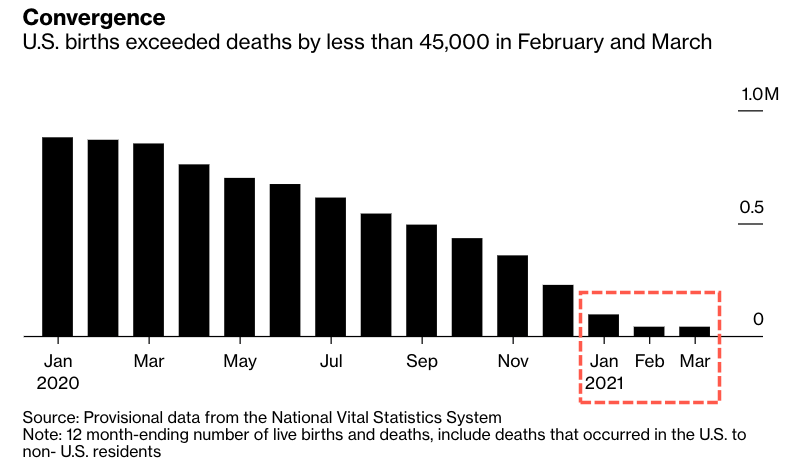
In terms of race, births in December had the most significant reduction among Asians, plunging 19% from the same period in 2019.
What this shows are some early signs of a COVID baby bust. But most of this is a continuation of a trend that’s been happening for more than a decade. With birthrates faltering and debts soaring. We believe the primary secular economic trend is, and has been for at least a decade is deflation – as we’ve said before, Japan is a microcosm of what America is facing as the “3-D’s” of debt, deflation, and the inevitability of demographics implosion continues to widen the wealth gap.
Culture
Have the Great Reset Technocrats Really Thought This Through?
The only thing left to destroy in a world populated by elites alone, are other elites.

The only thing left to destroy in a world populated by elites alone, are other elites. It would seem that the desire to dominate others does not simply come to an end on its own.
With the UN World Food Program announcing that some 270 million people worldwide now face starvation, the ongoing debate about the real aims of the technocracy is profound. The question is whether their aim tends more towards major population reduction, or more towards a new type of slavery.
It appears that philosophical and long-term practical questions remain a mystery. We will argue that evil, not simply the influence of the base upon the superstructure, is at the core of this endeavor. We have defined evil as inflicting the highest degree of pain upon the greatest number of resisting subjects. In short, we have defined evil as sadism, inflicting evil because it brings satisfaction to those inflicting it.
Because evil is fundamentally a destructive force, it cannot create anything: nothing in it is truly novel nor of use to humanity. Its pleasures are short-lived and spurious. It is unsustainable, self-defeating, ultimately leading to self-destruction.
We have adequately assessed from any number of sources that nefarious interests are behind this process, who seek to make the process also about the exercise of power, in addition to several other aims (remaining in power, exercising power in ways consistent with their occult beliefs about evil, etc.). We understand that they are ‘evil’ because they involve a type of ‘power-over’ (as opposed to power-with/consent) which derives this power from fear-mongering and terrorism upon the population. Terrorism here is defined as the operationalized use of fear, pain, and other injury towards socio-political aims.
Had their plans not been rooted in evil, they would have used soft-power tactics like manufacturing consent, to arrive at their ends.
The aim of the Great Reset is to transition the ruling plutocratic oligarchy into a technocratic one. The basis of plutocracy is finance, and the introduction of AI and automation eliminates the basis for finance as the foundation of an economy of scale. This is because automation and deflation move in tandem, making new technologies net losers. Therefore a new paradigm accounting for this post-financial ‘Fourth Industrial Revolution’, must be introduced.

Side-by-side comparison of auto-assembly line: 1920 vs. 2020 – ‘Humans need not apply’
But the ideology of the Great Reset is based within the old financialist paradigm, which is one of cost externalization. When human beings are no longer involved in the valorization process in the production of goods and services, then humanity itself is the cost that requires externalization – elimination.
But how it is that sadism became the occult religion of the ruling class, presents a “chicken-or-the-egg” type of question. That is, did the corporate ideology mutate into occult sadism, or did occult sadism find its expression through the corporate ideology? This question will no doubt form the basis of later inquiry.
We often defer to nefarious motivations or processes in terms of ‘greed’, or ‘self-interest’, ‘power obsession’ or the ‘crisis of capital accumulation’, ‘speculative bubbles’.
And these do not suffice in the final analysis, though they provide explanatory power. The problem arises in predictive power, because while we face a crisis of diminishing returns due to automation (as the increasing tendency towards net loss on new large capital investments), the real psychological needs that motivate the present plutocracy as a power-group are actually undermined in significant and sudden population reduction, or new post-coercive technologies that eliminate human agency. This may seem counter-intuitive, but in light of an understanding of the self-defeating nature of evil, we will explore this question.
When we map out the probabilities of three intersecting policy vectors, we can understand this question even better. Those policy vectors are a.) neuralink/AI/Neural Implants/magneto proteins and related transhumanism, b.) depopulation as part of stated Agenda 2030 goals, c.) automation/roboticization, 4IR, and IoT.
This will follow from our last piece on the subject, The Great Reset Morality: Euthanization of the Inessentials:
Neural Implants
The development and introduction of neural implants, magneto proteins, etc., can go in any number of directions. Some types of these promise to give elites ‘super-human’ cognitive abilities. However, another very practical application is to mandate that these are used on the general populace as to handicap them or control their thoughts in some way.
In that sense, neural implants can work like pharmaceuticals are used in psychiatry. In the creation of this sort of Huxleyesque ‘Brave New World’, we can easily see the continuation of a paradigm already existing today. This is one where it is common-place to find various predictable depressions, anxieties, and neuroticisms caused by contemporary social conditions, but treated psychiatrically instead of resolved socio-economically.
Neural implants can also perform a similar function, but go even further. Beyond emotions or basic effect on the re-uptake of certain hormones like serotonin, etc.; neural implants can direct thoughts or change whole cognitive processes. Beyond feelings, drives, and impulses, neural implants promise to produce actual thoughts in the minds of the subject.

LLNL engineer Vanessa Tolosa holds up a brain implant – credit: Extreme Tech Magazine, July 2014
In between these two is a hybrid form – nanotech and chemogenetics working with optogenetics. Because the delivery system to the brain can be through injection, nanolipids and other compounds can come in the form of shots. These can be delivered as part of a required ‘vaccination’ regimen (insofar as that term has been redefined), as nanotech features already in the Covid-19 shot.
Therefore, such can be included – whether disclosed to the public or not – in required vaccinations.
The development of these would seem, however, to be a technology that would support slavery, but does not rule out genocide. Certainly the ability to control the thoughts of a population would greatly mitigate risk in the view of the state apparatus, especially as it moves towards genocide.
Depopulation: Myths vs. Facts
Population control and population reduction have long been policy at various institutions and think tanks committed to global governance, from the UN to the World Economic Forum. It was a part of the UN’s Millennium goals, and since the dawn of the 21st century, has been part of UN Agenda 2030.
It is important to now introduce a framework for understanding the problem of population in light of economic development. The long standing view is that economic development leads to population stagnation, even decline. The idea here is that education and urbanization are processes which lead towards better knowledge of basic family planning, in tandem with improved access to abortion and birth control.
The underlying postulate is that people naturally do not want to be burdened with children, that children are an affront to freedom in the abstract. The formula is that as people are better educated and have more meaningful work and interesting lives, they know both how to prevent pregnancy and also no longer have ‘primitive’ inclinations towards large family building.
This mythology was built up around a notion that people are fundamentally self-interested in the narrowest sense, to the exclusion of other desires, needs, and impulses. They are presented as the norm such to furthermore create a broader culture which opposes procreation.
Instead, the real mechanism pushing population stagnation in the 1st world are increased pressures of work, and increased costs of living. Rather than ascribing population stagnation to improved conditions of life, these are more related to austere conditions imposed by late modernity. The costs of property, of rents, of food, and also because of the decline in quality of goods through increased planned obsolescence, has placed more economic pressure on individuals and couples. It has led to the requirement that both members of a household are working full-time. And even with this, home ownership in cosmopolitan centers is practically impossible for most. Austerity has also led to stagnation in life expectancy.
This truth is exposed in actual policy papers like “New strategies for slowing population growth” (1995). Here, the doublespeak is evident, with easily decipherable phrases within it; “…reduce unwanted pregnancies by expanding services that promote reproductive choice and better health, to reduce the demand for large families by creating favorable conditions for small families…”. What could possibly be meant by ‘create favorable conditions for small families’?
Economic development does not reduce population, but if we add austerity and demanding and inflexible work obligations, then we land on an answer. Economic prosperity, as it has for time immemorial, promises to greatly increase the population in the absence of a program of population reduction. Because an organic 4IR not brought in by the technocracy would decrease work obligations and increase quality of life markers, we would expect a population boom.
Consequently, projections that that population will top off at just under 10 billion by the 2060’s are as erroneous as they are linear. Without a technocracy working to actively reduce population, as they believe, an economy based on automation and AI would see a population explosion.
Conclusion
It is still likely that the would-be technocrats have indeed thought out the end-game, and that there are any number of possibilities that will allow them to harvest sadistic pleasure as an exercise of absolute power, in perpetuity. This might mean increasing fear of extermination far beyond actual population reduction. It could mean maintaining many aspects of agency for the controlled population, so that their pains are internalized in multivariate and complex fashions, that include confused feelings of self-blame, identifying with the abuser, resentment, regret, and also violations of will and dignity. Again, if will is not a factor, then all of these potential arenas of psychological pain are not present.
To frame the following, it is fundamental to understand that in a post-labor civilization, the status of humanity no longer exists upon a metric of utility. Either civilization exists to improve the human condition, or to increase human suffering. There are no trade-offs or costs. Society is either good or evil.
But evil is short lived and short-sighted, and this is why: Sudden population reduction is a fire-cracker, it explodes just once. The pleasure in the process of eradicating billions of people, and the fear, pain, and suffering this would cause, within the span of a few short years, only gets to be enjoyed once. It’s a sacrificial ritual upon the altar of Moloch that can only be performed one time.
Likewise with post-coercive technologies: Without agency, controlling people serves no purpose in terms of violating their own will or desire. Causing pain on a subject that does not resist because he has no will, gives the sadist much less pleasure than would pain on a subject against their will.
Moreover, the position of being elite is relative to a number of factors such as distribution of wealth, power, and/or privilege, and the sheer numbers in terms of population, that one possesses these advantages over.
If there are only elites remaining, then they would have merely introduced a new kind of egalitarian society on the foundation of superabundance and a miniscule human population. If living conditions of an existing humanity can be greatly reduced, then the relative privilege and luxury enjoyed by the elites grows in that proportion.
Absent some radical life-extending technology, it is conceivable that science and technology have already reached the zenith point at which privilege and luxury cannot be furthered. A reasonable solution would be to reduce living conditions for others so as to enhance their own relative privilege. The greater number of people who live in reduced conditions, the more privileged one’s position of privilege actually is.
Likewise, it would seem that maintaining some human population as ‘possessions’ would serve to augment ownership over human beings, perhaps the most valuable type of possession because they are aware that they are owned – but only if that humiliates them. For what other purpose is there for slavery, in a world without human labor?
Does it have any meaning, or is any satisfaction achieved, by governing over people without the possibility to have the will to either consent, or conversely, resent the ruler? Here we can understand it along these lines: the possibility for agency means that governing can happen with their support, or against their will.
But neural implant control over cognitive processes, eliminates the possibility for will, which would deprive technocrats of the pleasure of ruling with or against the will of the ruled.
Therefore, the destructive evil framework of those behind the Great Reset is revealed. The use of strategy, planning, and cunning to achieve their desired result is prevalent. But have they examined the foundation of their desires? Do they understand what their victory would deliver to them?
The only thing left to destroy in a world populated by elites alone, are other elites. It would seem that the desire to dominate others does not simply come to an end on its own.
For these reasons, it is likely that some elites have seen the problem in this end game. This would explain the inter-elite conflict which we have explored previously, and will return to in the near future.

Join the community.

McMaken: The Fed’s Inflation Is Behind the Supply-Chain Mess

‘White People, You Are The Problem’: AT&T’s Internal ‘Racial Reeducation Program’ Leaked

Matrix? Misdirection? Cringe? Zuckerberg’s presentation of future life in ‘metaverse’ sparks fear, loathing, marvel and mockery

New York facing streets without cops because of COVID vaccine mandate

The Establishment Is Hiding Mass Resistance To Vaccine Mandates With The “Striketober” Farce
