
Health
Lockdowns Don’t Prevent Coronavirus Spread
What the new study from Northern Jutland shows is that an extreme form of lockdown didn’t work in one of the most law-abiding societies in the world.


Much has been said about the terrifying models that in the spring projected such a staggering number of deaths from the novel coronavirus.
In hindsight, as bad as the pandemic has been, it never even approached the dismal numbers suggested ‒ the very numbers that rationalized society-wide lockdowns in Italy, the U.K., New York City, and then in many other places as the pandemic spread.
What researchers have struggled with since then is how to measure the impact of various actions taken. Do we even know if what we’re doing is working? Where’s the evidence for that, and are there other things we ought to do instead?
Naturally, proponents of lockdowns have long said that strong government action prevented all kinds of horrors. If anything, the poor outcomes we had in the spring and the fall indicated that we didn’t do enough. Skeptics, on the other hand, said that lockdowns did nothing but harm our societies ‒ physically, economically, and mentally ‒ and that infection rate curves moved the way they did regardless of what strong-worded politicians implemented, and often before their strong policies took effect. The August NBER paper by Andrew Atkeson, Karen Kopecky and Tao Zha, ‘Four Stylized Facts about COVID-19’ spells out the uncomfortable position for most policy-makers: the virus seems to spread rapidly, kill selectively, and in no way responds to anything that well-meaning politicians have thrown at it.
The general corona debate quickly became a battle of pointing to this or that country: Lockdowners picked Australia and New Zealand; skeptics picked Sweden and Taiwan. The angry feuds in political arenas and editorial pages were off to the races. Death rates in Sweden far outstripped those of its neighboring countries, a topic on which we already in August tried to bring some clarity. To an American and British audience who couldn’t tell Bergen from Ystad, or slurred Danish from Finnish diphthongs, higher death rates and weaker restrictions were conclusive evidence that Sweden’s slightly-more-open strategy had failed. Never mind that the Nordic countries may differ in other respects. One-variable statistical analysis at its worst while practically no one compared Sweden to the much worse-performing UK, Belgium or France.
Maybe countries greatly differed from one another in ways that would make such naive comparisons completely misleading: demographics, population densities, the size of the Covid-shock, the effect of government advice, the soft cultural values of how real people interact and how they responded to the pandemic. Besides, all these countries introduced so many new policies and behavioral changes that even those of us who tried to make sense of them quickly lost track.
What we needed was an experiment, where all of those background differences were controlled for. Ideally, a jurisdiction with similar conditions operating on similar rules; where some of their areas locked down hard, while their neighboring counties, identical in every other way, did not. In a new article, one of us together with another co-author, did exactly that. The article, “Lockdown Effects on Sars-CoV-2 Transmission – The evidence from Northern Jutland,” by Kasper Planeta Kepp and Christian Bjørnskov is now available on MedRxiv.
In late summer, a new mutation of the Sars-CoV-2 virus was discovered among mink farms in Denmark. That information suddenly became important in Danish debate in October, when researchers from the Danish Serum Institute warned against the mutation, and politicians demanded action. On November 4, the prime minister announced that in the Danish region of Northern Jutland, seven municipalities were to enter into extreme lockdown, enacting the usual battery of work-from-home, closing of commercial and leisure activities and closed public transport. Scattered among them, all in the same region of Northern Jutland, were four municipalities that didn’t; they remained under the then-fairly moderate rules in the rest of Denmark. In total 280,000 people and 126,000 jobs were affected by the extreme lockdown, as people were banned from crossing municipal borders to go to work.
Here was a golden opportunity to measure the infection impacts of very strict lockdowns. By comparing otherwise very similar municipalities ‒ language, culture, administrative region, geography ‒ the Danish professors could avoid the problems with identifying cause and effect that hampered cross-country observations. In addition, the lockdown of seven municipalities was not justified on different case numbers or spread of the virus, but only on a worry about a new mutation that subsequently proved to be unfounded.
Prior to the heavier lockdowns in our seven municipalities, there was no detectable difference between the two Northern Jutland groups. In the seven days before the lockdowns, the strict group had 0.15 positive tests per thousand inhabitants per day compared to 0.14 in the open group. In the spring, too, when far fewer people were tested, the former group experienced a total of 0.69 positive tests per thousand inhabitants while the open group saw 0.82 positive tests (all differences statistically insignificant).
Treating the two groups as stand-alone units, Planeta Keep and Bjørnskov write that
“[W]e find no statistically significant differences between the two groups of municipalities prior to intervention. The strong similarity in infection rates at different timescales before the intervention strongly supports treating the lockdown as an actual quasi-natural experiment.”
In no statistical specification that the researchers run does the lockdown variable ‒ shifted by 4, 7, or 10 days to allow for an uncertain incubation period of the virus ‒ pass conventional significance tests for its impact on the number of infections. The only thing that seems to be driving positive tests in the North-Danish municipalities are the infections in previous days and weeks.
As seen in Figure 1 of the paper, the number of Covid infections in the two groups was already falling before the onset of the heavy restrictions in the lockdown municipalities ‒ and it keeps falling just the same in both groups. In non-statistical terms: looking at identical counties, with as natural as natural experiments come, the researchers cannot detect any impact from lockdowns. Lockdowns don’t stop, slow down, or seem to affect the future spread of the disease in any way.
Figure 1
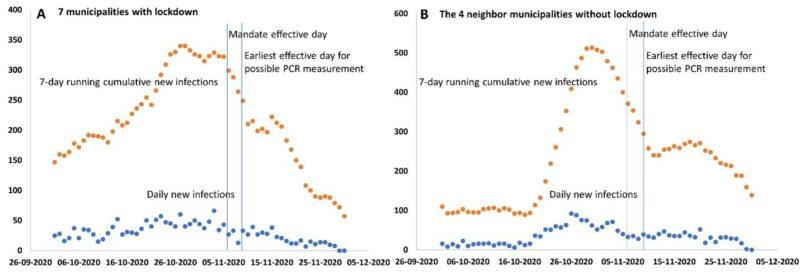
What’s remarkable is that the study includes a big enough population to detect that change. It has similar test-and-control groups with hundreds of infections in each. There was a big push for mass testing in both groups, and so virtually no chance that testers did not detect a meaningful number of infections. The professors reflect on the study and describe it as
“[T]he most time- and space-focused empirical dataset available with sufficient statistical power, adequate and homogeneous control group, nearly complete testing, and with the smallest possible confounder pollution imaginable in a real setting.”
In great contrast to the terrifying projections from imagined models, this study showed real outcomes with real people going about their real pandemic lives. It could very well be that lockdowns work in some settings, in some jurisdictions, and under some conditions. But in a setting with voluntary compliance, high trust in government and lots of general information available to the citizen, such as across Denmark (and other Nordic and Northern European countries), lockdowns don’t seem to have added anything to prevent the spread.
Whether this result is unique to a predominantly rural part of Denmark, or whether it translates to lockdown as a preventive policy more broadly remains to be seen. Because it has “lack[ed] actual empirical control cases for the same populations,” the scientific community has not been able to tease out what works and what doesn’t. However, a number of recent studies trying to get around different problems in different ways also conclude that lockdowns don’t work.
What the new study from Northern Jutland shows is that an extreme form of lockdown didn’t work in one of the most law-abiding societies in the world. Why, then, should we expect lockdowns to be effective anywhere else?
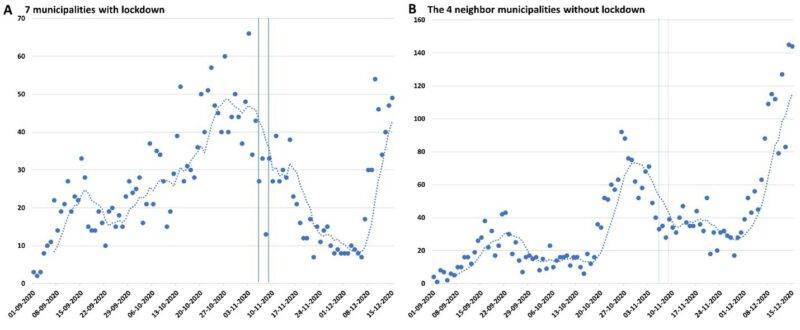
Figure A2: Increase in infection in December


Health
FDA Committee Members Reviewing Pfizer Vaccine For Children Have Worked For Pfizer, Have Big Pfizer Connections
“The industry defends the attempts to influence committee members as simply efforts to best present their case”

The FDA’s Vaccines and Related Biological Products Advisory Committee is holding a virtual meeting Tuesday October 26 to discuss authorizing a Pfizer-BioNTech Coronavirus vaccine for children between the ages of 5 to 11 years old.
This committee has a lot of sway with the FDA and their findings will be relevant, considering the Biden administration is getting ready to ship vaccines to elementary schools and California has already mandated the vaccine for schoolchildren pending federal authorization.
But the meeting roster shows that numerous members of the committee and temporary voting members have worked for Pfizer or have major connections to Pfizer.
Members include a former vice president of Pfizer Vaccines, a recent Pfizer consultant, a recent Pfizer research grant recipient, a man who mentored a current top Pfizer vaccine executive, a man who runs a center that gives out Pfizer vaccines, the chair of a Pfizer data group, a guy who was proudly photographed taking a Pfizer vaccine, and numerous people who are already on the record supporting Coronavirus vaccines for children. Meanwhile, recent FDA Commissioner Scott Gottlieb is on Pfizer’s board of directors.
HERE’S THE MEETING ROSTER: Vaccines and Related Biological Products Advisory Committee October 26, 2021 Meeting Draft Roster.
Acting Chair Arnold S. Monto was a paid Pfizer consultant as recently as 2018.
Steven Pergam got the Pfizer vaccine: Building trust in safe and effective COVID-19 vaccines (fredhutch.org)
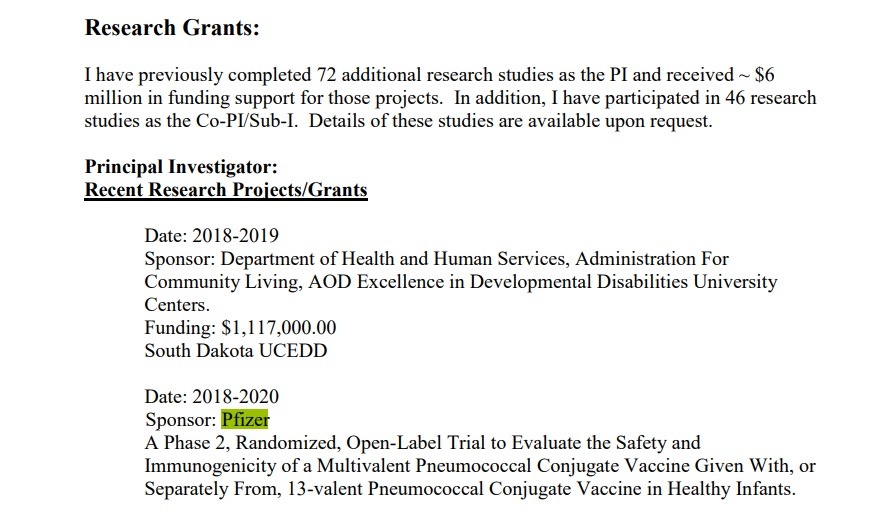
Committee member Archana Chatterjee worked on a research project related to vaccines for infants between 2018-2020, and the research project was sponsored by Pfizer.
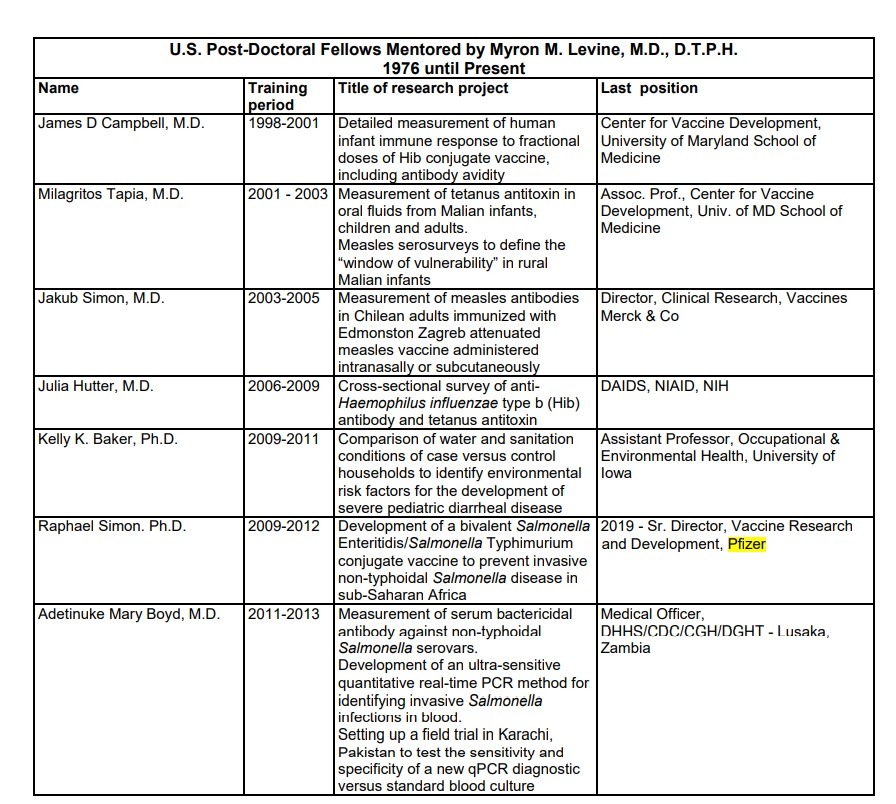
Myron Levine has mentored some U.S. post-doctoral fellows, and one of his proteges happens to be Raphael Simon, the senior director of vaccine research and development at Pfizer.
James Hildreth, temporary voting member, made a financial interest disclosure for this meeting in which he disclosed more than $1.5 million in relevant financial interests, including his work as president of Meharry Medical College, which administers Pfizer Coronavirus vaccines.
Geeta K. Swamy is listed as the chair of the “Independent Data Monitoring Committee for the Pfizer Group B Streptococcus Vaccine Program,” a committee sponsored by Pfizer. Duke University states that “Dr. Swamy serves as a co-investigator for the Pfizer COVID-19 vaccine trial.”

Gregg Sylvester previously served as a vice president for Pfizer Vaccines, where he launched Pfizer vaccines including one for children.
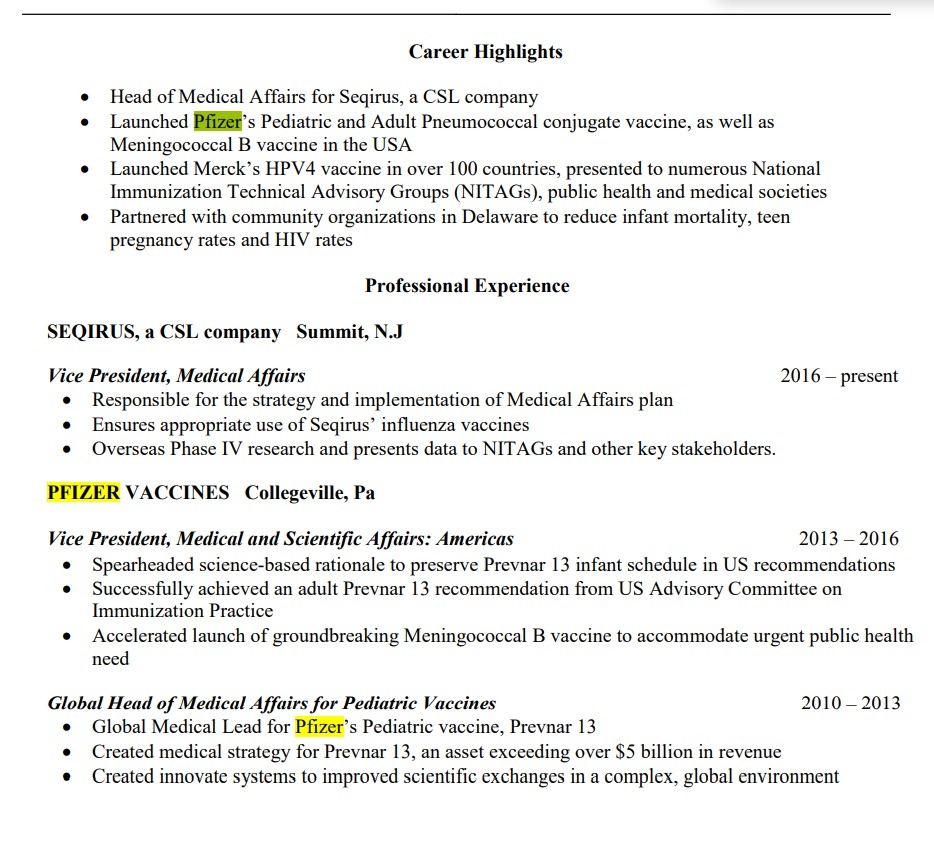 Among the meeting’s “temporary voting members,” Ofer Levy, Boston Children’s Hospital, is for the Pfizer vaccine for children, Eric Rubin is pro-vaccine for children, Jay Portnoy supports authorizing Coronavirus vaccines for kids, and Melinda Wharton complained over the summer about how orders for the CDC’s “Vaccines For Children” program dropped.
FDANews stated last December: “FDA advisory committee members in the past have frequently been the target of heavy politicking by industry representatives of whatever drug they were considering for a recommendation at in-person meetings. That process has been somewhat altered by the fact that during COVID-19, meetings are being held virtually. But it’s likely that behind-the-scenes pressuring still goes on. The industry defends the attempts to influence committee members as simply efforts to best present their case.”
Health
FDA Panel Backs Pfizer Shot For Kids: “We’re Never Going to Learn About How Safe This Vaccine Is Unless We Start Giving It”
The same FDA panel approved the rollout of boosters earlier this month based off “gut feeling” rather than data.
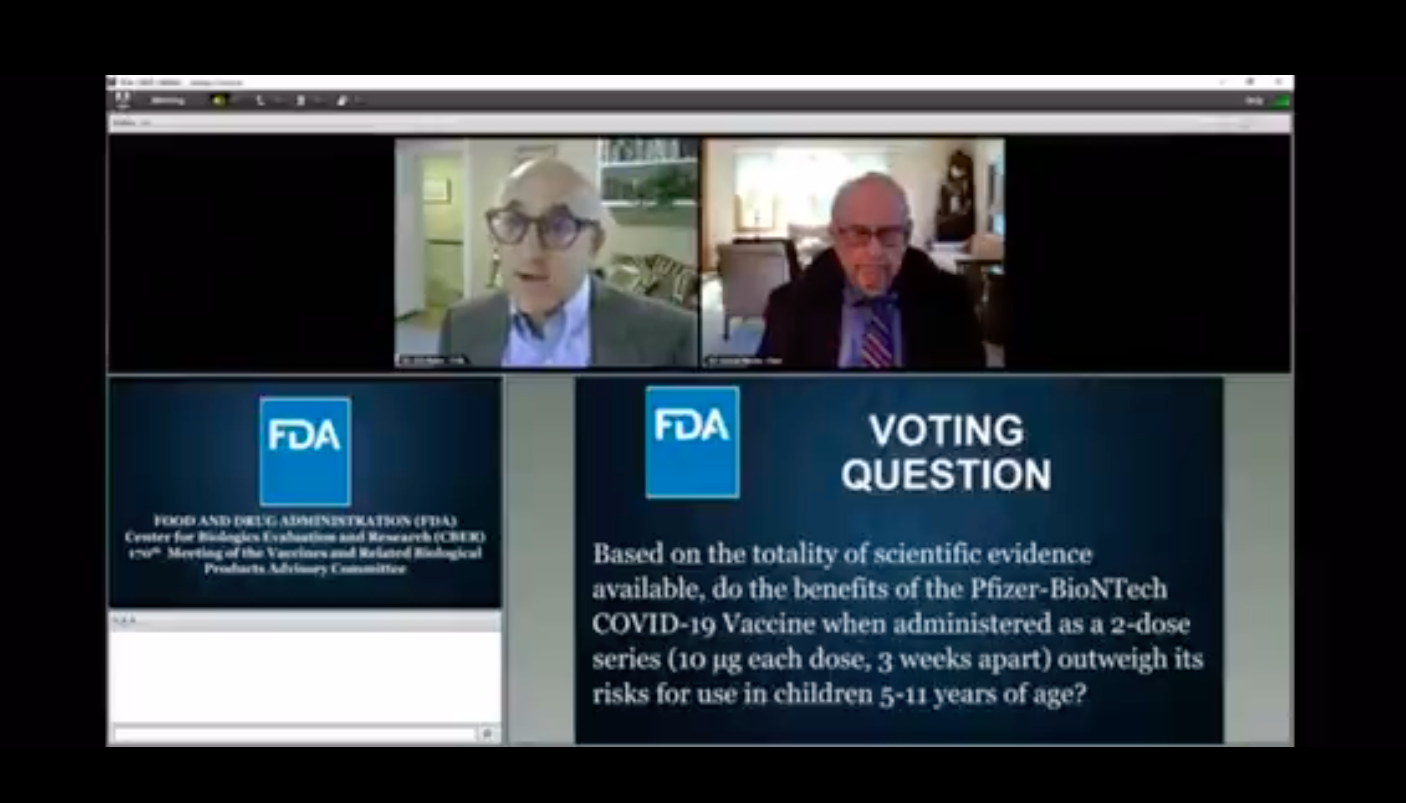
An FDA vaccine advisory panel on Tuesday voted unanimously 17-0 in favor shooting up kids aged 5-11 with Pfizer’s experimental mRNA injection with panelist Dr Eric Rubin stating, “we’re never going to learn about how safe this vaccine is unless we start giving it.”
Full context:
“We’re never going to learn about how safe this vaccine is unless we start giving it,” Dr Rubin said, urging other panelists to vote for it. “That’s just the way it goes.”
The panel voted in favor of experimenting on tens of millions of helpless children with zero long-term data on side effects because 94 children between 5 and 11 have died with COVID-19 (they claimed “of”) and “all have names. All of them had mothers,” to quote the emotional gobbledegook uttered by panelist Patrick S. Moore.
From The Washington Post:
“To me, it seems that it is a hard decision but a clear one,” said Patrick S. Moore, a University of Pittsburgh microbiologist and committee member. He noted that 94 children between 5 and 11 have died of covid-19, and “all have names. All of them had mothers.”
As the WSJ reported:
Members of the FDA’s vaccine-advisory panel supported Moderna’s booster dose even though the evidence for it was from a small study and had mixed results.
“It’s more a gut feeling rather than based on really truly serious data,” said Patrick Moore, a member of the committee and a professor of molecular genetics and biochemistry at the University of Pittsburgh School of Medicine. “The data itself is not strong, but it is certainly going in the direction that is supportive of this vote.”
This is how they “follow the science.”
Health
Governor takes over state’s PRIVATE businesses, mandates vaccines for all
‘His message was crystal clear, obey or lose your job’

The governor of Washington has begun a process that could result in a statewide mandate for all workers to accept the experimental COVID-19 shots in order to be able to get a paycheck.
Across America already, universities, schools and hospitals have COVID vaccination mandates – even though as experimental treatments those actions remain under court challenge in many cases.
President Biden also has ordered the vaccinations for federal workers and the military. And companies with more than 100 employees.
But now Democratic Gov. Jay Inslee in Washington has moved the agenda even further.
A report at the PostMillennial explains under Inslee, the Washington Department of Labor and Industries has proposed an emergency package of rules addressing the “emergency powers” given Inslee to respond to COVID-19.
“This package, which is an extension of current mandates, grants Inslee the ability to enforce COVID vaccine mandates on all private businesses in the state of Washington, according to elected officials,” the report said.
It was a statement from Republicans Jim Walsh and Jesse Young of the legislature that revealed the actions.
“This mandate from L&I demonstrates a complete lack of transparency, which dilutes public trust in our government and fails to show the agency’s good faith in promulgating the rule. The reality is this move by L&I is a blank check for the agency to enforce any of the governor’s mandates or edicts on private employers,” they wrote.
They explained if the state agency wants such a rule, officials should request it in “an open and transparent manner that allows public review and comment.”
“Even if an opportunity for review and comment is not afforded the public, L&I’s website should host the proposed rulemaking to grant easy access to the public,” they said.
They also warned about arbitrary enforcement because of the proposal’s vagueness.
“There is no clear case for ‘good cause’ or ‘the preservation of the public health, safety, or general welfare’ as the governor’s proclamation already addresses these issues, making L&I’s mandate arbitrary and capricious,” they said. “We call on the governor to immediately repeal this mandate. If L&I wants to push this policy, it needs to go through the proper channels and work with the Legislature.”
The report explained Inslee’s recent vaccine mandate was unlike others in that it provided no opt-out for testing instead.
“His message was crystal clear, obey or lose your job,” the report said. “Despite mass protests across the state with thousands of state workers in attendance, Inslee followed through on his orders and terminated thousands that decided not to comply.”
The report warned, “If Inslee follows through on L&I’s emergency rulemaking package, all businesses and employees in the state of Washington will be subjected to submitting proof of vaccination as a condition of employment.”
Real Clear Policy earlier explained that Americans simply don’t like Biden’s orders and mandates.
The article pointed out that health authorities have openly misled the public, including top medical adviser Anthony Fauci’s multiple flip-flops on COVID issues.
He deceived the public, for example, by saying the public didn’t need to wear masks, then again when commenting about “herd immunity.”

Join the community.

McMaken: The Fed’s Inflation Is Behind the Supply-Chain Mess

‘White People, You Are The Problem’: AT&T’s Internal ‘Racial Reeducation Program’ Leaked

Matrix? Misdirection? Cringe? Zuckerberg’s presentation of future life in ‘metaverse’ sparks fear, loathing, marvel and mockery

New York facing streets without cops because of COVID vaccine mandate

The Establishment Is Hiding Mass Resistance To Vaccine Mandates With The “Striketober” Farce
