
Economy
Government’s Money Monopoly and the “Great Reset”
Ending the state money production monopoly and allowing a free market in money is perhaps the most effective line of defense against world tyranny.

The unbacked paper money system is an economically and socially destructive system—with far-reaching and harmful economic and social consequences beyond what most people would imagine. Fiat money is inflationary; it benefits some at the expense of many others; it causes boom-and-bust cycles; it corrupts the morality of society; it will ultimately end in a major bust; and it leads to overindebtedness.
The Institute of International Finance (IIF) estimates that global debt climbed to $277 trillion by the end of 2020, amounting to a staggering 365 percent of world gross domestic product (GDP). As the graph below shows, global debt versus GDP has risen in recent years, suggesting that the increase in debt has outpaced the rise in GDP. This buildup of excessive debt, the path to overindebtedness, results from an unbacked paper money system.

In close cooperation with commercial banks, the central banks artificially lower the market interest rate through credit expansion, which increases the money supply. Consumption increases and savings decline, while capital expenditures go up. Taken together, this means that the economy is living beyond its means. While the injection of new credit and money at artificially low interest rates causes an initial surge in economic activity, this boom will and must be followed by bust.
Learning from the Austrian Business Cycle Theory
The Austrian business cycle theory (ABCT) points to this with rigorous logic. The reason is that once the injection of new credit and money has run its course—after wages are raised, cost of capital lowered, etc.—market interest rates return to their original levels, that is the levels which prevailed before the issuance of credit and money out of thin air. Once market interest rates start to rise, the boom slackens and collapses.
Higher market interest rates prompt people to reduce consumption and increase savings from current income. In addition, new investment projects that are considered profitable in times of artificially suppressed market interest rates turn out to be unprofitable. Firms start to rein in spending, cut jobs, liquidate assets. Painful as it is for most people, this is the process through which the economy cleanses itself of overconsumption and malinvestment caused by the boom.
As a rule of thumb, the higher the debt burden on an economy, the higher its debt in relation to income, the more problematic it is when a recession hits. Generally speaking, a decrease in output worsens borrowers’ ability to service their debt. However, once debt has reached relatively high levels, a recession can cause debtors to default on their payment obligations. In fact, it can cause the debt pyramid to collapse, sending the economy into depression.
Critics of the ABCT may argue that the unbacked paper money system, despite its sky-high debt, did not collapse in the 2008–09 crisis, nor did it collapse in the politically dictated lockdown crisis of 2020–21. Doesn’t that suggest the ABCT got it wrong? The answer is no; the important point here is that when applying the ABCT to past or current real events, it is important to take “special conditions” into account appropriately.
Once that is done, it becomes evident that central banks have taken control of market interest rates in recent years. Market interest rates are no longer “freely” determined in the market, but effectively dictated by monetary authorities. Indeed, central banks can—and do—prevent market interest rates from rising, which means that they are actually disrupting the corrective force that could turn the boom into bust, keeping the boom going for longer.
This policy has consequences that should also be taken into account. When central banks successfully intervene in the credit market and fend off the bust, the misallocation of scarce resources continues and gets even worse—adding to the scale and scope of the inevitable crisis in the future. What more, the monetary policy of preventing a bust by any means allows anticapitalist forces to destroy what little is left of the free market system. And that is exactly what is happening around the world.
An Uncomfortable Truth: The State Feeds on Crises
The politically dictated lockdown crisis has slowed down economic activity in many countries around the world and in extreme cases brought it to a standstill. Recession, business failures, and mass unemployment are the results. In the meantime, the governments—which have caused the disaster in the first place—have “come to the rescue”: they are letting their central banks put ever-greater amounts of money in the bank accounts of consumers and producers.
In relying on this money flow, a growing number of people and business models become dependent on government handouts. It does not take much to realize that this whole process is clearly playing into the hands of those political quarters that want to grow the state even bigger, push back the remaining capitalist elements in the economic system, and establish a collectivist-socialist regime—that it operates the switches to a truly “socialist transformation.”
When consumers and businesspeople receive generous financial support from the government, resistance against a policy that destroys many firms and jobs is greatly reduced—compared to a situation where those who suffer from such government policies receive no compensation. In other words, by running the electronic printing presses, state power is greatly increased at the expense of civil liberties and freedom.
History shows that emergencies and crises strengthen the power of the state; and also that it is very difficult to ever take power away from the state once it has seized it. And the more powerful the state becomes, the more it will be used by resourceful special interest groups—such as the military-industrial complex, Big Banking, Big Tech—as the economic theory of so-called rent seeking would explain to us.
The Trouble with Oligarchic Democracy
This development is accelerated in democracies, because democracies develop into oligarchies, as the sociologist Robert Michels (1876–1936) argues. Why is that? In representative democracies, political parties are formed. These parties are organizations run by the most determined, power-hungry people. They become the “oligarchic party elite” and are in a position to set their own agendas, regardless of the will of the party base or party voters.
Various oligarchic party elite groups begin to work together, paving the way toward an “oligarchic democracy,” in which the powerful few rule over the many powerless. In other words: Michels argues that the idea of democracy is turned on its head. In fact, in an oligarchic democracy, it becomes possible for the political and corporate “elites” to effectively run the show, enforcing their favored political, economic, and social concept with joint forces.
Against this backdrop, the buzzwords “Great Transformation,” “Great Reset,” and “new world order” seem to be the brainchildren of today’s political and corporate elites, meant to replace what little is left of the free market system and install a so-called command economic system: While the institution of property is maintained in name, it is the central authority, the power elite, that determines what the owners of property may or may not do with their property.
In a command economic system, the oligarchic party elites would effectively dictate what is produced by whom, when, where, and at what cost, and who gets what and when from the production output; and it takes only a fairly small—and logically consistent—step to transform the command economic system into outright socialism—where the oligarchic party elites and their partners would effectively own the means of production. But socialism is a recipe for disaster.
We Must End the State’s Money Monopoly
The productivity of a command economy, let alone full-blown socialism, could not support, feed, clothe, and house a world population of currently around 7.8 billion people. In fact, a command economy or outright socialism would mean the death of millions, if not billions, of people. Ludwig von Mises (1881–1973) pointed this out as early as 1919: Socialism is impossible, it leads to chaos, impoverishment, and total loss of individual freedom.
And yet, collectivist-socialist ideologues and their supporters, politically weaponizing “climate change” and, most recently, the “coronavirus epidemic,” are pushing very hard to abolish the market system (or what little is left of it) altogether to impose a command economic system, or even a socialist regime, on mankind. Although they enjoy support by large numbers of people, that does not mean that socialism is inevitable, as Marxist-socialist thinkers wish to make their audience believe.
Mises understood that peaceful and productive cooperation among men at national and international levels requires private property and unimpeded division of labor, or what it boils down to: the free market system, or capitalism. He also pointed out that society lives and acts only in individuals, and that it is in the interest of every individual to stand up for the defense of the free market system. Mises noted in Socialism (1951):
society…was created by mankind. Whether society shall continue to evolve or whether it shall decay lies—in the sense in which causal determination of all events permits us to speak of freewill—in the hand of man. Whether Society is good or bad may be a matter of individual judgment; but whoever prefers life to death, happiness to suffering, well-being to misery, must accept society. And whoever desires that society should exist and develop must also accept, without limitation or reserve, private ownership in the means of production.
Against this backdrop, it should be clear that the unbacked paper money system is not only a cause of crises, it is also the central instrument for those political forces—namely the oligarchic party elites and their supporters—that want to overthrow the existing economic and social order and install a collectivist-socialist dictatorship. Because without the state being in a position to increase the money supply at will, people would sooner or later feel the true costs of the state’s machinations.
And once people understand the true costs of the politically orchestrated economic transformation to their own lives and the well-being of their families and communities, resistance would certainly ensue that has the potential to put an end to a political system that increasingly erodes individual freedoms and liberties. Ending the state money production monopoly and allowing a free market in money is perhaps the most effective line of defense against world tyranny.


Economy
McMaken: The Fed’s Inflation Is Behind the Supply-Chain Mess
… the idea that supply chain problems are “driving inflation” gets the causation backward.

It seems supporters of the Biden Administration finally settled on a narrative they like for explaining away supply chain shortages.
Here’s the administration’s talking point: the US economy is rolling along so well that Americans are demanding huge amounts of goods. That’s overwhelming the supply chain and causing the back-ups roiling America’s ports and logistic infrastructure.
For example, Transportation Secretary Buttigieg this month declared “Demand is up … because income is up, because the president has successfully guided this economy out of the teeth of a terrifying recession.”
Similarly, White House spokeswoman Jen Psaki told reporters supply chain problems are occurring because “people have more money … their wages are up…“we’ve seen an economic recovery that is underway…”
This position has been mocked by a number of conservative politicians—including Senator Ted Cruz—and commentators who find this to be an absurd assumption.
Yet, the administrator’s defenders aren’t totally wrong. As Mihai Macovei showed earlier this month, the global volume of trade and shipping volume in 2021 have actually exceeded pre-pandemic numbers. For example, in the port of Los Angeles, “loaded imports” and “total imports” for the 2020-2021 fiscal year (ending June 30, 2021) were both up when compared to the same period of the 2018-2019 fiscal year.
In other words, it’s not as if nothing’s moving through these ports. In fact, more is moving through them than ever before. That suggests demand is indeed higher.
But why is it higher? It some ways, it’s true that, as Psaki says, people have more money.
But that’s where the veracity and usefulness of Biden’s defenders end in explaining the problem.
Much of the answer can be found in monetary inflation. Obviously, Joe Biden hasn’t “successfully guided the economy” through anything, but it is accurate to say that people have more money in a nominal sense. Wages are up nominally. After all, if we look at the immense amount of new money created over the past 18 months, we should absolutely expect people to have more money sloshing around. But this also means a lot more pressure on the logistical infrastructure as people buy up more consumer goods.
In other words, the idea that supply chain problems are “driving inflation” gets the causation backward. It’s money-supply inflation that’s causing much of the supply chain’s problems. Not the other way around.
After all, since February 2020, M2 has increased from $15.2 trillion to $20.9 trillion in September 2021. That’s an increase of 35 percent. Yes, some of that has been kept within the banking system through the Fed’s payment of interest on reserves, but a lot of it clearly has entered the “real economy” through stimulus payments, unemployment insurance, and federal deficit spending in general.
Originally, the public was saving a lot of that stimulus and bailout money, with the personal savings rate hitting historic highs of over 25 percent. But this past summer the savings rate collapsed again, and as of September is back under eight percent. The public is now flooding the economy with its former savings.
The American appetite for spending on consumer goods hasn’t gone away. Yet, there are many reasons to suspect this spending spree is unsupported by actual economic activity, and in a phenomenon of monetary inflation.
For example, today’s tsunami of spending raises questions when we consider there are still about five million fewer people working in the American economy than was the case in early 2020. That means fewer people being paid wages. Without monetary inflation, an economy with millions of fewer workers suggests there should be less spending.
Additionally, spending increases when the public suspects that inflation is going to increase. That is, if there is perception the value of money will decline, the demand for money will decline also. As Ludwig von Mises noted: “once public opinion is convinced … the prices of all commodities and services will not cease to rise, everybody becomes eager to buy as much as possible and to restrict his cash holding to a minimum size.”
That means more spending. This phenomenon is already clear in home prices and grocery prices. The public may suspect rising prices are here to stay. Meanwhile, the Consumer Price Index—a very limited measure of goods-price inflation—is nonetheless near a 35-year high. That means now’s a good time to spend.
With 2020’s panic-induced saving subsiding, people are now wondering if their savings produce any returns. But ordinary savers are surely now remembering that the interest returns from savings right now are next to nothing. Thanks to the central bank’s ultra-low interest rate policy, we live in a yield-starved world. That’s OK for hedge funders who can participate in carry trades and other high-yield forms of investment. But for regular people they’re stuck with interest rates that don’t keep up with price inflation. So it makes more sense to spend dollars rather than save them.
So, Biden’s people are correct in a certain sense that people have “more money” and that “demand is up.” With federal spending hitting historic highs—and half of it is deficit spending that’s being monetized—we should expect people to have “more money.” This is just what we would expect in an inflationary environment. We should expect demand for everything (but money) to be up.
The question, however, is how much of this windfall will continue in real, inflation-adjusted terms. It’s too early to tell, although we can also see that inflation-adjusted median earnings collapsed 6.3 percent, year over year, during the second quarter of 2021. We can see that real GDP growth has dramatically slowed.
But at least as far as the third quarter is concerned, it’s fairly clear the US was—and likely still is—in the midst of an inflationary boom. But how long will it last?
Economy
There Are Still Over 14 Million Americans On Some Form Of Government Dole
… we remind readers of the gaping chasm between those still claiming some form of pandemic-related unemployment benefit and the record number of job openings in America currently…

Initial jobless claims hovered at post-COVID-lockdown lows but were disappointing at 373k – well above the 200k-ish norms of pre-COVID
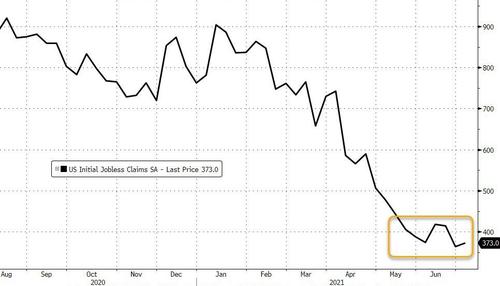

Source: Bloomberg
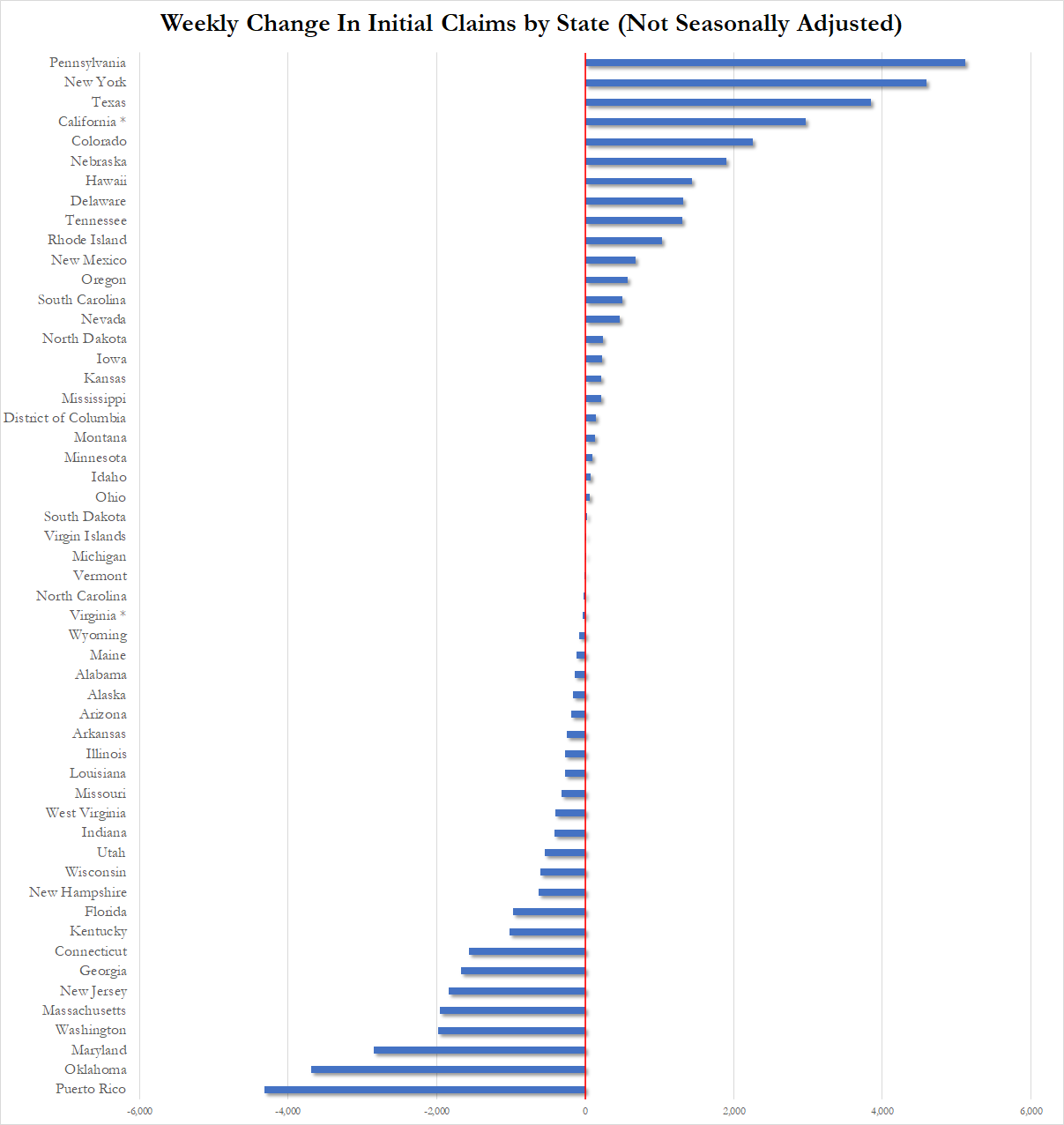
Notably, California and Virginia ‘estimated’ their jobless claims last week and Pennsylvania continues to swing wildly from week to week…

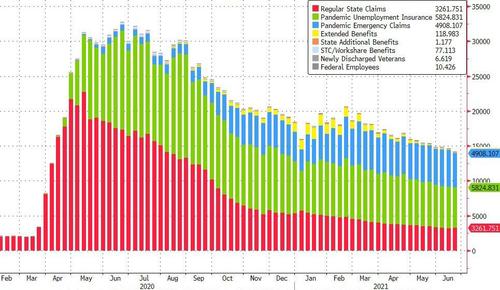
But, while the picture is improving overall, we should still remember that there are over 14 million Americans still on some of government dole…

Source: Bloomberg
We do note that 460k Americans dropped off the pandemic emergency aid rolls…
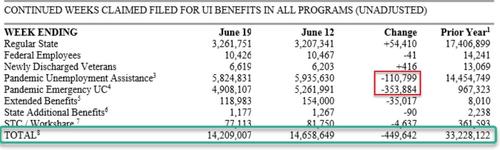

Finally, we remind readers of the gaping chasm between those still claiming some form of pandemic-related unemployment benefit and the record number of job openings in America currently…
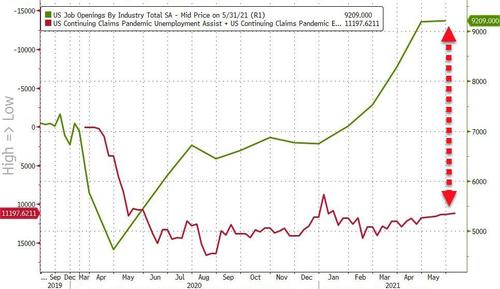

Source: Bloomberg
Tick-tock on those benefits.
Economy
The Fed in a Box Part 2: They Cannot End Quantitative Easing
If inflation doesn’t slow in the coming months, the Fed may be forced to step in.
- If the Fed tapers QE, it may reveal waning appetite for long-term treasuries
- The Treasury may have used its cash balance reserve to anchor inflation expectations
- If inflation persists, the Fed may have to increase rather than decrease QE
Note: By definition, inflation is an expansion of the money supply. In this article, inflation will be used interchangeably with rising prices (usually as a result of money supply expansion)
Introduction
When the economy was shut down in March 2020, the government responded with massive fiscal and monetary support. The fiscal stimulus totaled $4T+ in relief packages. All of this spending was paid for with debt issued by the Treasury. The Treasury mostly issued short-term debt. With rates being held at zero by the Fed, and strong demand for short-term debt, it made sense to quickly raise cash using Treasury Bills as interest-free loans.
The Fed monetary policy was two fold, slash short-term rates to zero and inject $1.5 trillion into the long-term debt treasury market. The effect was to bring down interest rates across the entire yield curve. After the initial debt binge, QE went on auto-pilot, with the central bank buying about $80B a month in long-term debt (plus another $40B in Mortgage debt). Over the last year, the Treasury has continued to issue long-term debt, averaging more than the $80B the Fed has been buying. This has caused long-term rates to rise.
All of this fiscal and monetary stimulus is not without cost. Historically this type of activity almost always leads to higher inflation. The Fed may have recently indicated it wants higher inflation, but this is not true. This stance simply provides cover for them to not act in the face of rising prices. To actually fight inflation, the Fed would have to increase short-term rates above the rate of inflation. Part 1 of this series went into detail about how US short-term debt has doubled from $2.5T to $4.5T. This makes even small changes in short-term rates an immediate risk to the federal government, not to mention the much higher rates needed in a true inflation fight.
In theory, the Fed could leave short-term rates at 0% while ending QE and even shrinking its balance sheet. This would push long-term rates up to combat inflation. In the short/medium term the Treasury can mathematically handle higher long-term rates because it takes time for the higher rates to work their way through long-term debt. See the chart below that shows how the last tightening cycle worked its way through the average interest rate across debt instrument. Specifically, look at Notes compared to Bills. The average weighted interest rate on Bills moved very quickly where the rate on Notes barely had time to increase before rates dropped again.
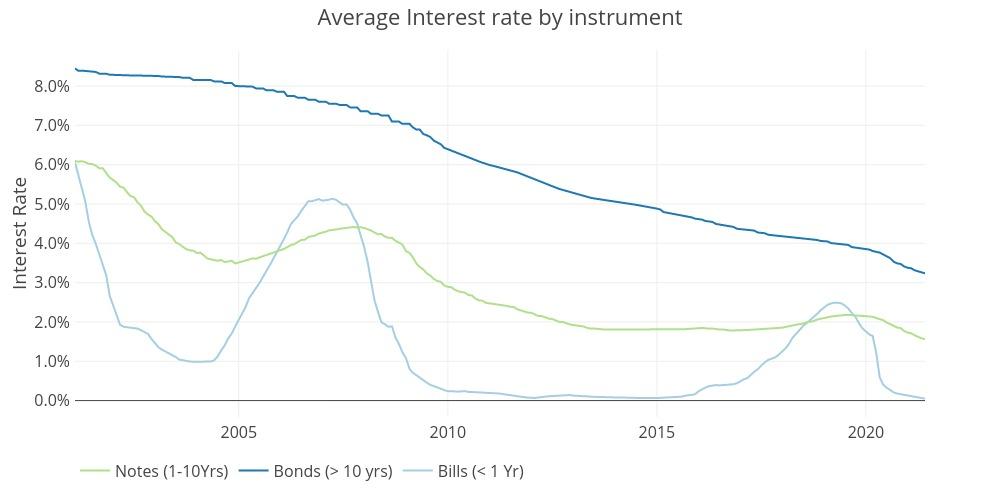
Source – Treasurydirect.gov
Although the Treasury could handle rising long-term rates (even if the economy and mortgage market cannot), the Fed has another problem. Rising long-term rates send an important message: rising inflation expectations. While inflation is first and foremost a result of monetary policy, higher inflation expectations quickly exacerbate the problem. This is why the Fed has been messaging they are OK with higher inflation and also why they have been pounding the table that inflation is transitory. They need to keep inflation expectations low! If inflation expectations were to rise, especially at this critical juncture, it would be game over for the Fed, as they would have to raise short-term rates (devastating the Treasury and economy) in order to save the dollar and squash inflation.
With the economy opening up in March of this year, things were getting very precarious as inflation was rapidly rising along with surging long-term rates. Remember that rising long-term rates indicate rising inflation expectations. This could cause transitory inflation to be much less transitory.
In summer 2020, the Treasury issued enough debt to build up a significant cash reserve. In response to rising long-term rates in Q1 2021, it appears the Treasury strategically used its cash reserves to slow down the issuance of long-term debt. With total short-term debt outstanding already so high, the cash balance gave the Treasury ammunition to decrease debt issuance just as a $1.9T stimulus bill was passed and inflation was set to explode higher. This would have been perfect timing to support the Feds narrative that inflation is transitory to keep expectations from snowballing out of control.
If inflation doesn’t slow in the coming months, the Fed may be forced to step in. With the Treasury poised to issue more debt, it can no longer rely on its one-time use of excess cash reserves. This will put more pressure on the Fed to clamp down long-term rates by increasing rather than decreasing QE. Yes, the Fed may decide to print more money (leading to higher prices) to fight rising inflation expectations (higher long-term interest rates).
Understanding recent fiscal and monetary maneuvers
Last year, when the pandemic hit, the US Government started spending trillions of dollars. Massive spending plans were approved in the name of stimulus and COVID relief. Because the government does not have much money on hand, and taxes cannot quickly be raised, the Treasury issued trillions in debt. The markets can easily absorb short-term US Treasury Bills, so when the Fed abruptly cut rates to 0%, the Treasury responded by issuing short-term debt to the tune of $2.4T from March to June 2020. See figure 1 below.
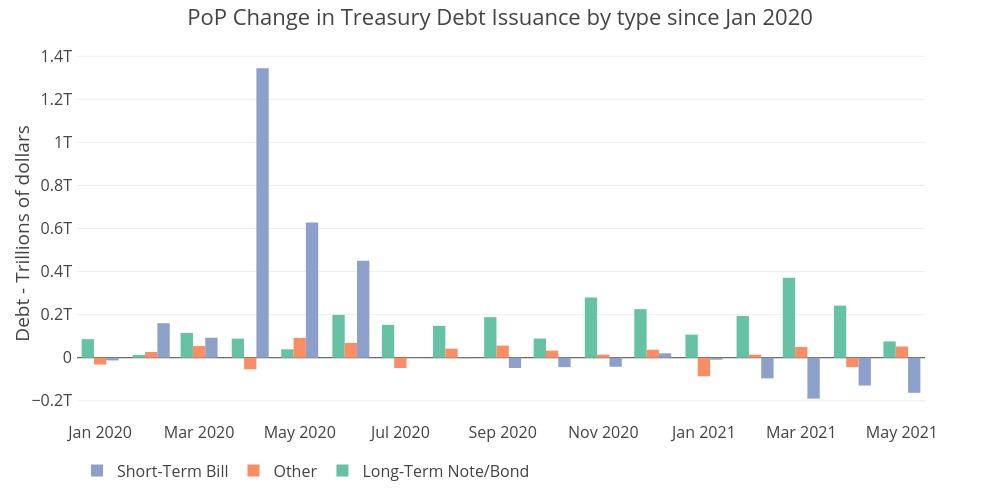
Source – Treasurydirect.gov
In tandem, the Fed bought up trillions of dollars in US Debt, but the Fed was buying on the long end of the curve while the Treasury was issuing debt on the short end. This caused long-term rates to collapse. The Fed purchased enough long-term debt to absorb more than a year’s worth of long-term debt issuance. The chart below shows how the month over month and cumulative change in the Feds balance sheet compared to the Treasury Debt Issuance of long-term notes and bonds.
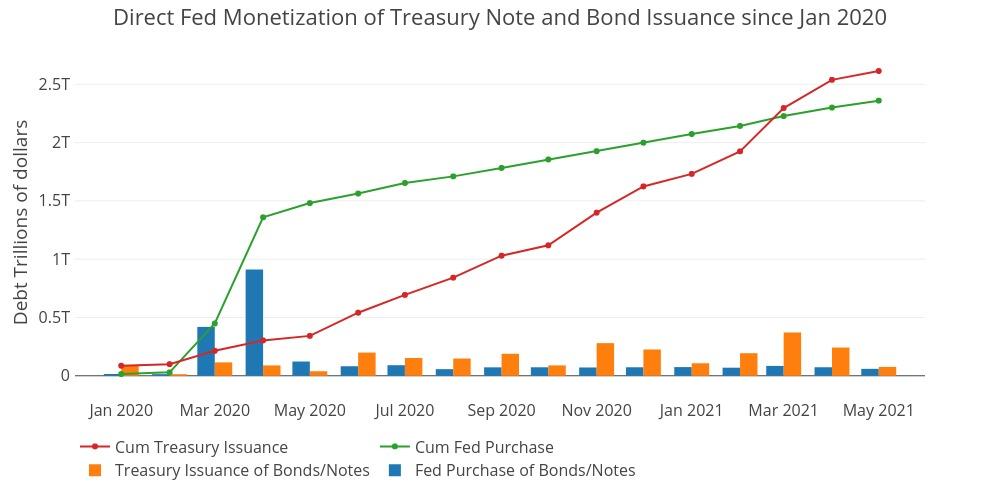
Source – Treasurydirect.gov
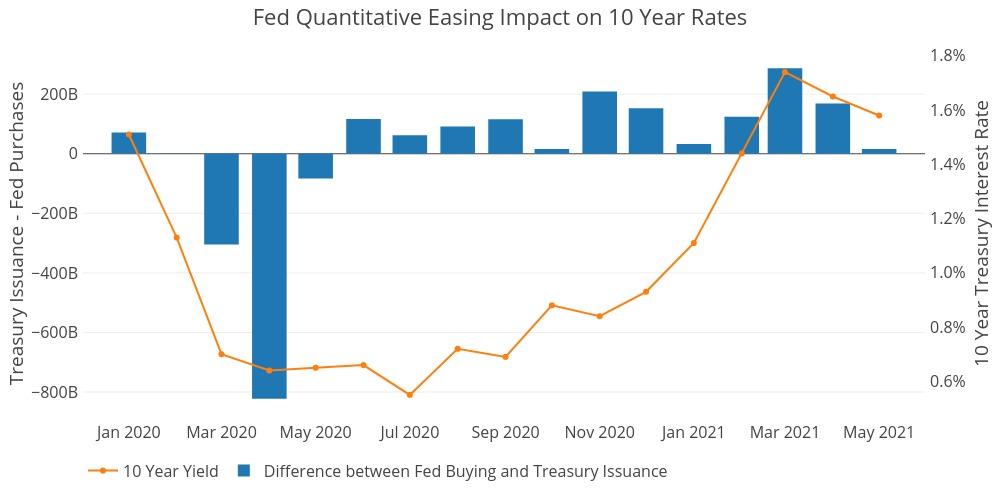
This action by the Fed had a massive impact on long-term rates. The chart below shows the difference between the two bars above, specifically the difference in Fed Buying and Treasury issuance of long-term debt for each individual month since Jan 2020. These values are not cumulative. The right Y-Axis shows the month-end interest rate of the 10-year bond. Looking at this chart shows something extremely clear: When the Fed buying exceeds debt issuance, rates are flat or falling; however when long-term debt issuance surpasses the Fed’s buying, rates rise.
Source – Treasurydirect.gov
The impact of the Fed can first be seen as interest rates fell from 1.5% to .6% during the initial buying spree. After the initial burst, the Fed put QE on auto-pilot, buying “only” $80B a month in long-term Treasuries. However, because the Treasury was issuing more than $80B a month as depicted by the positive bars starting in June 2020, interest rates started rising.
This trend started to accelerate in November of 2020, as long-term debt issuance was outpacing Fed Buying by around $200B. Things really started to escalate in the first quarter of 2021 as Treasury Debt issuance surpassed Fed buying by $286B in March right as interest rates were crossing above 1.7%.
Then, suddenly, long-term debt issuance started falling in April and was almost even with Fed buying in May. This consequently led to a fall in long-term rates, which are now hovering back around 1.5%. How did this happen just as Biden was pushing through a $1.9 stimulus package? Unlike 2020, when short-term debt issuance was used to plug the gap, Figure 1 above shows that short-term debt issuance was actually turning negative (blue bars).
What gives?
One look at the Treasury Cash Balance sheet in the chart below tells almost the entire story. This was first highlighted by a SchiffGold article published June 16. The chart below shows a massive surge in cash reserves by the treasury last year. Since March of this year, the cash balance has plummeted by over $1T.
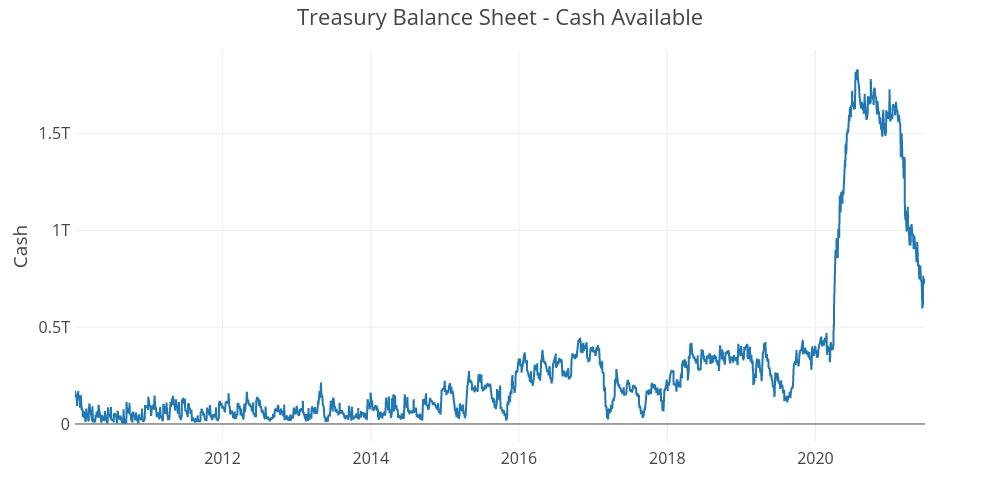
Source – Treasurydirect.gov
Inflation Expectations
Why such a massive and sudden drawdown in the cash balance? In truth, there could be lots of reasons, but it does seem extremely sudden. One would think the Treasury, led by Yellen, would be very deliberate and thoughtful about how to use up $1T+ in dry powder. For the past 3 months, the Fed has been shouting from the rooftops that inflation is transitory. At the June FOMC press conference, Powell stood up and explained how long-term inflation expectations remain well-anchored. A proxy for inflation expectations is long-term interest rates.
Had interest rates continued to rise similar to the recent trajectory (climbing from .8% in Nov to 1.7% in March), this would have been a difficult narrative to push. The Fed needs inflation expectations to remain in check or else inflation will be anything but transitory. Thus, the perfect time for the Treasury to pause issuance of long-term debt would be April-June 2021 just as the economy is re-opening and the Fed is forecasting inflation to be at its worst before coming back down.
While this is speculation, it would be a very strategic move from both Powell and Yellen. Regardless of the intention though, the problem is that the Treasury has now spent its large cash balance. It could return to the short-term debt market, but the outstanding balance is still sitting above $4T (see part 1). It needs to be converting that short-term debt to long-term debt while long-term interest rates are still low and the Fed is still buying. But the Fed is simply not buying enough at $80B to convert all that debt!
If inflation persists beyond a few months, then interest rates are going to rise in a hurry as the market demands higher rates. Adding fuel to the fire will be the Treasury debt issuance overwhelming the $80B Fed buying as it did from November to March.
Then what?
Who is absorbing the long-term debt to keep interest rates from returning to the upward trajectory from Aug 2020 – Mar 2021?
International creditors have had little appetite for US Debt lately. The chart below shows the total outstanding debt held by foreign governments. In the past 15 months, while the Treasury has issued over $4T in new debt, the net amount bought by foreign governments is close to zero.
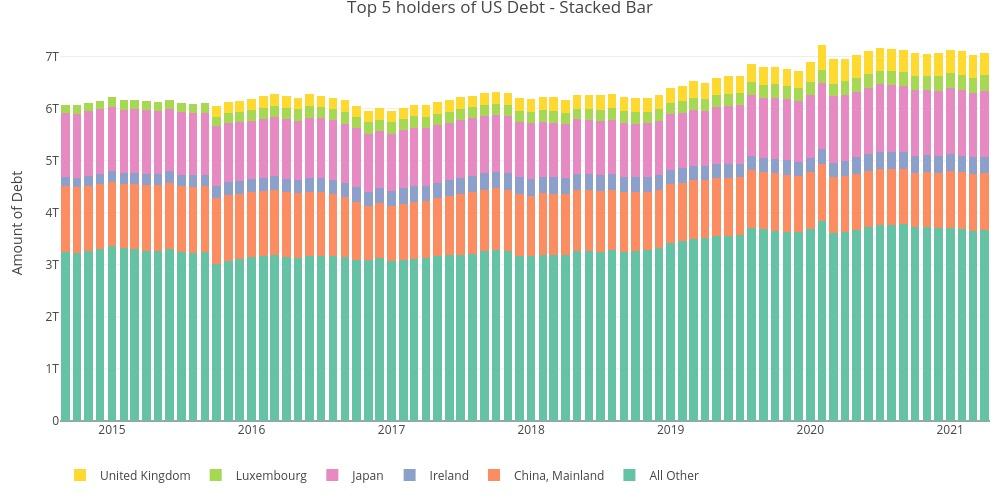
Source – https://ticdata.treasury.gov/Publish/mfh.txt
To zoom into the exact amount of change since the massive debt issuance, see the chart below. In total, foreign creditors have absorbed $120 billion of $6T+ or less than 2% of total issuance!
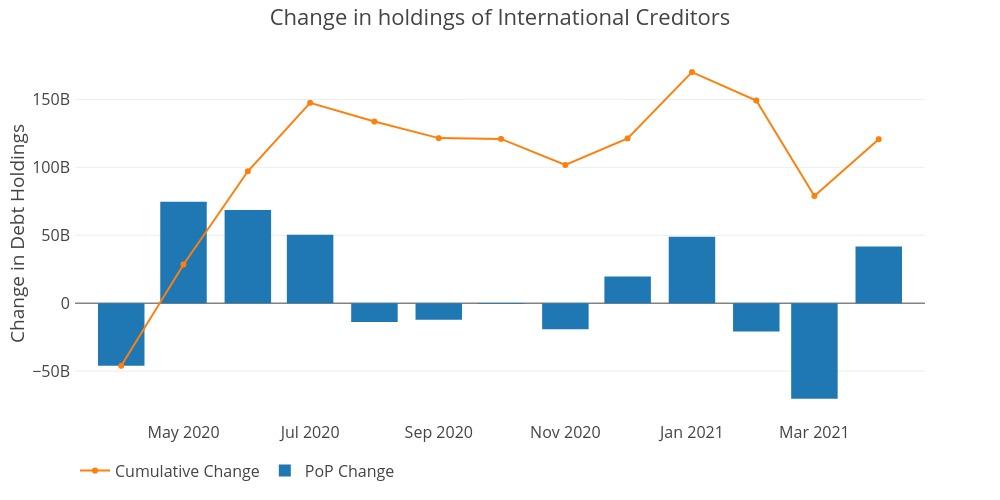
Source – https://ticdata.treasury.gov/Publish/mfh.txt
How are rates going to stay low if the Fed keeps the treasury buying cap at $80B? The Treasury will have to issue more than $80B in long-term debt to continue funding all the massive spending. If inflation expectations stay low, maybe the market will have enough firepower to ingest some of the new debt, but not all of it. With the Fed planning to begin tapering at the end of the year, someone will need to fill the $80 billion void. This does not even take into account the possibility of shrinking the Fed balance sheet, which should be considered impossible at this point.
The chart of the international holders above brings to mind the image of the Wiley Coyote running off a cliff. With 10-year interest rates hovering near 1.5%, one could argue there is strong demand for long-term Treasury debt. Unfortunately, foreign creditors have turned off their debt purchases. It took decades for them to accumulate ~$7T in Treasury debt. The Fed alone has accumulated more than half that (~$4.5T) over the last decade. The Fed is making the market seem strong, but as shown above, there might be nothing but air if they were to exit the market. With a thumb on the scale, no one is getting an accurate reading of true demand for US long-term debt.

Source – Warner Brothers
What about short-term debt markets?
As highlighted several times, the demand for short-term debt seems to remain very strong. This makes sense as T-Bills mature in less than a year, so these investments are perceived as nearly risk-free. In fact, it could be argued that the recent Treasury Bill issuance hiatus (Figure 1 – blue bars turning negative) could be causing stress in the Reverse Repo market. The chart below shows the current Reverse Repo market. Based on past quarter-end data, it’s very possible that Reverse Repos could exceed $1.5T by this coming Wednesday, June 30, before coming back down.
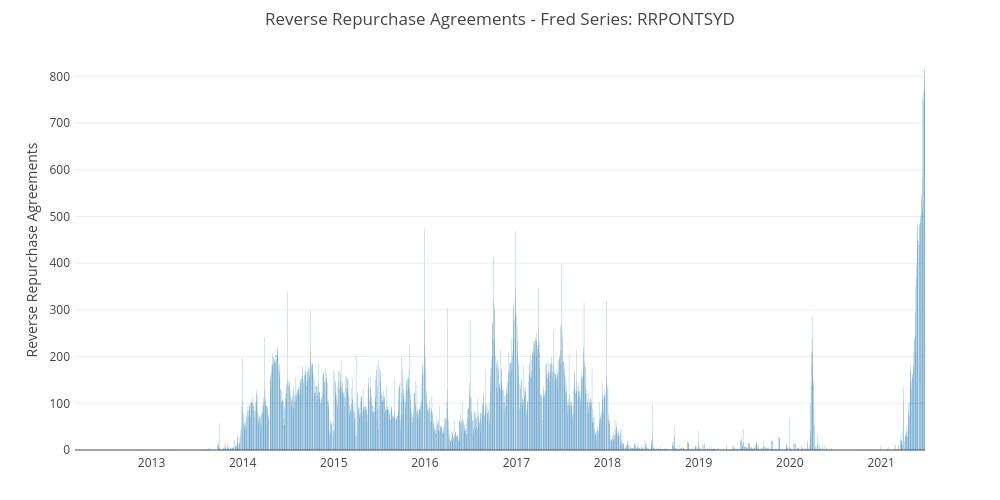
Source – https://fred.stlouisfed.org/series/RRPONTSYD
Many articles have been written to explain this phenomenon, without providing exact clarity on what’s actually going on. The current understanding seems to be that the banks are awash with cash – so much cash, they are hitting the limits in terms of how much cash they can hold on balance overnight. This is cash that should be invested on behalf of money market funds. But with so much cash in the system, if it were to all be invested in short-term debt instruments, it could drive rates negative. To avoid negative rates, the Fed is lending banks assets on its balance sheet overnight in exchange for cash. It is critical to avoid negative rates to insure money market funds never experience a loss and result in breaking the buck.
Maybe this is a leap too far, but it seems another solution to the Fed reverse repurchase activity could be for the Treasury to issue more short-term debt. So, why has the Treasury been drawing down its cash balance and letting short-term debt mature when there seems to be strong demand in the market? The Treasury must recognize the risk of having too much debt in short-term instruments and is trying to lengthen the duration of its debt outstanding. Unfortunately, this abundance of cash in the repo market is in search of low-risk short-term debt so will not provide demand for long-term debt.
If this is the case, it has created quite the pickle for the Treasury. By issuing too much short-term debt, the Treasury is by default putting pressure on the Fed to not raise short-term interest rates. However, by issuing too much long-term debt, the Treasury is by default putting pressure on the Fed to maintain or even increase quantitative easing. To reiterate, this is why it is imperative the market believes inflation is transitory. The Treasury cannot stop issuing debt, which leaves the Fed unable to raise rates or taper QE without wreaking havoc in the bond market. Additionally, if the Fed has to fight inflation, then it’s not just the Treasury facing its Wiley Coyote moment, but the entire US economy.
Wrapping up
With the economy reopening, the Treasury deployed its cash balance at the most opportune time, unless of course inflation numbers continue to increase (which based on all the data, anecdotal evidence, and liquidity in the repo market seems like a strong possibility). Unfortunately for the Fed, the Treasury will have to begin re-issuing debt again. Will it lean towards short-term debt hoping the Fed keeps interest rates low, or long-term debt hoping the Fed will expand QE?
But Fed may be constrained either way because it has its own problem. Powell must be praying that inflation readings come in low AND job numbers disappoint. If both don’t occur, then tough questions will be asked to justify more stimulus. Yellen and Powell may be best buds, but simple coordination will not be enough. They will need magic and luck to keep the course steady heading into 2H 2021 and 2022.
If the Fed is lucky enough to get low inflation readings out of its rigged CPI, it may provide cover to begin tapering. Rising long-term rates won’t have the same compounding effect on inflation expectations in a “low” inflation environment. Unfortunately, long-term rates will not be tenable over the medium term as the government has to finance more and more debt. As the market this year has indicated, when issuance surpasses Fed buying, rates have gone up. So what happens to rates when the Fed leaves the market entirely? Presumably, they go up a lot. How high will the Fed let rates go before re-entering?
Just because something is inevitable (US Debt spiral) does not make it imminent; however, the next six months of data may shine a bright light on all the irresponsibility over the last 12 years if inflation proves not so transitory. Chances are, the only thing transitory will be “talking about talking about” tapering.
US Debt interactive charts and graphs can always be found on the Exploring Finance dashboard: https://exploringfinance.shinyapps.io/USDebt/

Join the community.

McMaken: The Fed’s Inflation Is Behind the Supply-Chain Mess

‘White People, You Are The Problem’: AT&T’s Internal ‘Racial Reeducation Program’ Leaked

Matrix? Misdirection? Cringe? Zuckerberg’s presentation of future life in ‘metaverse’ sparks fear, loathing, marvel and mockery

New York facing streets without cops because of COVID vaccine mandate

The Establishment Is Hiding Mass Resistance To Vaccine Mandates With The “Striketober” Farce
