
Economy
Can Governments Stop Bitcoin?
Even if a government took control of a majority of the Bitcoin hashrate, this doesn’t enable them to change the Bitcoin consensus rules or print more Bitcoin or steal anyone’s holdings.

Since its creation more than 12 years ago, Bitcoin is undefeated. Its price has leaped from $5 to $50 to $500 to $5,000 to now past $50,000. The number of global users has eclipsed 100 million. The system’s network security, number of developers, and new applications are at all-time highs. Dozens of companies including Tesla and Square have started to add Bitcoin to their corporate treasuries.
This worldwide success doesn’t mean that people haven’t tried to stop Bitcoin. The digital money project has in fact survived a variety of attacks which in some cases threatened its existence. There are two main vectors: network attacks on the software and hardware infrastructure, and legal attacks on Bitcoin users. Before we explore them and consider why they failed, let’s start at the beginning.
In January 2009, a mysterious coder going by the name of Satoshi Nakamoto launched Bitcoin, an open-source financial network with big ambitions: to replace central banking with a decentralized, peer-to-peer system with no rulers. It would use a programmable, highly-fungible token that could be spent like electronic cash or saved like digital gold. It would be distributed around the world through a set-in-stone money printing schedule to a subset of users who would compete to secure the network with energy and in return, get freshly minted Bitcoin.
Initially, most were understandably skeptical, and very few paid attention. There had been attempts at creating “ecash” before, and all had failed. No one had been able to figure out how to create a decentralized, incorruptible mint, or how to grow a system that couldn’t be stopped by governments.
But a small community grew around Bitcoin, which promised just that. Led by Satoshi and Hal Finney, this group of iconoclasts discussed, tinkered with, and improved the software in its first year, using their computers to mine1 50 worthless Bitcoin every 10 minutes. Eventually, someone decided these virtual tokens were worth enough to accept in return for a real-world good. On May 22nd, 2010, a developer named Laszlo Hanyecz paid 10,000 Bitcoin for two Papa John’s pizzas, at an exchange rate of .1 cents per Bitcoin. No one could have predicted that Laszlo’s pizza order would one day be so costly: today, this order is worth more than $500 million.
Since the early days of PC mining and the Silk Road, Bitcoin has become a global phenomenon. No one knows who Satoshi is, but if their creation was a company, it would be one of the world’s top 10 most valuable. Its fan base has grown from a few pseudonyms on Cypherpunk messageboards to including the likes of Twitter CEO Jack Dorsey, Tesla CEO Elon Musk, Harvard professor Niall Ferguson, Fidelity CEO Abby Johnson, actress Lindsay Lohan, singer Soulja Boy, skateboarder Tony Hawk, and investor Paul Tudor Jones. It has its own unicode character, the ₿. An industry conference held this month focusing on how to add Bitcoin to corporate treasuries drew more than 6,000 companies. MIT boasts a research center contributing to long-term Bitcoin security.
Bitcoin markets have popped up in virtually every country and major urban area on Earth, with local traders eager to buy Bitcoin in exchange for local currency everywhere from Caracas to Manila to Moscow. Millions of people in Nigeria, Argentina, Iran, Cuba, and beyond are now using Bitcoin to escape their local currency system, and opt into something with a better track record as a store of value than the naira, bolivar, rial, or peso. They can control their Bitcoin with a private key (think: password) that they can store on a phone, USB stick, on paper, or even with memorized wordlists, and send the currency to family or friends anywhere on Earth in minutes, with no permission from any authority required.
The mainstream media typically portrays Bitcoin as a penny stock gone wild, or a new kind of digital tulip mania. But the reality is Bitcoin is a political project that threatens to fundamentally disrupt the Davos-led economic system, with everyone from Janet Yellen to Christine Lagarde expressing fear about its rise and demanding it be regulated.
Governments retain their power in part by issuing and controlling money. Bitcoin is a new model that mints and secures money without governments. So the big question is: Why haven’t governments or megacorps stopped it? And if they try to attack Bitcoin in the near future, what would that look like?
There is an enormous amount of speculation on the Internet about how Bitcoin might be attacked, but few stop to think about why it hasn’t already been destroyed. The answer is that there are political and economic incentives for more and more people to push the system forward and strengthen its security, and strong political, economic, and technical disincentives that discourage attacks.
Certainly, Bitcoin isn’t too small to draw the attention of governments. Previous attempts at parallel online digital currencies, like e-Gold and Liberty Reserve, were shut down by the US government before even making it to $10 billion in market capitalization. Bitcoin now has a market cap north of $1 trillion. Every day Bitcoin survives, it becomes stronger, and for many attack vectors, the windows are rapidly closing.
One reason that Bitcoin is so tenacious is that it is a globally-distributed phenomenon. The vast majority of mining takes place outside of the US in China and central Asia. But the vast majority of Bitcoin holders and buyers appear to be US and EU entities, and the software’s core developers and node-runners (who host Bitcoin’s servers) are scattered throughout the world. The most important person in Bitcoin—its inventor—is no longer relevant, and could even be dead.
Coding, mining, infrastructure, and markets are all independent, happening in competing jurisdictions and geopolitical rivals, often done by anonymous or pseudonymous actors, all with different philosophies and goals, but with one uniting motivation: to keep Bitcoin going.
Unlike every other cryptocurrency, there is no central point of failure. Bitcoin has no Vitalik Buterin, no Ethereum Foundation, no Deltec bank like Tether, no fancy offices in San Francisco, no team of lawyers, no governance token, no VC-backing, no pre-mine, no small council, and no whales able to manipulate the system. This decentralized architecture has already insulated Bitcoin from attacks at the highest levels. No matter how much Bitcoin you own, you can’t change the rules, print more, censor, steal or prevent others from using the network.
Arguably the most powerful financial force in the world—the US government led by then-Treasury secretary Steve Mnuchin—just launched an attack on Bitcoin in December 2020. It was not a particularly strong one, but still, an attack nonetheless, which would have forced US exchanges to gather more information about individuals withdrawing their Bitcoin to wallets they control than even mainstream banks collect, handing the surveillance state much more intricate knowledge of Bitcoin’s flow of funds. But the crackdown failed, stymied by a broad coalition of opposition, and Mnuchin is now gone.
The new US regulatory regime might be less aggressive. In fact, incoming SEC chairman Gary Gensler once taught a class about Bitcoin. Cynthia Lummis, a freshly elected Senator from Wyoming and passionate Bitcoin supporter, has been named to the Senate Banking Committee. That means one of the most powerful bodies in the US financial system now sports a member who recently tweeted about Bitcoin: “I came for the store of value. I stayed for the censorship-resistance.” Lummis joins Warren Davidson and others in Congress who have vowed to defend Bitcoin.
The biggest attack in Bitcoin’s history came in 2017 at the software level. That spring a handful of the most important industry actors gathered and signed what is called the New York Agreement. The authors boasted more than 83% of the global mining hashpower1, more than 50 total companies, more than 20 million wallets, and a huge share of the payment infrastructure. It was an alliance between Chinese miners, Silicon Valley, and Wall Street, and their goal was to change Bitcoin to allow it to process more transactions per second, at the cost of sacrificing decentralization and the ability of users to audit the monetary supply from home.
Despite the odds, a handful of grassroots activists ended up building a movement that stunningly defeated this New York alliance. By November 2017, the corporate “SegWit2X” plan was dead, and Bitcoin remained decentralized. The lesson from these “scaling wars” is that neither miners nor corporations control Bitcoin. Yes, miners process transactions, and developers propose upgrades to the software, but tens of thousands of users running nodes actually decide what transactions are valid and what software version is adopted.
Even if a government took control of a majority of the Bitcoin hashrate, this doesn’t enable them to change the Bitcoin consensus rules or print more Bitcoin or steal anyone’s holdings. The worst they could do is use their power to mine new versions of Bitcoin (which, in the case of BCH or BSV, has failed spectacularly), or burn billions of dollars to temporarily damage the network in what’s called a “51% attack.” In such an attack, a majority of miners could team up and use their superior hashrate to momentarily overwhelm the network. The price of the hardware required would exceed $5 billion.
Even if a government did want to risk that much on such an exotic assault, it is unlikely that they would divert the precious fabrication capacity of the world’s few semiconductor manufacturers to this very speculative purpose. For China or the US, disrupting existing semiconductor orders during a global shortage could put national security at stake. An alternative would be to seize a majority of the world’s mining equipment in a military operation. But the logistics of trying to locate and violently capture hundreds of thousands of 5-pound machines owned by often pseudonymous actors across dozens of jurisdictions would be hugely prohibitive.
Speculation about other technical attacks on Bitcoin abounds: mining pools censoring transactions (miners make more money from not censoring, can quickly switch to non-censoring pools, and may adopt software that makes censorship impossible), a global internet shutdown (could be disruptive, but not fatal), mining hardware backdoors (this actually happened, but was not exploited, and the threat is now fading), quantum computers breaking Bitcoin’s cryptography (not to be taken seriously according to experts), and even bad actors making harmful updates to the codebase (this wouldn’t stand a chance against hundreds of watchful developers).
The fact is, despite constant fear-mongering about how Bitcoin could fail, all users have always been able to transact. There have been no significant acts of censorship. Attempts to disrupt the protocol or the network infrastructure would be incredibly difficult and costly to attempt, and have no guarantee of success. As we saw in 2017, even if powers are able to amass a super-majority of the hashrate, they could be defeated by the network’s decentralized architecture. Far easier and far more likely are attacks on users themselves.
There are several nightmare scenarios that Bitcoiners fear that don’t involve science fiction around governments teaming up in a Mission Impossible-style mission to seize billions of dollars of energy and mining equipment. One such fear is four numbers: 6102.
In 1933, the FDR administration passed Executive Order 6102, which banned citizens from holding gold and forced them to turn in any gold to the authorities. The US government, or any other government, could try doing the same, giving citizens a window to declare and sell their Bitcoin to the government, or else face jail time.
The Bitcoin community is already preparing for such an attack. One reason 6102 was so successful is that the government could just go to banks who held gold on behalf of citizens, and seize at point of custody. So every January 3rd, users celebrate “proof of keys” day, where it is customary to withdraw any Bitcoin they own on exchanges or in the custody of third parties to wallets that the end users control. “Not your keys, not your coins,” first popularized by Bitcoin educator Andreas Antonopoulos, is a community mantra. With more than 10 percent of the American population using Bitcoin, if enough people self-custody, then a 6102 attack would be of limited effect. Given that the keys to your Bitcoin account are typically in the form of 24 seed words that can be written down, hidden, encoded, or memorized, a military home-by-home raid couldn’t work very well and would constitute a mass set of human rights violations.
Another regulatory threat would be a new unrealized gains tax on Bitcoin, which would be devastating to long-term savers, or new strict “know your customer” rules making it a crime to buy Bitcoin through an unauthorized issuer. But such rules have many obstacles: first and fourth amendment protections; numerous senators and congressmen pushing for a more Bitcoin-inclusive policy; and a large and growing cryptocurrency industry that would vigorously lobby against such rules.
Governments could try to marginalize Bitcoin by introducing a competitor: a Central Bank Digital Currency. Most central banks worldwide are experimenting with the idea of replacing banknotes with digital tokens that citizens could hold in mobile wallets. One argument that promoters of these systems make is that they could help check the thirst for Bitcoin. Ultimately, however, CBDCs like China’s DCEP can’t compete because their floating global price will be tied to the existing fiat currency, which will inevitably fall in relative purchasing power. Meanwhile, Bitcoin’s purchasing power continues to rise over time, and it offers a level of transactional freedom and privacy from the state that no CBDC could ever boast.
Another attack vector could be a ban on the act of Bitcoin mining itself inside democracies. Today, many mainstream media articles describe Bitcoin as an environmental disaster. In reality, it relies heavily on renewable energy (estimates range from 39 percent to 74 percent), consumes a lot of stranded or excess energy, and could very well have a mostly green future. But given the poorly-informed narratives around the subject, one could imagine a world in which the Biden Administration restricts Bitcoin mining as part of a Green New Deal.
The “two-Bitcoin” problem is perhaps the biggest existing threat to Bitcoin users today. If the top 25 global exchanges in the US, EU, and East Asia agreed to end user withdrawals, then that would effectively bifurcate the system. Bitcoin inside the bubble would be “whitelisted” and Bitcoin outside could be “blacklisted” — meaning, if a merchant accepts Bitcoin from you that is not on a certain list, they’d be running a risk. No matter how private you are with your Bitcoin, it wouldn’t matter. You’d need to find people willing to accept your Bitcoin with no trail. Such laws would force users into peer-to-peer markets, where buyers don’t care about coin history.
Even still, there are lots of barriers to this attack. Exchanges would lose millions of customers and billions of dollars of business. The “DeFi” ecosystem would potentially collapse, given it relies on users being able to purchase ETH with dollars on big exchanges and then withdraw to trading platforms like Uniswap. Companies in this space would vigorously resist any change that would prevent citizens from withdrawing Bitcoin or any cryptocurrency to self-controlled wallets.
As these examples show, there are plenty of kinds of regulatory attacks that should concern Bitcoin users, and they are much more likely than cryptographic or hashrate attacks on the network, but the reality is that many legal attacks have already happened, and they have been ineffective.
In 2017, the Chinese Communist Party restricted the ability of its citizens to exchange RMB for Bitcoin. Shortly thereafter, the Indian government did the same, followed by the Pakistani government and several others. In other words, the two largest governments in the world tried to cut off Bitcoin access to their citizenry at the most obvious point: the on and off ramps where citizens exchange local currency for Bitcoin through exchanges.
Last year, the Indian Supreme Court reversed this rule, and Bitcoin is no longer restricted. The government is again seeking to pass a bill prohibiting Bitcoin and all non-state cryptocurrencies, while also launching a digital currency to be issued by the Reserve Bank of India, but in the meantime, local usage grows. In China after the 2017 restrictions, some companies moved to other countries in east Asia, but continued to do business with Chinese customers. Two of the biggest exchanges for the Chinese market, Huobi and OKCoin, still service millions of Chinese. In Pakistan, Bitcoin is de facto banned, but adoption is exploding.
In Nigeria, the government is currently promising to freeze the bank accounts of any citizens who are identified as buying or selling Bitcoin. This regime has tried similar tactics before, but all have failed. What these actions actually accomplish is to drive citizens into harder to control peer-to-peer markets, and into the arms of risk-tolerant entrepreneurs committed to helping their fellow citizens access a better financial system.
In the United States, the recent last-minute attack by Secretary Mnuchin aside, American financial activity is increasingly monitored under laws like the Bank Secrecy Act. In line with this trend, cryptocurrency exchanges have introduced more stringent identification requirements for their customers, as well as increasingly small withdrawal limits. So far though, Americans are still easily able to buy Bitcoin and withdraw it to wallets they control, and this will be defended by new powerful allies.
Senator Lummis and Congressmen Davidson, McHenry, Emmer, and Soto, as well as state leaders like Miami mayor Francis Suarez, have all come out in support of Bitcoin, whether by hosting the whitepaper on their websites, promising to fend off overly-restrictive regulation, or pledging to make their jurisdictions hotspots for Bitcoin entrepreneurial activity and innovation. Mayor Suarez, for example, is pushing for employees of the city of Miami to earn a percentage of their salary in Bitcoin, for residents to be able to pay taxes in Bitcoin, and to include Bitcoin as part of the city’s investment portfolio.
Some argue that corporate America will try to attack Bitcoin. But so far, it seems that big companies are instead trying to join the party. In the past few months, Tesla, Microstrategy, Square, Grayscale, and others are buying up billions of dollars more Bitcoin than the amount being produced through mining. And, as savvy investors will realize, ultimately you can’t separate Bitcoin from its cypherpunk nature. Bitcoin is only valuable as an asset because of its decentralization, since no one can arbitrarily change its rules or decide to print more. Driven by self-interest, Wall Street may ironically end up being one of the biggest cheerleaders of this new technology that Washington can’t control.
So far, it seems that when governments try to ban or restrict Bitcoin, it ends up merely accelerating the adoption of the currency inside their countries. Governments that have failed miserably with their Wars on Drugs may find stopping people from holding something that’s invisible, borderless, and teleporting much more difficult. In democracies, governments will face major obstacles from the tech and financial industries, but also from the fact that restrictions on Bitcoin ownership can clash with free speech, privacy, and private property protections. Confiscation will require brutality, and it’s not clear that all governments have the stomach or ability.
In the end, Bitcoin’s biggest defense is human nature itself. We are greedy and self-interested, and this applies to our governments. Already, some authorities are starting to mine or are encouraging mining. This is happening everywhere from Beijing to Kentucky to Siberia to Ukraine. As the price rises, more and more are buying into Bitcoin’s value as a long-term store-of-value and inflation hedge. Just as some governments with weak currencies have been forced to dollarize, others in the future could be forced to accumulate Bitcoin. It’s a rivalrous planet.
Why would a government attack Bitcoin if it could gain more from using its energy monopoly or ability to print fiat to buy some? The rich and powerful will always design systems that benefit them before everyone else. The genius of Bitcoin is to take advantage of that very base reality and force them to get involved and help run the system, instead of attacking it.
In a world with friendly US regulators, rogue regimes mining Bitcoin to print dollars, and citizens of the world demanding an asset that can’t be inflated away, the incentive to attack Bitcoin is dwindling.
In the end, the only way to kill Bitcoin may be to make it so that people don’t need it anymore. If no one wants a devaluation-proof, censorship-resistant, permissionless, borderless, non-discriminatory, teleporting financial asset, then no one will feed it energy, and it will die. Perhaps humanity can come up with another technology that addresses these needs.
But until then, Bitcoin will thrive.


Economy
McMaken: The Fed’s Inflation Is Behind the Supply-Chain Mess
… the idea that supply chain problems are “driving inflation” gets the causation backward.

It seems supporters of the Biden Administration finally settled on a narrative they like for explaining away supply chain shortages.
Here’s the administration’s talking point: the US economy is rolling along so well that Americans are demanding huge amounts of goods. That’s overwhelming the supply chain and causing the back-ups roiling America’s ports and logistic infrastructure.
For example, Transportation Secretary Buttigieg this month declared “Demand is up … because income is up, because the president has successfully guided this economy out of the teeth of a terrifying recession.”
Similarly, White House spokeswoman Jen Psaki told reporters supply chain problems are occurring because “people have more money … their wages are up…“we’ve seen an economic recovery that is underway…”
This position has been mocked by a number of conservative politicians—including Senator Ted Cruz—and commentators who find this to be an absurd assumption.
Yet, the administrator’s defenders aren’t totally wrong. As Mihai Macovei showed earlier this month, the global volume of trade and shipping volume in 2021 have actually exceeded pre-pandemic numbers. For example, in the port of Los Angeles, “loaded imports” and “total imports” for the 2020-2021 fiscal year (ending June 30, 2021) were both up when compared to the same period of the 2018-2019 fiscal year.
In other words, it’s not as if nothing’s moving through these ports. In fact, more is moving through them than ever before. That suggests demand is indeed higher.
But why is it higher? It some ways, it’s true that, as Psaki says, people have more money.
But that’s where the veracity and usefulness of Biden’s defenders end in explaining the problem.
Much of the answer can be found in monetary inflation. Obviously, Joe Biden hasn’t “successfully guided the economy” through anything, but it is accurate to say that people have more money in a nominal sense. Wages are up nominally. After all, if we look at the immense amount of new money created over the past 18 months, we should absolutely expect people to have more money sloshing around. But this also means a lot more pressure on the logistical infrastructure as people buy up more consumer goods.
In other words, the idea that supply chain problems are “driving inflation” gets the causation backward. It’s money-supply inflation that’s causing much of the supply chain’s problems. Not the other way around.
After all, since February 2020, M2 has increased from $15.2 trillion to $20.9 trillion in September 2021. That’s an increase of 35 percent. Yes, some of that has been kept within the banking system through the Fed’s payment of interest on reserves, but a lot of it clearly has entered the “real economy” through stimulus payments, unemployment insurance, and federal deficit spending in general.
Originally, the public was saving a lot of that stimulus and bailout money, with the personal savings rate hitting historic highs of over 25 percent. But this past summer the savings rate collapsed again, and as of September is back under eight percent. The public is now flooding the economy with its former savings.
The American appetite for spending on consumer goods hasn’t gone away. Yet, there are many reasons to suspect this spending spree is unsupported by actual economic activity, and in a phenomenon of monetary inflation.
For example, today’s tsunami of spending raises questions when we consider there are still about five million fewer people working in the American economy than was the case in early 2020. That means fewer people being paid wages. Without monetary inflation, an economy with millions of fewer workers suggests there should be less spending.
Additionally, spending increases when the public suspects that inflation is going to increase. That is, if there is perception the value of money will decline, the demand for money will decline also. As Ludwig von Mises noted: “once public opinion is convinced … the prices of all commodities and services will not cease to rise, everybody becomes eager to buy as much as possible and to restrict his cash holding to a minimum size.”
That means more spending. This phenomenon is already clear in home prices and grocery prices. The public may suspect rising prices are here to stay. Meanwhile, the Consumer Price Index—a very limited measure of goods-price inflation—is nonetheless near a 35-year high. That means now’s a good time to spend.
With 2020’s panic-induced saving subsiding, people are now wondering if their savings produce any returns. But ordinary savers are surely now remembering that the interest returns from savings right now are next to nothing. Thanks to the central bank’s ultra-low interest rate policy, we live in a yield-starved world. That’s OK for hedge funders who can participate in carry trades and other high-yield forms of investment. But for regular people they’re stuck with interest rates that don’t keep up with price inflation. So it makes more sense to spend dollars rather than save them.
So, Biden’s people are correct in a certain sense that people have “more money” and that “demand is up.” With federal spending hitting historic highs—and half of it is deficit spending that’s being monetized—we should expect people to have “more money.” This is just what we would expect in an inflationary environment. We should expect demand for everything (but money) to be up.
The question, however, is how much of this windfall will continue in real, inflation-adjusted terms. It’s too early to tell, although we can also see that inflation-adjusted median earnings collapsed 6.3 percent, year over year, during the second quarter of 2021. We can see that real GDP growth has dramatically slowed.
But at least as far as the third quarter is concerned, it’s fairly clear the US was—and likely still is—in the midst of an inflationary boom. But how long will it last?
Economy
There Are Still Over 14 Million Americans On Some Form Of Government Dole
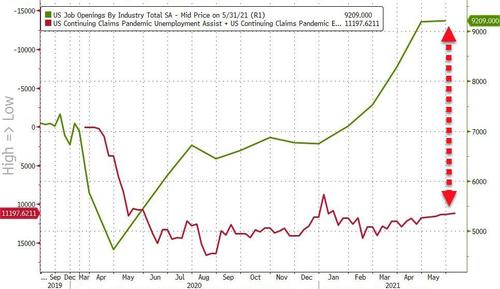
… we remind readers of the gaping chasm between those still claiming some form of pandemic-related unemployment benefit and the record number of job openings in America currently…

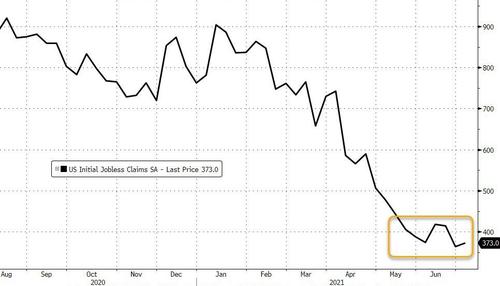
Initial jobless claims hovered at post-COVID-lockdown lows but were disappointing at 373k – well above the 200k-ish norms of pre-COVID

Source: Bloomberg
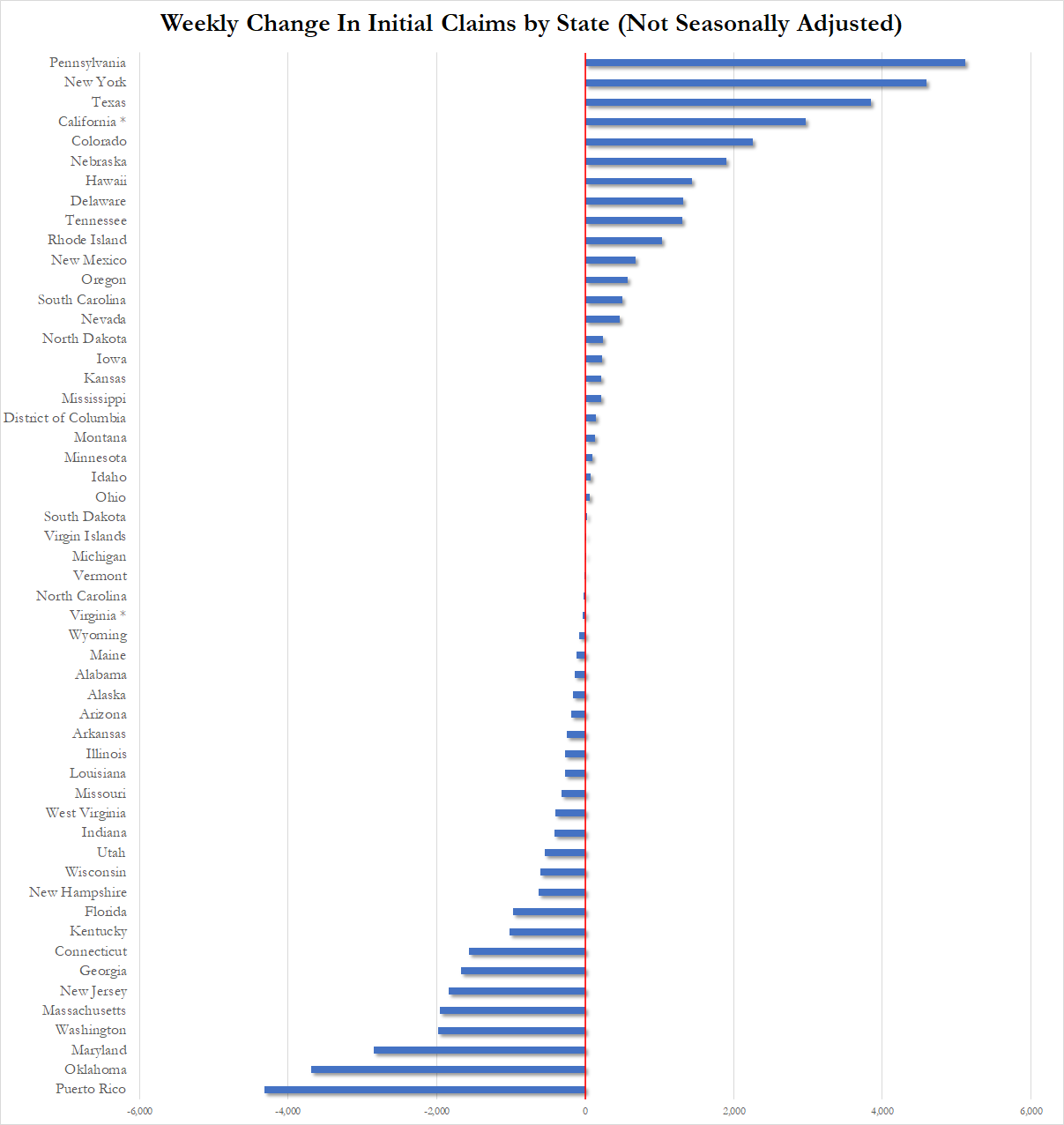
Notably, California and Virginia ‘estimated’ their jobless claims last week and Pennsylvania continues to swing wildly from week to week…

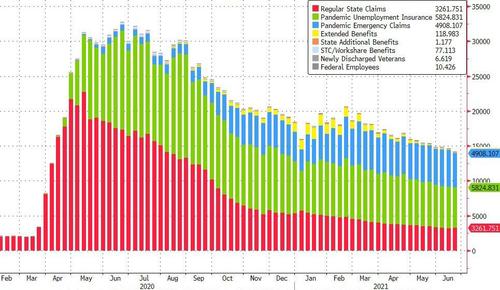
But, while the picture is improving overall, we should still remember that there are over 14 million Americans still on some of government dole…

Source: Bloomberg
We do note that 460k Americans dropped off the pandemic emergency aid rolls…
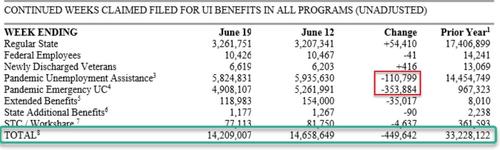

Finally, we remind readers of the gaping chasm between those still claiming some form of pandemic-related unemployment benefit and the record number of job openings in America currently…

Source: Bloomberg
Tick-tock on those benefits.
Economy
The Fed in a Box Part 2: They Cannot End Quantitative Easing
If inflation doesn’t slow in the coming months, the Fed may be forced to step in.
- If the Fed tapers QE, it may reveal waning appetite for long-term treasuries
- The Treasury may have used its cash balance reserve to anchor inflation expectations
- If inflation persists, the Fed may have to increase rather than decrease QE
Note: By definition, inflation is an expansion of the money supply. In this article, inflation will be used interchangeably with rising prices (usually as a result of money supply expansion)
Introduction
When the economy was shut down in March 2020, the government responded with massive fiscal and monetary support. The fiscal stimulus totaled $4T+ in relief packages. All of this spending was paid for with debt issued by the Treasury. The Treasury mostly issued short-term debt. With rates being held at zero by the Fed, and strong demand for short-term debt, it made sense to quickly raise cash using Treasury Bills as interest-free loans.
The Fed monetary policy was two fold, slash short-term rates to zero and inject $1.5 trillion into the long-term debt treasury market. The effect was to bring down interest rates across the entire yield curve. After the initial debt binge, QE went on auto-pilot, with the central bank buying about $80B a month in long-term debt (plus another $40B in Mortgage debt). Over the last year, the Treasury has continued to issue long-term debt, averaging more than the $80B the Fed has been buying. This has caused long-term rates to rise.
All of this fiscal and monetary stimulus is not without cost. Historically this type of activity almost always leads to higher inflation. The Fed may have recently indicated it wants higher inflation, but this is not true. This stance simply provides cover for them to not act in the face of rising prices. To actually fight inflation, the Fed would have to increase short-term rates above the rate of inflation. Part 1 of this series went into detail about how US short-term debt has doubled from $2.5T to $4.5T. This makes even small changes in short-term rates an immediate risk to the federal government, not to mention the much higher rates needed in a true inflation fight.
In theory, the Fed could leave short-term rates at 0% while ending QE and even shrinking its balance sheet. This would push long-term rates up to combat inflation. In the short/medium term the Treasury can mathematically handle higher long-term rates because it takes time for the higher rates to work their way through long-term debt. See the chart below that shows how the last tightening cycle worked its way through the average interest rate across debt instrument. Specifically, look at Notes compared to Bills. The average weighted interest rate on Bills moved very quickly where the rate on Notes barely had time to increase before rates dropped again.
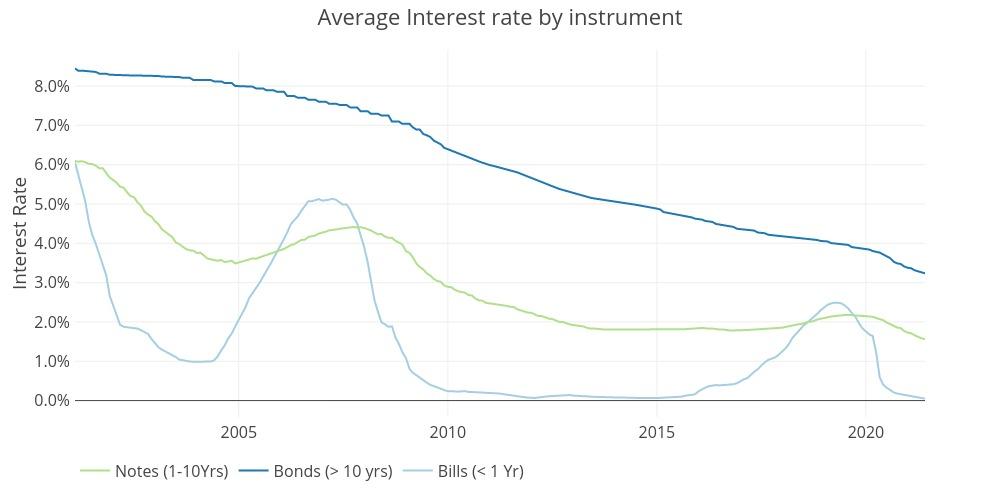
Source – Treasurydirect.gov
Although the Treasury could handle rising long-term rates (even if the economy and mortgage market cannot), the Fed has another problem. Rising long-term rates send an important message: rising inflation expectations. While inflation is first and foremost a result of monetary policy, higher inflation expectations quickly exacerbate the problem. This is why the Fed has been messaging they are OK with higher inflation and also why they have been pounding the table that inflation is transitory. They need to keep inflation expectations low! If inflation expectations were to rise, especially at this critical juncture, it would be game over for the Fed, as they would have to raise short-term rates (devastating the Treasury and economy) in order to save the dollar and squash inflation.
With the economy opening up in March of this year, things were getting very precarious as inflation was rapidly rising along with surging long-term rates. Remember that rising long-term rates indicate rising inflation expectations. This could cause transitory inflation to be much less transitory.
In summer 2020, the Treasury issued enough debt to build up a significant cash reserve. In response to rising long-term rates in Q1 2021, it appears the Treasury strategically used its cash reserves to slow down the issuance of long-term debt. With total short-term debt outstanding already so high, the cash balance gave the Treasury ammunition to decrease debt issuance just as a $1.9T stimulus bill was passed and inflation was set to explode higher. This would have been perfect timing to support the Feds narrative that inflation is transitory to keep expectations from snowballing out of control.
If inflation doesn’t slow in the coming months, the Fed may be forced to step in. With the Treasury poised to issue more debt, it can no longer rely on its one-time use of excess cash reserves. This will put more pressure on the Fed to clamp down long-term rates by increasing rather than decreasing QE. Yes, the Fed may decide to print more money (leading to higher prices) to fight rising inflation expectations (higher long-term interest rates).
Understanding recent fiscal and monetary maneuvers
Last year, when the pandemic hit, the US Government started spending trillions of dollars. Massive spending plans were approved in the name of stimulus and COVID relief. Because the government does not have much money on hand, and taxes cannot quickly be raised, the Treasury issued trillions in debt. The markets can easily absorb short-term US Treasury Bills, so when the Fed abruptly cut rates to 0%, the Treasury responded by issuing short-term debt to the tune of $2.4T from March to June 2020. See figure 1 below.
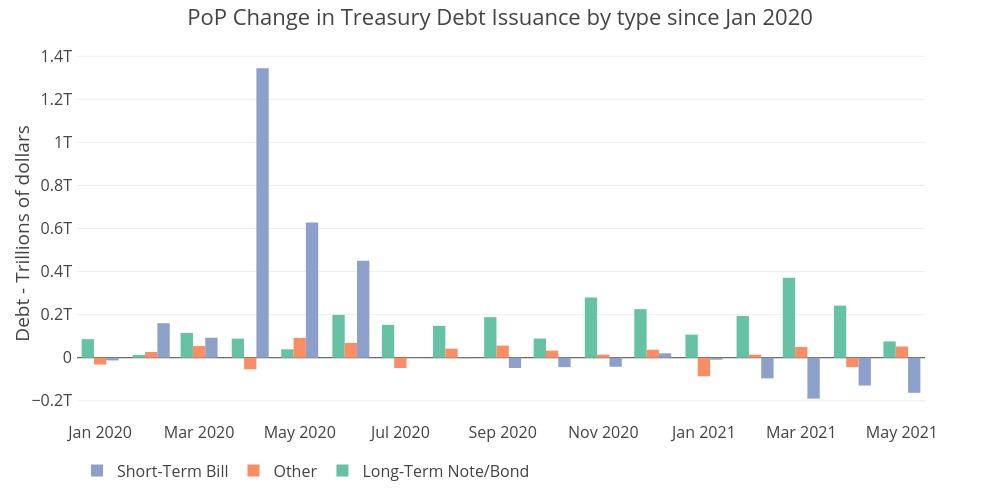
Source – Treasurydirect.gov
In tandem, the Fed bought up trillions of dollars in US Debt, but the Fed was buying on the long end of the curve while the Treasury was issuing debt on the short end. This caused long-term rates to collapse. The Fed purchased enough long-term debt to absorb more than a year’s worth of long-term debt issuance. The chart below shows how the month over month and cumulative change in the Feds balance sheet compared to the Treasury Debt Issuance of long-term notes and bonds.
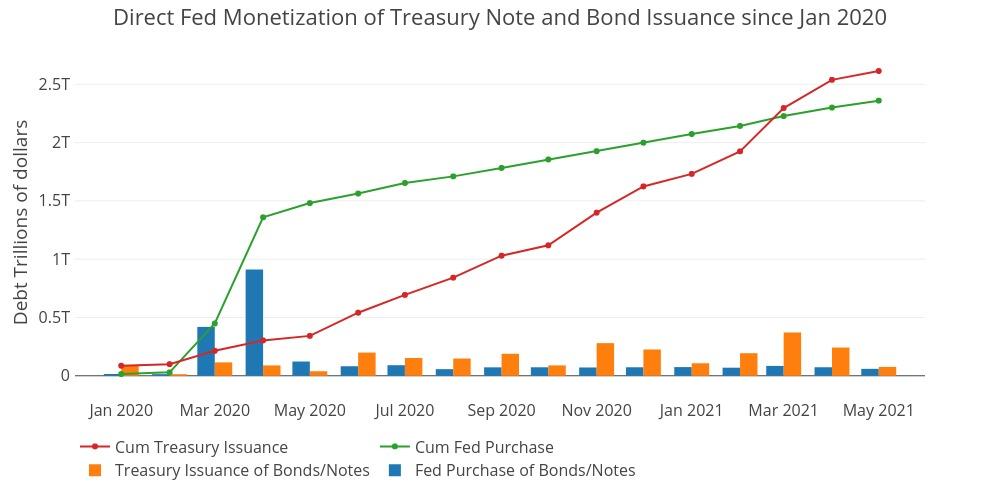
Source – Treasurydirect.gov
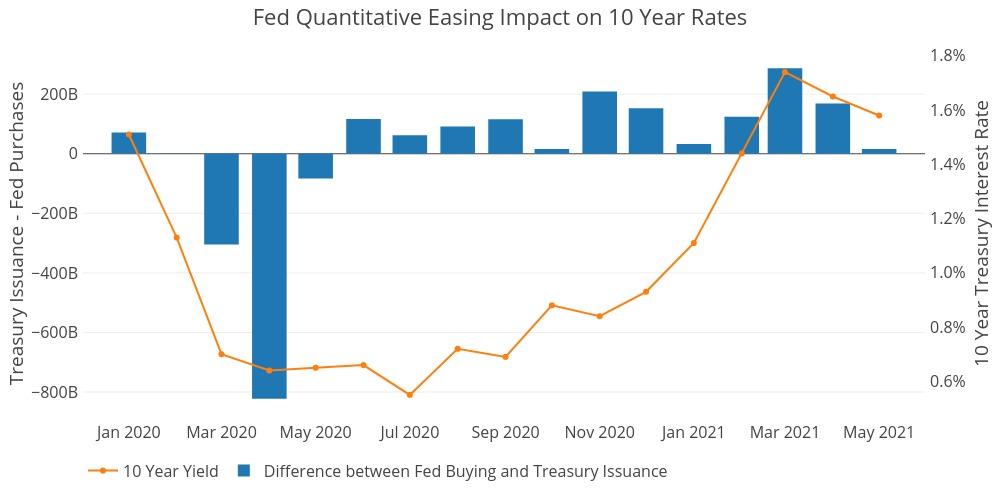
This action by the Fed had a massive impact on long-term rates. The chart below shows the difference between the two bars above, specifically the difference in Fed Buying and Treasury issuance of long-term debt for each individual month since Jan 2020. These values are not cumulative. The right Y-Axis shows the month-end interest rate of the 10-year bond. Looking at this chart shows something extremely clear: When the Fed buying exceeds debt issuance, rates are flat or falling; however when long-term debt issuance surpasses the Fed’s buying, rates rise.
Source – Treasurydirect.gov
The impact of the Fed can first be seen as interest rates fell from 1.5% to .6% during the initial buying spree. After the initial burst, the Fed put QE on auto-pilot, buying “only” $80B a month in long-term Treasuries. However, because the Treasury was issuing more than $80B a month as depicted by the positive bars starting in June 2020, interest rates started rising.
This trend started to accelerate in November of 2020, as long-term debt issuance was outpacing Fed Buying by around $200B. Things really started to escalate in the first quarter of 2021 as Treasury Debt issuance surpassed Fed buying by $286B in March right as interest rates were crossing above 1.7%.
Then, suddenly, long-term debt issuance started falling in April and was almost even with Fed buying in May. This consequently led to a fall in long-term rates, which are now hovering back around 1.5%. How did this happen just as Biden was pushing through a $1.9 stimulus package? Unlike 2020, when short-term debt issuance was used to plug the gap, Figure 1 above shows that short-term debt issuance was actually turning negative (blue bars).
What gives?
One look at the Treasury Cash Balance sheet in the chart below tells almost the entire story. This was first highlighted by a SchiffGold article published June 16. The chart below shows a massive surge in cash reserves by the treasury last year. Since March of this year, the cash balance has plummeted by over $1T.
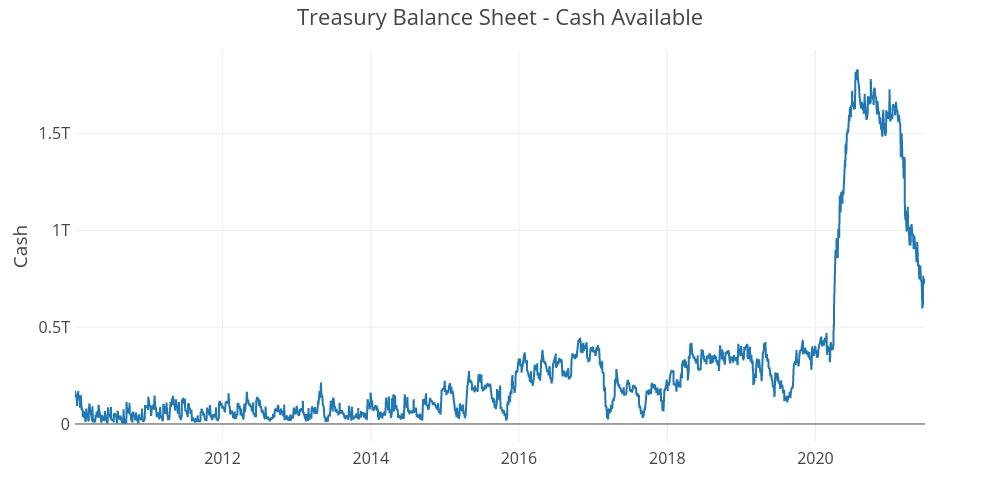
Source – Treasurydirect.gov
Inflation Expectations
Why such a massive and sudden drawdown in the cash balance? In truth, there could be lots of reasons, but it does seem extremely sudden. One would think the Treasury, led by Yellen, would be very deliberate and thoughtful about how to use up $1T+ in dry powder. For the past 3 months, the Fed has been shouting from the rooftops that inflation is transitory. At the June FOMC press conference, Powell stood up and explained how long-term inflation expectations remain well-anchored. A proxy for inflation expectations is long-term interest rates.
Had interest rates continued to rise similar to the recent trajectory (climbing from .8% in Nov to 1.7% in March), this would have been a difficult narrative to push. The Fed needs inflation expectations to remain in check or else inflation will be anything but transitory. Thus, the perfect time for the Treasury to pause issuance of long-term debt would be April-June 2021 just as the economy is re-opening and the Fed is forecasting inflation to be at its worst before coming back down.
While this is speculation, it would be a very strategic move from both Powell and Yellen. Regardless of the intention though, the problem is that the Treasury has now spent its large cash balance. It could return to the short-term debt market, but the outstanding balance is still sitting above $4T (see part 1). It needs to be converting that short-term debt to long-term debt while long-term interest rates are still low and the Fed is still buying. But the Fed is simply not buying enough at $80B to convert all that debt!
If inflation persists beyond a few months, then interest rates are going to rise in a hurry as the market demands higher rates. Adding fuel to the fire will be the Treasury debt issuance overwhelming the $80B Fed buying as it did from November to March.
Then what?
Who is absorbing the long-term debt to keep interest rates from returning to the upward trajectory from Aug 2020 – Mar 2021?
International creditors have had little appetite for US Debt lately. The chart below shows the total outstanding debt held by foreign governments. In the past 15 months, while the Treasury has issued over $4T in new debt, the net amount bought by foreign governments is close to zero.
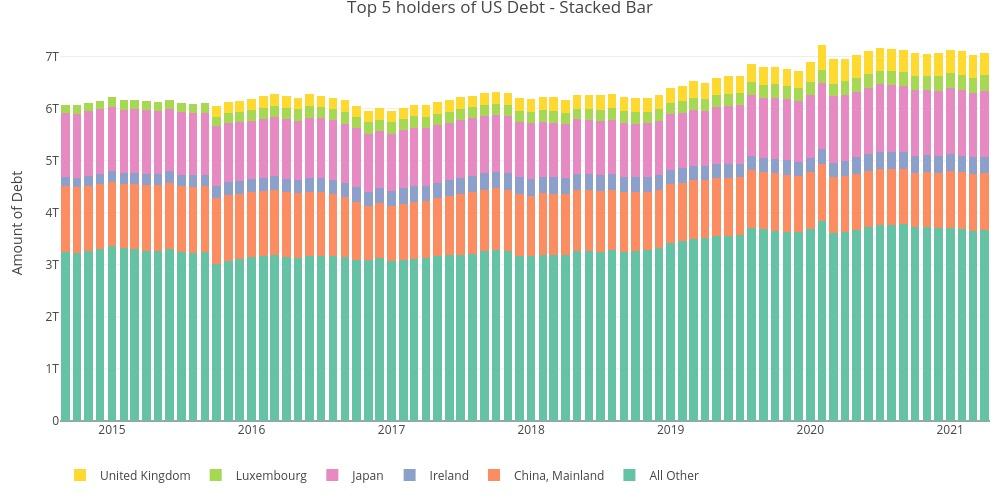
Source – https://ticdata.treasury.gov/Publish/mfh.txt
To zoom into the exact amount of change since the massive debt issuance, see the chart below. In total, foreign creditors have absorbed $120 billion of $6T+ or less than 2% of total issuance!
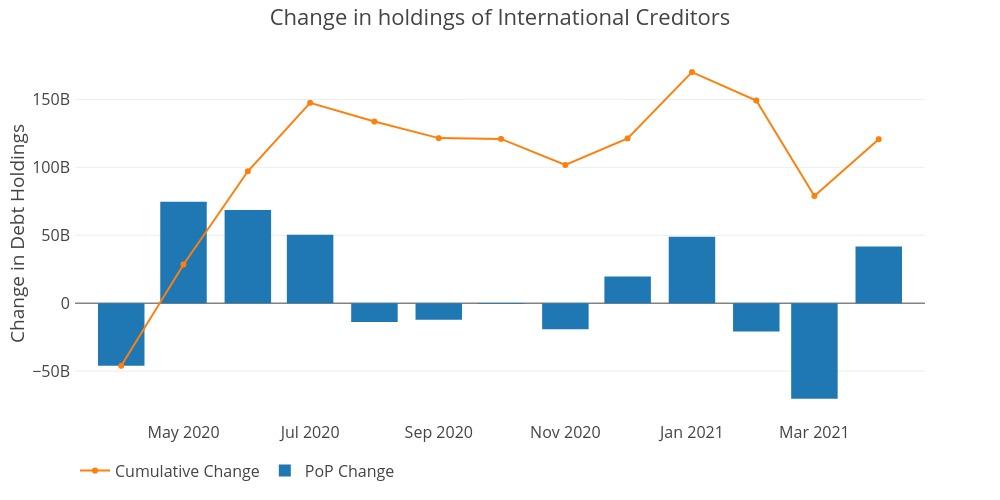
Source – https://ticdata.treasury.gov/Publish/mfh.txt
How are rates going to stay low if the Fed keeps the treasury buying cap at $80B? The Treasury will have to issue more than $80B in long-term debt to continue funding all the massive spending. If inflation expectations stay low, maybe the market will have enough firepower to ingest some of the new debt, but not all of it. With the Fed planning to begin tapering at the end of the year, someone will need to fill the $80 billion void. This does not even take into account the possibility of shrinking the Fed balance sheet, which should be considered impossible at this point.
The chart of the international holders above brings to mind the image of the Wiley Coyote running off a cliff. With 10-year interest rates hovering near 1.5%, one could argue there is strong demand for long-term Treasury debt. Unfortunately, foreign creditors have turned off their debt purchases. It took decades for them to accumulate ~$7T in Treasury debt. The Fed alone has accumulated more than half that (~$4.5T) over the last decade. The Fed is making the market seem strong, but as shown above, there might be nothing but air if they were to exit the market. With a thumb on the scale, no one is getting an accurate reading of true demand for US long-term debt.

Source – Warner Brothers
What about short-term debt markets?
As highlighted several times, the demand for short-term debt seems to remain very strong. This makes sense as T-Bills mature in less than a year, so these investments are perceived as nearly risk-free. In fact, it could be argued that the recent Treasury Bill issuance hiatus (Figure 1 – blue bars turning negative) could be causing stress in the Reverse Repo market. The chart below shows the current Reverse Repo market. Based on past quarter-end data, it’s very possible that Reverse Repos could exceed $1.5T by this coming Wednesday, June 30, before coming back down.
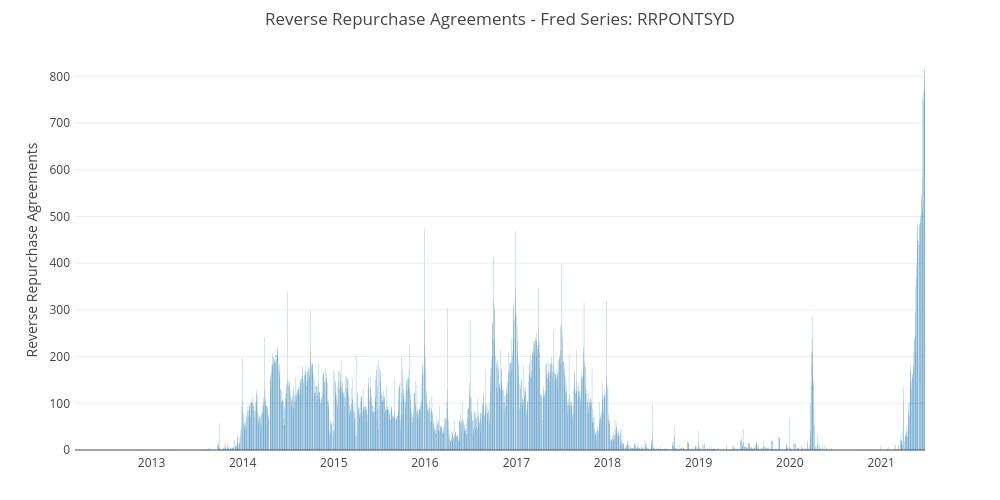
Source – https://fred.stlouisfed.org/series/RRPONTSYD
Many articles have been written to explain this phenomenon, without providing exact clarity on what’s actually going on. The current understanding seems to be that the banks are awash with cash – so much cash, they are hitting the limits in terms of how much cash they can hold on balance overnight. This is cash that should be invested on behalf of money market funds. But with so much cash in the system, if it were to all be invested in short-term debt instruments, it could drive rates negative. To avoid negative rates, the Fed is lending banks assets on its balance sheet overnight in exchange for cash. It is critical to avoid negative rates to insure money market funds never experience a loss and result in breaking the buck.
Maybe this is a leap too far, but it seems another solution to the Fed reverse repurchase activity could be for the Treasury to issue more short-term debt. So, why has the Treasury been drawing down its cash balance and letting short-term debt mature when there seems to be strong demand in the market? The Treasury must recognize the risk of having too much debt in short-term instruments and is trying to lengthen the duration of its debt outstanding. Unfortunately, this abundance of cash in the repo market is in search of low-risk short-term debt so will not provide demand for long-term debt.
If this is the case, it has created quite the pickle for the Treasury. By issuing too much short-term debt, the Treasury is by default putting pressure on the Fed to not raise short-term interest rates. However, by issuing too much long-term debt, the Treasury is by default putting pressure on the Fed to maintain or even increase quantitative easing. To reiterate, this is why it is imperative the market believes inflation is transitory. The Treasury cannot stop issuing debt, which leaves the Fed unable to raise rates or taper QE without wreaking havoc in the bond market. Additionally, if the Fed has to fight inflation, then it’s not just the Treasury facing its Wiley Coyote moment, but the entire US economy.
Wrapping up
With the economy reopening, the Treasury deployed its cash balance at the most opportune time, unless of course inflation numbers continue to increase (which based on all the data, anecdotal evidence, and liquidity in the repo market seems like a strong possibility). Unfortunately for the Fed, the Treasury will have to begin re-issuing debt again. Will it lean towards short-term debt hoping the Fed keeps interest rates low, or long-term debt hoping the Fed will expand QE?
But Fed may be constrained either way because it has its own problem. Powell must be praying that inflation readings come in low AND job numbers disappoint. If both don’t occur, then tough questions will be asked to justify more stimulus. Yellen and Powell may be best buds, but simple coordination will not be enough. They will need magic and luck to keep the course steady heading into 2H 2021 and 2022.
If the Fed is lucky enough to get low inflation readings out of its rigged CPI, it may provide cover to begin tapering. Rising long-term rates won’t have the same compounding effect on inflation expectations in a “low” inflation environment. Unfortunately, long-term rates will not be tenable over the medium term as the government has to finance more and more debt. As the market this year has indicated, when issuance surpasses Fed buying, rates have gone up. So what happens to rates when the Fed leaves the market entirely? Presumably, they go up a lot. How high will the Fed let rates go before re-entering?
Just because something is inevitable (US Debt spiral) does not make it imminent; however, the next six months of data may shine a bright light on all the irresponsibility over the last 12 years if inflation proves not so transitory. Chances are, the only thing transitory will be “talking about talking about” tapering.
US Debt interactive charts and graphs can always be found on the Exploring Finance dashboard: https://exploringfinance.shinyapps.io/USDebt/

Join the community.

McMaken: The Fed’s Inflation Is Behind the Supply-Chain Mess

‘White People, You Are The Problem’: AT&T’s Internal ‘Racial Reeducation Program’ Leaked

Matrix? Misdirection? Cringe? Zuckerberg’s presentation of future life in ‘metaverse’ sparks fear, loathing, marvel and mockery

New York facing streets without cops because of COVID vaccine mandate

The Establishment Is Hiding Mass Resistance To Vaccine Mandates With The “Striketober” Farce
