
Economy
The Great Paper-Money Experiment
The manipulation of the currency, the increase in public debt, and the mismanagement of state finances had produced a state of chaos in France by 1709.


The name of that ardent Scotsman, John Law, is short. His career was likewise short: he was comptroller general of France for less than five months in the year 1720. The space of time during which he bestrode the financial world of Europe like a Colossus scarcely exceeded five years at the most. The financial mania that swept over the continent at his touch flamed and died in less than two years. His epoch is usually dismissed by historians with a short passage on the “bubble era”; and by economists, if discussed at all, it is treated as a freak in the hothouse growth of modern finance.
The Prepared Ground
The financial situation of France at the close of the reign of Louis XIV in 1715 was prepared ground for fiat money and experiments with the money mechanism. During a long reign of 72 years, the Grand Monarque had elevated France to the foremost position in Europe, and in the process had reduced his subjects to poverty and the state to bankruptcy. At the end of the reign of Louis XIV, in 1715, the consolidated debt of the government totaled around two billion livres, and the floating debt an additional billion. The interest on this debt was around 86 million livres, against state revenues of 165 million livres, leaving less than 70 million livres to meet a state budget of 150 million livres. The debt had increased twenty-fold in less than 30 years.
Just how much this amounted to in purchasing power is a matter almost past determination because of the inflation of values, the depreciation of the currency, the duality of the coinage system, and the currency manipulation that had been practiced unconscionably after the death of Colbert (1683), beginning particularly in 1687. The livre had been successively reduced from 362 to the gold mark (3777.5 English grains) in 1643 to 600 in 1709, and in terms of silver from 26.75 to the mark to 41. These changes were made by the process of repeated recoinages and new tariffs, ostensibly to adjust the changing ratio of gold and silver. Between 1689 and 1715, we are informed by Despaux, the value of money was changed 43 times:
These money manipulations did not have the sole purpose of furnishing revenue to the treasury or of following the fluctuations of parity in the ratio between the precious metals, [says Despaux]. They were employed for other and various ends. The administration of the finances appears to have practiced a subtle and ingenious monetary tactic, conceived in the eighteenth century, but almost forgotten until the twentieth when it was again practiced by Germany. The financial administration, by modifications in the monetary unit, attempted to influence economic phenomena much the same as central banks and governments today manipulate foreign exchange. Changes in the specie were made to prepare for the issue of loans, or to audit the circulation of the treasury notes, or to regulate exchange, to modify the balances of trade and accounts, to effect a redistribution of wealth, to influence the price level of commodities, perhaps to attenuate the economic crises and famines, since the currency manipulation of 1693 to 1709 coincided with a period of bad harvests.1
The manipulation of the currency, the increase in public debt, and the mismanagement of state finances had produced a state of chaos in France by 1709. “Gold and silver were hoarded or driven from the country,” writes James Breck Perkins.
The lack of sufficient specie for ordinary circulation checked every branch of business. Bankers failed, the notes of merchants went to protest, there was no money with which to pay taxes. The king sent his plate to be melted down, and his example was followed by the rest of the nobility. Edicts were issued in order to improve the situation, but the laws of trade could not be controlled even by an absolute monarch. There is little doubt that the depreciation of the currency did more injury to France than the victories of Marlborough, and that it was an important factor in the desperate condition of that country in 1709. The Dutch claimed they might wisely continue the war when they could raise money at five per cent and the advances which the French obtained cost them twenty per cent.2
A series of successes on the field of battle in the latter days of Louis’s reign saved that monarch from the humiliation of a complete collapse of public finance, and fortunately he died soon afterward. But on the death of Louis the true state of anarchy in the commerce and trade of France was fully revealed. The Duke of Noailles, the chief of the Council of Finance under the regency, wrote to Mme. de Maintenon, September 21, 1715:
We have found matters in a more terrible state than can be described; both the king and his subjects ruined; nothing paid for several years; confidence entirely gone. Hardly ever has the monarchy been in such a condition, though it has several times been near its ruin.3
La Bruyère, who was also an eyewitness of the day, described the countryside as follows:
One sees certain wild animals, male and female, scattered over the country, black, livid, burned by the sun, attached to the soil, which they cultivate with an invincible pertinacity. They have an articulate voice, and when they stand erect they show a human face, and in fact they are men. At night they retire into their dens; they live on water, black bread and roots.4
Such was the state of France when there appeared in Paris a Scotsman with a plan by which all of these misfortunes were to be repaired. This Scotsman was John Law.
Germination of the Seed
John Law was born in Edinburgh in 1671. His father was a goldsmith and, as was customary at that period, combined with his trade the care of moneys entrusted to him and many of the functions now discharged by bankers. John Law was educated at Edinburgh, where he showed an amazing aptitude for mathematics, especially the intricacies of algebra, which was later to stand him in good stead while explaining the ramifications of his financial plans.
On the death of his father, he went to London, where his prepossessing manner gained him friends, and he became known for his skill as a gambler and for his intrigues with women. He became involved in an affair, fought a duel with a Mr. Wilson, and killed him on the spot.5 For this crime he was tried, convicted of murder, and sentenced to be hanged. He managed to obtain a commutation of sentence, and succeeded in escaping to the continent.
Georges Oudard, in his Amazing Life of John Law, gives us a lively picture of the Scotsman’s career as he wandered about Europe, increasing his financial knowledge, sharpening his wits, making friends among the highly placed, perfecting his ideas, and finally, achieving their execution in France during the regency of the Duke of Orleans.6
In the summer of 1700, John Law returned to his native land of Scotland, where he found a condition of affairs in which he thought to develop his growing financial ideas. In Scotland, as in England and throughout Europe, a spirit of gambling and speculation had been induced by the uncertainties of a long war, by the disturbances to trade which made some wealthy overnight and reduced others to poverty, by the inflated demand for war materials, by the depreciation of the currency that had been practiced not alone in France but elsewhere, by the sudden rise of banks, and by the discovery of the joint-stock mechanism.
A great many Scotsmen had been drawn into the scheme of William Paterson, founder of the Bank of England, for colonizing the Isthmus of Darien [Panama]. This scheme was the Scottish Company of Africa and India. It had failed miserably and had created the utmost distress in Scotland, where the shares had been avidly taken up. Paper money issued by the company and profusely distributed in competition with bills of the Bank of Scotland had impaired the position of the bank. Conditions were heartbreaking. Manufacturers were no longer exporting their goods, land rents were not being paid, money was leaving the country, and 200,000 poor were crying out for bread.
It was at this point that Law enunciated his great currency principle, of money based upon land values, rather than upon metallic values—what Henry Dunning MacLeod, whose theory it is that money consists of debt, denounces as the first “Lawism.”7
Law recalled that there was not one poor person in Holland, and that the Venetian Republic had only about 300. Out of these conditions and the study he gave them Law began to write his famous treatise Money and Trade Considered with a Proposal for Supplying the Nation with Money.
“Wealth depends on commerce,” he wrote, “and commerce depends on circulation.” The Scotch had but little silver and gold, and therefore they were poor. To make them rich, they required banks which could pour forth a stream of currency. A proper bank and currency would make the valley of the Clyde and fields of Fife blossom with prosperity, and would transform the shopkeeper of Edinburgh into the merchant prince of Genoa and Amsterdam.
Law proceeded to attack the mercantilist theory, then in vogue, that a nation’s wealth consisted of its stock of precious metals, and showed that the value of gold and silver fluctuated like pepper or corn. Land, on the other hand, was steady in value, intrinsically useful (whereas gold and silver were valuable chiefly in exchange) and always in demand.
“What I propose,” Law announced boldly, “is to make a land currency equal to the value of the land and to the value of actual coined money without being subject, as is coined money, to a fall in value.”
Law proposed, therefore, that commissioners should be authorized to issue paper money to all who required it, to be secured by mortgages to the value of two-thirds of the land, or issued for the entire value, upon the land’s being turned over to the commission. Such a currency, he said, would necessarily be in proportion to the needs of the community. In other words, if any man wanted money and had the land to secure it, he could get as much as he required; when no one needed money, there would be no demand, and none would be issued. Thus the currency would regulate itself, like a safety valve. So confident was he of the superiority of such a medium of exchange over gold and silver, that he advised a provision limiting the premium on paper to 10 percent.
It is quite possible that had this scheme been adopted we would have witnessed a hundred years earlier the situation produced by the issuance of the assignats during the French Revolution. There was, however, little danger of the adoption of Law’s proposals. The Scotch were smarting from the disastrous results of the Darien expedition, and they were not inclined to any new ventures.8
First Fruits
If John Law was a prophet without honor in his own country, he found a ready ear in the Duke of Orleans, who had become regent of France upon the death of Louis XIV.9 Orleans was anxious to be a popular ruler, and he had no stomach either for economy or for a debt repudiation—the alternatives offered by his ministers to meet the haggard state of the finances. The regent was a notorious roué. Some years earlier he had met Law in a gambling den and had been impressed with the Scotsman’s financial genius. When Law now presented himself at court, Orleans received him with open arms.
Law offered to assist France in her distress; to render her debt light by making her people rich; to restore her commerce, build up her industries; and make the regency of Orleans memorable as the beginning of an era of larger enterprise, increasing wealth, and abundant prosperity. “What is needed,” he said, in words which have a curiously modern ring,
is credit. The credit that I propose to establish will be different in its nature from the kinds of credit now in general use; it will be suited to this monarchy and the present state of affairs.
The means of furnishing this requirement for enlarged trade would be a bank, and Law dwelt upon the advantages which such institutions had rendered wherever established, and could render in France. Banks (now in need of no advocates) were at that time unknown in France, and for that matter little known anywhere. The Bank of Amsterdam was regarded as a mystery; the Bank of England had been established but a few years, and its creation had been opposed by a large portion of those who were considered the practical, hardheaded men of the day.
Law urged the advantages of his bank. By the very act of issuing currency, he declared that he could make the country richer; that plenty of banknotes would not only aid a commerce that existed, but could create one that had no existence; that an abundant currency would of itself bring prosperity to the land.
“A state,” he wrote, “must have a certain quantity of money proportioned to the number of its people,” thus giving utterance to a belief that still has many adherents.
The idea of currency based upon land, which he had proposed to the Scotch, was, however, conspicuously absent in the plans he outlined to the regency. The theory of money which Law now advocated was that of money created on the security of commercial credit. This was not an original idea, rather an outgrowth of the English goldsmiths’ practices, but Law was the first to propose and apply the theory on a national scale.
The plan which Law suggested was subject to little criticism. He advised that, in order to relieve business from the paralysis caused by the frequent depreciations of the currency of the government, the bills of the bank should be made payable in coin of a fixed weight and amount. He recognized also the necessity of measures by which the bills could always be promptly redeemed in coin.
When the question of a charter came before the Council of Finance, however, it met with unfriendly reception. Saint-Simon, hidebound old member of the aristocracy and a member of the Council of the Regency, gives us in his memoirs an account of the deliberations. He himself, with naive and frank appreciation of the weaknesses of his class, voiced the most pertinent and penetrating objections. The first objection, he said, was the difficulty of directing the bank with sufficient foresight and wisdom to avoid the dangers of overissue of notes. A second disadvantage was that a bank under the control of the government might be safe in a republic or a limited monarchy, but it would be sure to be abused where the king was absolute. An unfortunate war, the prodigality of a sovereign, the avidity of a minister, a favorite, or a mistress, a craving for luxury, foolish expenditure, would very soon exhaust the bank and ruin those holding its notes—in other words, ruin the whole nation.
Law’s answers to such objections showed the hopefulness of a promoter rather than the sagacity of a man of affairs. A bank, he insisted, would so increase the wealth of the nation, and therefore the revenues of the king, that it was incredible to suppose that any monarch would destroy the usefulness of an institution from the existence of which he would be the chief gainer.10
The deliberations of the council and Law’s astute arguments are of interest to us today because they present the same conflict and divergence of viewpoint over the proper sphere of banking, its limitations, and its mischievous possibilities which still appear and which will not be resolved until the money mechanism is treated not as the creator but as the safeguard of wealth.
Because of the objections of the council, the best Law could obtain was a charter for a private bank, which was granted May 2, 1716. The bank’s powers were, however, ample. It could receive money on deposit, discount commercial paper, and issue notes. In the following month the bank (known as Banque Générale) modestly began its career in the house where Law lived, Place Louis le Grand.
The institution was immediately prosperous. The fact alone that its notes, under the terms of its charter, were redeemed in coin of a fixed weight gave new life to commerce. The money had been subjected by the government to so many modifications that the specie value of a louis or a livre fluctuated like the price of shares in the market. The notes of Law’s bank furnished a currency safe and convenient in use, of which the value could not be modified by any royal edict.
As a result, business relations abroad were renewed, interest rates on good paper dropped from 30 percent to 6 percent and then to 4 percent. Bewildered moneylenders closed their shops. Law’s management seems to have been judicious and conservative. In October 1716, tax collectors were ordered to make their remittances payable in Paris by notes of the bank and to pay these notes on sight when they were presented. This in effect made the bank notes legal tender.
For two and a half years the bank remained a private institution. During that time Law’s success was gradually being acknowledged, and it is reported that Peter the Great of Russia sought Law’s assistance in reorganizing the finances of his empire. The regent began to urge new miracles from this financial wizard, and to offer Law new powers. In 1718 the Banque Générale was converted into a state bank with increased powers. From that moment Law’s undoing began and he moved on, like a figure in a tragedy, into heights of power and renown that only made the more precipitate and tragic his eventual fall.
The Mississippi Bubble
We now approach the flowering of Law’s “System,” the emergence and devolution of his great scheme for unifying the whole diverse substance of French economy into one grandiose whole, a great economic system conceived, delivered, and nurtured by credit. The great speculative inflorescence which followed in its wake—the Mississippi Bubble—is usually exhibited in economic history as the product of financial hysteria, without reference to the solid bases upon which it was founded. As a speculative inflorescence it indeed deserves our closest attention, for it was the first great “boom” of modern times, and in it we may trace the pattern of all subsequent booms; but not alone for this reason will it be treated in some detail, but also because, involved in it, as we shall have occasion to note, was the great misconception over which in the modern world “the whole financial order, big and little”—to quote Frank A. Vanderlip—”came a cropper.” This was the misconception over the possibility of giving currency liquidity to all forms of wealth.
In 1717 fortune was smiling upon Law, and he now gave rein to his imagination in the audacious project of developing the colonial possessions of France. He drew up and presented to the regent his scheme for his Mississippi Company (the Compagnie d’Occident), which should enjoy extensive and monopolistic privileges in Louisiana. Louisiana was then but a name, an unknown territory of unknown extent in which the claims of the French government were staked out by a few scattered forts and trading posts.
When the extent and the present wealth of this territory is considered, we cannot but admire the audacity of imagination of the man who could conceive the gigantic enterprise of colonizing it, or fail to excuse the enthusiasm to which he succumbed or the wild speculation which arose over the prospects for the development of this area. Certainly the speculative enthusiasm of France of 1718 to 1720 was founded on a far stronger basis than the speculative enthusiasm of the twenties of the 20th century.
The capital of the company was set at 100 million livres, but Law, either against his judgment or carried away by his enthusiasm, agreed that subscriptions could be made in state obligations, instead of coin. Thus the capital of the company, instead of being represented by ships, stores, forts, and warehouses, was invested in obligations of a government whose credit was exceedingly poor. Only the interest on this sum would be available for the actual work of commerce, and this at most was four million livres a year. The Compagnie d’Occident, founded with such extravagant hopes, thus became at the outset a vast machine which would swallow worthless state paper.
Nevertheless, Law was supported loyally by the Duke of Orleans and shortly afterward he added to the powers of his company the tobacco monopoly of France. Next, the East India Company and the Compagnie de Chine were absorbed, and in July 1719, the privilege of coinage was granted the company. The following month, Law obtained the monopoly of the tax farm, and in doing so incurred the bitter enmity of the financial interests that had previously held the privilege.
Finally, Law proposed a vast conversion of the national debt, offering to advance the state some 1.5 million livres at 3 percent, intending to raise this enormous sum by sale of shares in the company. Thus, by a series of operations, Law had brought under his personal control most of the organized capital and enterprise of France. He had created an enormous trust under the aegis of the state, and if ever an opportunity for “planned economy” existed, it was now.
To float such an enterprise as Law had conceived was, however, an operation that would have taxed the ingenuity of our most inventive modern financiers. Law was equal to the occasion. All the methods of stock jobbery and promotion that are still so successfully practiced were used.
Attempts at colonization were made in a manner to attract and delight the public. Large tracts of land were taken by prominent persons, Law himself taking a reservation in the Arkansas wilderness. Dealings in futures—equivalent to the “puts” and “calls” of Wall Street—were introduced. Law publicly took an option on shares of the company at a price 200 livres above the market and deposited 40,000 livres as security. Such a transaction filled the public with amazement, and as a stock-jobbing operation it may rank as one of the major coups of history. The price of the shares at once advanced, and the public bought eagerly.
Prospectuses, of the most extravagant sort, were issued. In them, Law quoted freely, without acknowledgments, from Walter Raleigh’s description of the Eldorado, which had delighted him in childhood. He had a plan of New Orleans published in the Mercure, according to which this settlement on the mud banks of the Mississippi was a metropolis equal to many in Europe.
Another of Law’s devices—one which was freely used during the 1920–1929 era—was that of issuing “rights to subscribe.” He required subscribers to his new issues to be holders of a certain number of old shares, under the pretext of favoring early buyers of the shares, and as the new shares were always issued at a discount under the market price of the old, and consequently represented an immediate profit to their holders, there was always a headlong rush to obtain the shares of the old series, called “mothers” (mères), in order to be able to subscribe to the new, called “daughters” (filles). This demand naturally increased the price of the old and added to the general enthusiasm. Finally, there were shares of “mothers,” “daughters,” and “granddaughters” in circulation.
Still another device was that of allowing subscriptions to be paid in installments. Shares were issued against 5 percent paid in, the balance being payable in nineteen monthly installments. This increased enormously the leverage of speculators and was equivalent to trading on margin. As the shares rose by 100 percent in less than two months’ time, profits of 450 percent to 600 percent were made by subscribers.
The most dangerous of his devices which have been aped in modern times was the declaration of dividends which had not been earned. At the first general meeting of the company, July 26, 1719, before there had been any earnings, he proposed and carried a dividend declaration of 12 percent on the par value of the shares.
Under these and similar measures, the price of the shares had risen in the space of 40 days, between June 20, 1719, and July 27, by 100 percent, a feat which recalls the 100 percent stock dividend declared by the Goldman Sachs Trading Corporation within six weeks after the original public offering of its shares in the summer of 1929.
In July 1719, the original shares of 500 livres par were quoted at 1,000. In September they sold at 5,000. As the market rose, additional issues were fed out to avid buyers. By October, issues totaling 1.5 million livres had been sold.
To support this tremendous security speculation, vast reserves of credit had to be opened, and they were obtained by the free use of the printing press. In the spring of 1719 the amount of bank notes outstanding was about 100 million livres. By June and July, 300 million livres more were uttered. In the last six months of 1719, notes were issued by the Royal Bank to the amount of 800 million livres. In July, to stem an incipient run on the bank, Law had taken the audacious step of lowering the value of gold! Instead of redeeming its paper with louis at 35 to the livre, the bank offered to pay out louis at the rate of 34 livres paper.
The scene presented by the speculation which grew apace in the fall and winter of 1719 was one which had no parallel in previous history and has had few since. The rue Quincampoix had been the resort for men dealing in government obligations, and the speculation in the securities of Law’s companies centered there.11 In the days of the highest excitement it presented a scene such as could be witnessed nowhere else in the world, with the possible exception of the Exchange Alley of London, where the speculation in the South Sea shares was concurrently taking place.
There were no brokers’ offices, and persons dealing in the shares met and trafficked in the highway. Here could be found those of every rank and occupation. Princes and priests, doctors of the Sorbonne, and shaven friars, mingled with money-shavers, shopkeepers, valets, and coachmen. Women jostled for shares with men. Ladies of fashion went there, as they went to the opera. The cafés were full of gentlemen and ladies, who sipped their wine, played quadrille, and sent out servants to execute their orders. The owners of the houses on the street grew rich from the enormous rents which they obtained. Money was gained with such rapidity that those plying the humblest trades received exorbitant compensation.
The fortunes made in the rue Quincampoix drew speculators from every part of Europe. A more cosmopolitan crowd was never seen than that which here jostled, shouted, and bargained. Thirty thousand foreigners were in Paris during the autumn of 1719 in search of fortune, besides the hosts that came from all parts of France. So great was the eagerness to reach the city that seats in the coaches from such towns as Lyons, Bordeaux, and Brussels were engaged long in advance. Fabulous prices were given for a place, and those who could not go to Paris and buy shares speculated on seats in the stagecoach.
For eight months there continued what would now be called a wild and rampant bull market, and the quotations on the shares gained on the average over ten points a day. Everyone was crazy with excitement long before the culmination of the speculation. The shares, which had sold at 500 livres in May were being quoted in November at 10,000. They soon rose to 12,000 and 15,000; there were many sales at those figures, even higher. It is said that as much as 20,000 livres was paid for a share of which the par value was 500. The highest prices were obtained in December and January, but though the market ceased to advance there was no rapid decline. From November 1719 until February 1720, the shares fluctuated between 10,000 and 15,000 livres.
Such a rise made for fabulous gains. A purchaser of the original shares, paying for them in bills of the state at 60 percent discount, could get 15,000 livres for what cost him 200. Twenty thousand livres placed in shares in the latter part of 1718 would have realized nearly two million a year later. A speculator who subscribed for a share in October 1719 and sold in November made 100 percent on his investment in a month. A valet was said to have made fifty millions [sic], a bootblack forty, and a restaurant waiter thirty. The word “millionaire,” which has since become so familiar both in French and English, was first used to describe the Mississippian who had suddenly grown wealthy.
All France, all Europe, was deceived by this sudden vision of untold riches. The overburdened country of Louis XIV seemed transformed into a fairyland. The notes of the bank, of which a billion were now in circulation, the shares of the company, at the absurd prices at which they were now selling, were thought to be so much added to the national wealth. A grave writer estimated that in November 1719, the country was richer by five billion livres than it had been a year before. And yet this fabulous increase was represented only by a few settlements in Louisiana and a few more ships trading with the East.
Law, meantime, was working at a furious rate remodeling everything in the kingdom. He was not content with printing notes with dangerous obstinacy; he was also busy concerning matters of trade and agriculture. He had in mind the idea of depriving the clergy of their uncultivated lands and giving them to the peasants. He wanted asylums for the poor built in all parts of the country. He encouraged fisheries and helped manufactures with substantial loans. He took an interest in large undertakings and furnished funds for building the bridge at Blois and for digging the canal at Briare.
He wanted to have barracks built in the provinces in order to spare the inhabitants from having to house the troops. He was taking steps towards making Paris a seaport. He was effecting economies in the tax collections, amounting to two million livres annually. He was on the point of abolishing tolls throughout the country in order to make the grain trade free. He was not only hastening to bring into force this much needed reform, but he was also reducing the import duties on oil, leather, tallow, and wines. He abolished the offices connected with the ports, harbors, and markets of all kinds in Paris, and this lowered by as much as 40 percent the price of wood, coal, hay, bread, game, poultry, butter, eggs, and cheese. Most of these reforms were abandoned after his fall.
The latter part of 1719 saw Law at the height of his greatness. He was the most prominent figure in Europe. He visited the street where millions were made daily out of his enterprises, and was received with an enthusiasm such as could hardly have been accorded a sovereign. His native town of Edinburgh sent the freedom of the city in a gold box to the Right Honorable John Law.
The Chevalier of St. George, the head of the house of Stuart, pretender to the English throne, wrote to ask his favor and his bounty. The English ambassador in France was recalled because he was on unfriendly terms with the new financial autocrat. Law was declared to be a minister whose merits exceeded anything that the past had known, the present could conceive, or the future would believe.
On January 5, 1720, Law was made comptroller general of France. He and his System had reached the zenith of their fortunes. Law surveyed a world inflated in an enormous bubble, as delicate and insubstantial as froth, a world gone mad in speculation, everywhere feverish activity, but activity of an unhealthy sort, concerned with the making of money rather than the creation of wealth, concerned with stocks and shares rather than ships and goods.
Law must have been perplexed and dismayed at what he saw. He had conceived a “state within a state,” an edifice of commerce and trade and industrial activity within the political state, a structure which would support and strengthen the degenerate and enfeebled state without; enterprise which would absorb the energies and interests of the people rather than the hollow and hectic life of the court.
Somewhere his plans had gone astray. Instead of creating a condition of industry and trade, geared and lubricated by the device of commercial credit, he found the same old interests and pursuits, but heightened and intensified by a spirit of gambling and speculation. A financial revolution had occurred which, like the political revolution of 1789, leveled all distinctions of rank. The greatest nobles shared an avidity for gain which was not surpassed by any lackey or coachman who became rich on the rue Quincampoix. Royalty had lost something of its sanctity from its connection with banks and trading companies, which was a relationship inconsistent with the majesty of the throne as it had been personified by Louis XIV.
The unconcealed greed of the nobility to share in the profits of Law’s enterprises revealed the general spirit of commercialism that had suddenly been awakened. A feudal nobleman, living on his ancient estates, ruling his tenantry, despising trade and the vulgar interests of plebians, might command respect, but a duke dabbling in shares on the rue Quincampoix put himself on the same level as the widow Chaumont, or André the Mississippian.
The Final Experiment
It is at this point in the story of Law’s System, when the great speculative structure he had created was beginning to topple, that we note the development in all its theoretical perfection of the last great “Lawism”: the attempt to give currency liquidity to wealth, the same disastrous attempt which the modern world has made with its heterogeneous and conflicting instrumentalities of credit and banking and money.
The speculative character of Law’s edifice had become nowhere more evident than in the fact that the success of his whole scheme depended upon the maintenance of the price level to which the shares had risen, just as in 1933–1934 it was the general conception that to restore prosperity prices must be restored to the 1926 level. Doubtless, at an earlier stage the prices of the shares would have been an immaterial factor. With the monopoly of foreign trade, together with the power over coinage and tax collections in his hands, Law could have contented himself with paying what the company could earn and disregarding quotations. But this foresight Law lacked, as have also many promoters and financiers since then who have been sincere and honest in their intentions.
But six months later was too late. Prices had risen so rapidly and exorbitantly, public interest had so focused on the share market, that any action tending to disturb quotations would have been fatal.
Moreover, inflation had spread to commodities, and a great rise in prices had followed. Land was especially in demand. Houses, chateaux, and farms sold at three or four times their former value. A property which had brought 700,000 livres a few months before was now sold for over two million. A loaf of bread, usually sold at from one to two sous a pound, now brought three sous. The cost of other provisions had advanced in the same proportion.
A collapse was inevitable, sooner or later; but Law, fascinated by the thing he had set in motion, was lacking in the will to throw on the brakes. Law feared the effect of a fall upon the bank and the company, as well as upon his own popularity.
Early in November, however, large blocks of stock began to be thrown on the market. Efforts to sustain prices led to further inflation of the currency, and the continuing drop in the value of the bank notes led to new measures to support their value. In December, the bank notes were given an official premium of 5 percent over coin.
In February, the hoarding of gold or silver was prohibited on severe penalties, and the act was enforced by bounties to informers and summary search and inquisitorial measures. These measures were without effect, and on March 11 the use of gold or silver for the payment of any debt was forbidden. Thus, for a short time, France had the distinction of being the one civilized country where a man could not pay his debts with gold or silver.
To prohibit the use of gold and silver was a departure from the principles on which Law’s bank had been organized; it was not, perhaps, at variance with the theories of a “managed currency” he had frequently announced. He had often argued against the use of the precious metals for currency, because of the fluctuations in their value, and had proposed, in their stead, a currency which would possess no intrinsic value, and of which the quantity would be fixed by the state in accordance with the needs of trade.
Paper was most fit for this use, and therefore it had been adopted in France; gold and silver, like wool and silk, could now be put to some useful purpose. As the new money would have no intrinsic value, no one would be tempted to export it or convert it or melt it down. It would serve for one purpose only: that of circulation as a medium of exchange.12
We come now to Law’s final and revolutionary attempt to salvage his System. Law had proposed to the Scotch a system of money based on land; he now effectuated a system based completely on evidences of commercial wealth—an adumbration of the modern system of money based on commercial credit. In an effort to check the market decline in the shares of the company, and to put intrinsic value behind his bank paper, the Royal Bank and the company were consolidated, and two weeks later the value of the shares was fixed at 9,000 livres. A bureau of conversion was established, where the shares were purchased at that price, paid for in notes of the bank, or, conversely, sold at the same price.
By making interchangeable the shares in his company, in which was absorbed most of the commercial activity of the country, and the paper of the bank, Law achieved a perfect assimilation, in theory, between money and wealth and achieved the ideal still so eagerly sought of making capital wealth perfectly liquid and money perfectly representative of commercial activity.
The actual results were, of course, quite the contrary. The share market continued to fall, and shares were converted into bank money in enormous quantities. The shares which had been issued at from 500 to 5,000 livres, were now repurchased at 9,000. More than the wealth of the West and the East Indies would have been required to sustain such an operation. Over two million livres were paid out, without effect, in an effort to sustain the market, and the currency was inflated to an extent far exceeding the issues of the year before. By the close of the era the amount of bank issues outstanding totaled three million livres.
The general eagerness of holders to convert their shares into money was tempered only by the fact that the notes which they received in payment were rapidly becoming as worthless as the shares. Investors had to choose between an investment that would yield nothing, and notes that would buy nothing. The attempt to make money and commercial wealth synonymous was a fiasco. This perhaps most audacious attempt in history at managed currency overlooked one vital fact: when trade is bad, good money is more than ever necessary. The state of money cannot be made to depend on the state of the market.
The continued drop in the price of shares and the corresponding rise in the price of bread and other necessities led to further frantic and desperate measures. The value of the bank money was officially lowered by 50 percent.
This was, of course, a mere juggling of words, which made no man either richer or poorer, but to such a degree were wealth and money confused in the public mind that the effect of the decree was cataclysmic. The man who had a hundred livre[s] note saw it worth, in six months, but fifty livres. The operator who had lulled himself with the belief that he was worth a million saw his property to be only 500,000. The wealth represented by billions of shares and notes had been, indeed, but a dream, but it was a stern awakening to have a royal edict proclaim the fact that it was worth only half what it professed to be.
The edict was repealed after having been in effect but six days, but the damage had been done past repair. From then on there remained only the ghastly work of gathering together the broken and shattered bits of the System, and the thankless task of reconciling a disillusioned public that for a year had been living in a fool’s paradise.
The depreciation of the currency had caused such serious disturbances as, later in the century, might have ripened into revolution. Butchers, bakers, grocers, and other tradespeople were unwilling to receive paper money at all. Specie had been driven out of circulation. There arose a fierce demand for something with which one could buy bread to eat, wood to burn, and clothes to wear.
What had been a condition of physical need bade fair to become a condition of physical distress. Toward the end of May the prohibition of the use of the precious metals as currency was repealed, but as the metallic reserve of the bank was not 2 percent of the amount of its circulation, the effort to restore convertibility resulted in a series of new disasters.
The value of gold and silver was alternately raised and lowered. From September 1719 to December 1720, the value of gold was changed 28 times, and that of silver 35. This was a record surpassing the worst of the old regime. A louis ranged in value from 30 to 72 livres within six months. The weight of gold was the same, but the sum for which the government would issue or receive it fluctuated with startling rapidity. Such measures had no effect. In a condition of panic the only desire was to lay hold of a piece of gold, whether it was called ten livres or 50. It would buy something for daily needs, or it could be put aside with the assurance that ultimately it would command its real value.
The formal close of the System was marked by a decree of October 10, 1720, declaring the notes of the bank no longer currency, and requiring contracts to be discharged and payments to be made in gold and silver. The paper currency of the state, after an experience of less than two years, was extinguished. The experiment of a managed currency, of a currency that should expand with the needs of trade, was abandoned. In December 1720, Law was forced to flee the country which he had dominated as financial dictator for the space of two years. In January 1721, a gold louis, worth 45 livres, purchased a share of stock that had sold a year before for 20,000 livres.


Economy
McMaken: The Fed’s Inflation Is Behind the Supply-Chain Mess
… the idea that supply chain problems are “driving inflation” gets the causation backward.

It seems supporters of the Biden Administration finally settled on a narrative they like for explaining away supply chain shortages.
Here’s the administration’s talking point: the US economy is rolling along so well that Americans are demanding huge amounts of goods. That’s overwhelming the supply chain and causing the back-ups roiling America’s ports and logistic infrastructure.
For example, Transportation Secretary Buttigieg this month declared “Demand is up … because income is up, because the president has successfully guided this economy out of the teeth of a terrifying recession.”
Similarly, White House spokeswoman Jen Psaki told reporters supply chain problems are occurring because “people have more money … their wages are up…“we’ve seen an economic recovery that is underway…”
This position has been mocked by a number of conservative politicians—including Senator Ted Cruz—and commentators who find this to be an absurd assumption.
Yet, the administrator’s defenders aren’t totally wrong. As Mihai Macovei showed earlier this month, the global volume of trade and shipping volume in 2021 have actually exceeded pre-pandemic numbers. For example, in the port of Los Angeles, “loaded imports” and “total imports” for the 2020-2021 fiscal year (ending June 30, 2021) were both up when compared to the same period of the 2018-2019 fiscal year.
In other words, it’s not as if nothing’s moving through these ports. In fact, more is moving through them than ever before. That suggests demand is indeed higher.
But why is it higher? It some ways, it’s true that, as Psaki says, people have more money.
But that’s where the veracity and usefulness of Biden’s defenders end in explaining the problem.
Much of the answer can be found in monetary inflation. Obviously, Joe Biden hasn’t “successfully guided the economy” through anything, but it is accurate to say that people have more money in a nominal sense. Wages are up nominally. After all, if we look at the immense amount of new money created over the past 18 months, we should absolutely expect people to have more money sloshing around. But this also means a lot more pressure on the logistical infrastructure as people buy up more consumer goods.
In other words, the idea that supply chain problems are “driving inflation” gets the causation backward. It’s money-supply inflation that’s causing much of the supply chain’s problems. Not the other way around.
After all, since February 2020, M2 has increased from $15.2 trillion to $20.9 trillion in September 2021. That’s an increase of 35 percent. Yes, some of that has been kept within the banking system through the Fed’s payment of interest on reserves, but a lot of it clearly has entered the “real economy” through stimulus payments, unemployment insurance, and federal deficit spending in general.
Originally, the public was saving a lot of that stimulus and bailout money, with the personal savings rate hitting historic highs of over 25 percent. But this past summer the savings rate collapsed again, and as of September is back under eight percent. The public is now flooding the economy with its former savings.
The American appetite for spending on consumer goods hasn’t gone away. Yet, there are many reasons to suspect this spending spree is unsupported by actual economic activity, and in a phenomenon of monetary inflation.
For example, today’s tsunami of spending raises questions when we consider there are still about five million fewer people working in the American economy than was the case in early 2020. That means fewer people being paid wages. Without monetary inflation, an economy with millions of fewer workers suggests there should be less spending.
Additionally, spending increases when the public suspects that inflation is going to increase. That is, if there is perception the value of money will decline, the demand for money will decline also. As Ludwig von Mises noted: “once public opinion is convinced … the prices of all commodities and services will not cease to rise, everybody becomes eager to buy as much as possible and to restrict his cash holding to a minimum size.”
That means more spending. This phenomenon is already clear in home prices and grocery prices. The public may suspect rising prices are here to stay. Meanwhile, the Consumer Price Index—a very limited measure of goods-price inflation—is nonetheless near a 35-year high. That means now’s a good time to spend.
With 2020’s panic-induced saving subsiding, people are now wondering if their savings produce any returns. But ordinary savers are surely now remembering that the interest returns from savings right now are next to nothing. Thanks to the central bank’s ultra-low interest rate policy, we live in a yield-starved world. That’s OK for hedge funders who can participate in carry trades and other high-yield forms of investment. But for regular people they’re stuck with interest rates that don’t keep up with price inflation. So it makes more sense to spend dollars rather than save them.
So, Biden’s people are correct in a certain sense that people have “more money” and that “demand is up.” With federal spending hitting historic highs—and half of it is deficit spending that’s being monetized—we should expect people to have “more money.” This is just what we would expect in an inflationary environment. We should expect demand for everything (but money) to be up.
The question, however, is how much of this windfall will continue in real, inflation-adjusted terms. It’s too early to tell, although we can also see that inflation-adjusted median earnings collapsed 6.3 percent, year over year, during the second quarter of 2021. We can see that real GDP growth has dramatically slowed.
But at least as far as the third quarter is concerned, it’s fairly clear the US was—and likely still is—in the midst of an inflationary boom. But how long will it last?
Economy
There Are Still Over 14 Million Americans On Some Form Of Government Dole
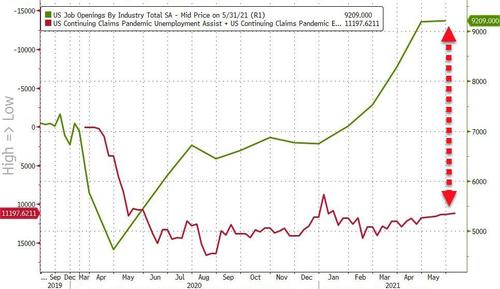
… we remind readers of the gaping chasm between those still claiming some form of pandemic-related unemployment benefit and the record number of job openings in America currently…

Initial jobless claims hovered at post-COVID-lockdown lows but were disappointing at 373k – well above the 200k-ish norms of pre-COVID
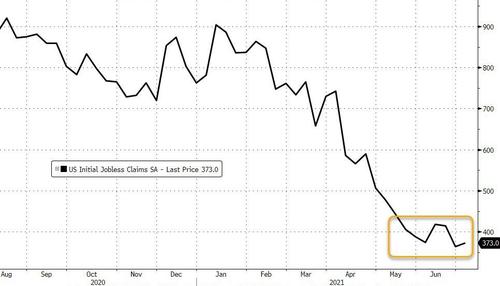

Source: Bloomberg
Notably, California and Virginia ‘estimated’ their jobless claims last week and Pennsylvania continues to swing wildly from week to week…

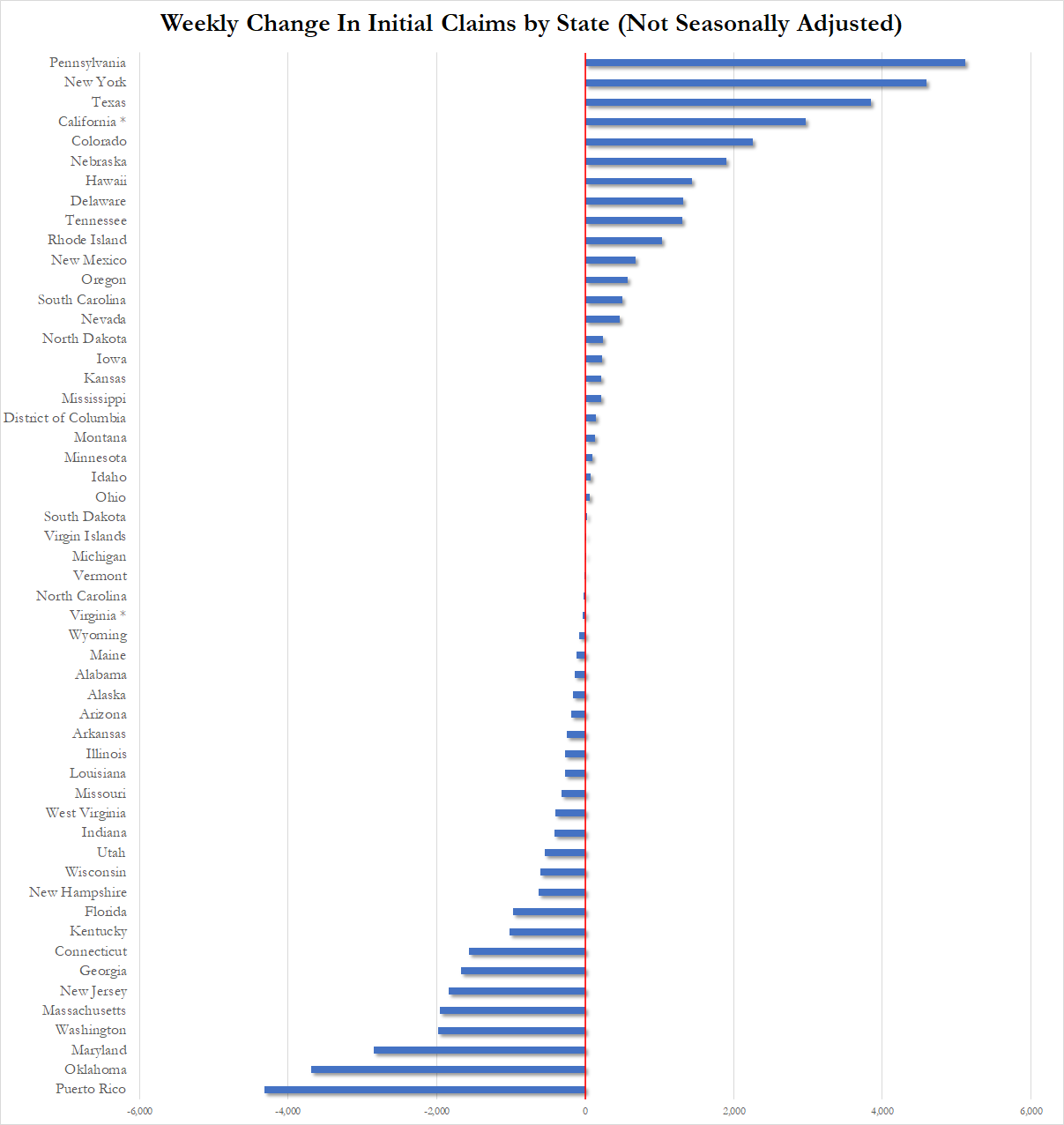
But, while the picture is improving overall, we should still remember that there are over 14 million Americans still on some of government dole…
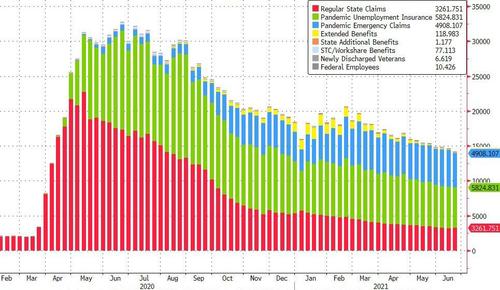

Source: Bloomberg
We do note that 460k Americans dropped off the pandemic emergency aid rolls…
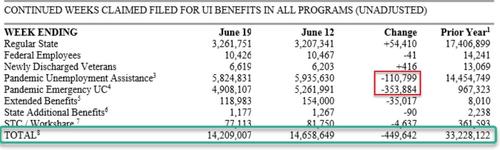

Finally, we remind readers of the gaping chasm between those still claiming some form of pandemic-related unemployment benefit and the record number of job openings in America currently…

Source: Bloomberg
Tick-tock on those benefits.
Economy
The Fed in a Box Part 2: They Cannot End Quantitative Easing
If inflation doesn’t slow in the coming months, the Fed may be forced to step in.
- If the Fed tapers QE, it may reveal waning appetite for long-term treasuries
- The Treasury may have used its cash balance reserve to anchor inflation expectations
- If inflation persists, the Fed may have to increase rather than decrease QE
Note: By definition, inflation is an expansion of the money supply. In this article, inflation will be used interchangeably with rising prices (usually as a result of money supply expansion)
Introduction
When the economy was shut down in March 2020, the government responded with massive fiscal and monetary support. The fiscal stimulus totaled $4T+ in relief packages. All of this spending was paid for with debt issued by the Treasury. The Treasury mostly issued short-term debt. With rates being held at zero by the Fed, and strong demand for short-term debt, it made sense to quickly raise cash using Treasury Bills as interest-free loans.
The Fed monetary policy was two fold, slash short-term rates to zero and inject $1.5 trillion into the long-term debt treasury market. The effect was to bring down interest rates across the entire yield curve. After the initial debt binge, QE went on auto-pilot, with the central bank buying about $80B a month in long-term debt (plus another $40B in Mortgage debt). Over the last year, the Treasury has continued to issue long-term debt, averaging more than the $80B the Fed has been buying. This has caused long-term rates to rise.
All of this fiscal and monetary stimulus is not without cost. Historically this type of activity almost always leads to higher inflation. The Fed may have recently indicated it wants higher inflation, but this is not true. This stance simply provides cover for them to not act in the face of rising prices. To actually fight inflation, the Fed would have to increase short-term rates above the rate of inflation. Part 1 of this series went into detail about how US short-term debt has doubled from $2.5T to $4.5T. This makes even small changes in short-term rates an immediate risk to the federal government, not to mention the much higher rates needed in a true inflation fight.
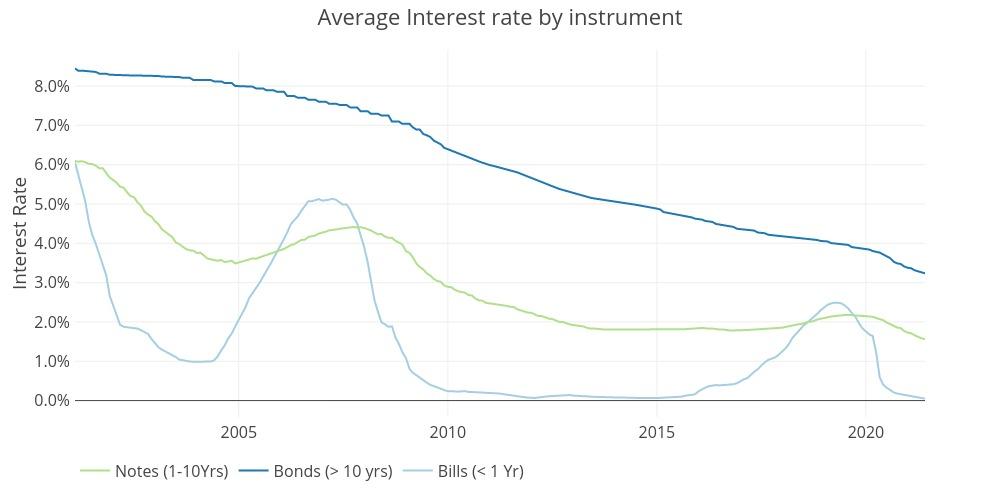
In theory, the Fed could leave short-term rates at 0% while ending QE and even shrinking its balance sheet. This would push long-term rates up to combat inflation. In the short/medium term the Treasury can mathematically handle higher long-term rates because it takes time for the higher rates to work their way through long-term debt. See the chart below that shows how the last tightening cycle worked its way through the average interest rate across debt instrument. Specifically, look at Notes compared to Bills. The average weighted interest rate on Bills moved very quickly where the rate on Notes barely had time to increase before rates dropped again.
Source – Treasurydirect.gov
Although the Treasury could handle rising long-term rates (even if the economy and mortgage market cannot), the Fed has another problem. Rising long-term rates send an important message: rising inflation expectations. While inflation is first and foremost a result of monetary policy, higher inflation expectations quickly exacerbate the problem. This is why the Fed has been messaging they are OK with higher inflation and also why they have been pounding the table that inflation is transitory. They need to keep inflation expectations low! If inflation expectations were to rise, especially at this critical juncture, it would be game over for the Fed, as they would have to raise short-term rates (devastating the Treasury and economy) in order to save the dollar and squash inflation.
With the economy opening up in March of this year, things were getting very precarious as inflation was rapidly rising along with surging long-term rates. Remember that rising long-term rates indicate rising inflation expectations. This could cause transitory inflation to be much less transitory.
In summer 2020, the Treasury issued enough debt to build up a significant cash reserve. In response to rising long-term rates in Q1 2021, it appears the Treasury strategically used its cash reserves to slow down the issuance of long-term debt. With total short-term debt outstanding already so high, the cash balance gave the Treasury ammunition to decrease debt issuance just as a $1.9T stimulus bill was passed and inflation was set to explode higher. This would have been perfect timing to support the Feds narrative that inflation is transitory to keep expectations from snowballing out of control.
If inflation doesn’t slow in the coming months, the Fed may be forced to step in. With the Treasury poised to issue more debt, it can no longer rely on its one-time use of excess cash reserves. This will put more pressure on the Fed to clamp down long-term rates by increasing rather than decreasing QE. Yes, the Fed may decide to print more money (leading to higher prices) to fight rising inflation expectations (higher long-term interest rates).
Understanding recent fiscal and monetary maneuvers
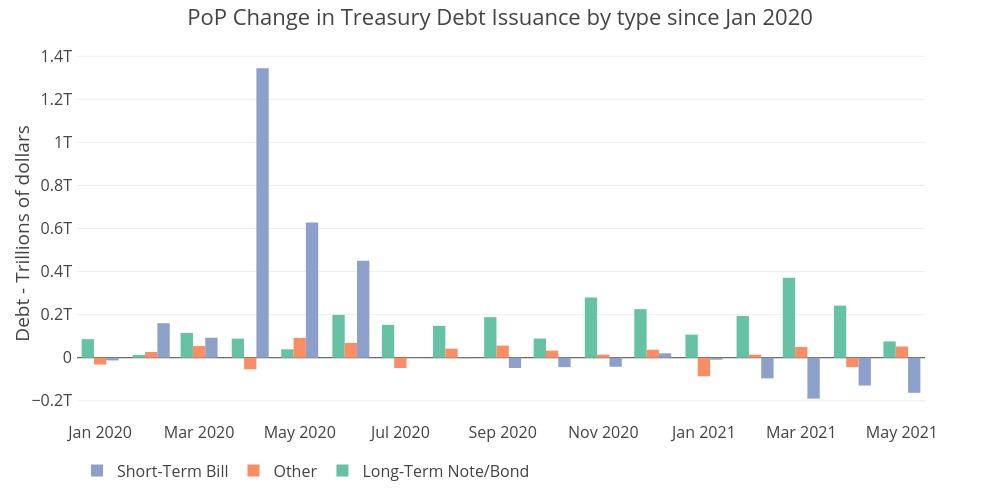
Last year, when the pandemic hit, the US Government started spending trillions of dollars. Massive spending plans were approved in the name of stimulus and COVID relief. Because the government does not have much money on hand, and taxes cannot quickly be raised, the Treasury issued trillions in debt. The markets can easily absorb short-term US Treasury Bills, so when the Fed abruptly cut rates to 0%, the Treasury responded by issuing short-term debt to the tune of $2.4T from March to June 2020. See figure 1 below.
Source – Treasurydirect.gov
In tandem, the Fed bought up trillions of dollars in US Debt, but the Fed was buying on the long end of the curve while the Treasury was issuing debt on the short end. This caused long-term rates to collapse. The Fed purchased enough long-term debt to absorb more than a year’s worth of long-term debt issuance. The chart below shows how the month over month and cumulative change in the Feds balance sheet compared to the Treasury Debt Issuance of long-term notes and bonds.
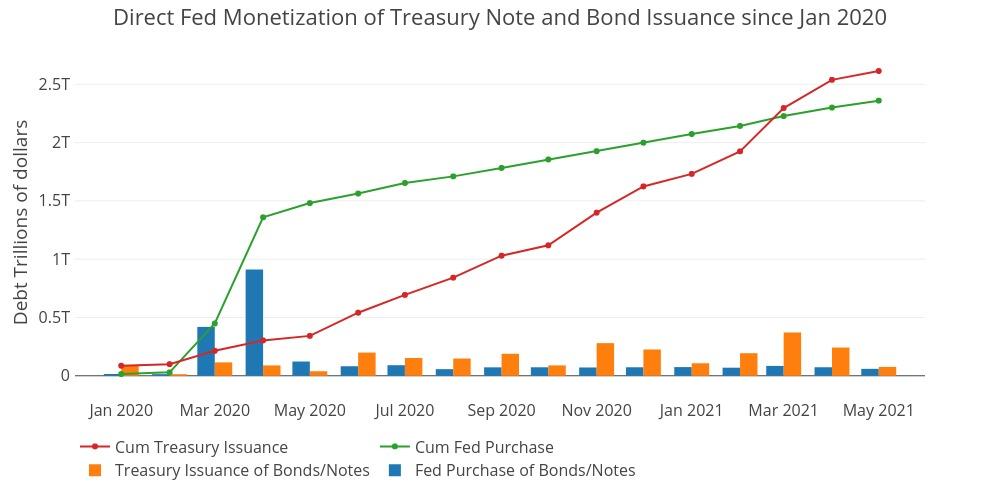
Source – Treasurydirect.gov
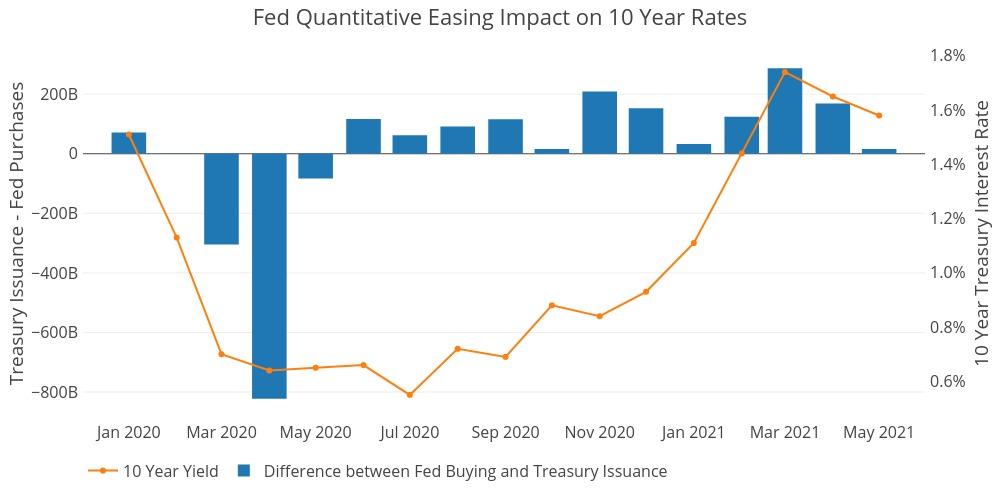
This action by the Fed had a massive impact on long-term rates. The chart below shows the difference between the two bars above, specifically the difference in Fed Buying and Treasury issuance of long-term debt for each individual month since Jan 2020. These values are not cumulative. The right Y-Axis shows the month-end interest rate of the 10-year bond. Looking at this chart shows something extremely clear: When the Fed buying exceeds debt issuance, rates are flat or falling; however when long-term debt issuance surpasses the Fed’s buying, rates rise.
Source – Treasurydirect.gov
The impact of the Fed can first be seen as interest rates fell from 1.5% to .6% during the initial buying spree. After the initial burst, the Fed put QE on auto-pilot, buying “only” $80B a month in long-term Treasuries. However, because the Treasury was issuing more than $80B a month as depicted by the positive bars starting in June 2020, interest rates started rising.
This trend started to accelerate in November of 2020, as long-term debt issuance was outpacing Fed Buying by around $200B. Things really started to escalate in the first quarter of 2021 as Treasury Debt issuance surpassed Fed buying by $286B in March right as interest rates were crossing above 1.7%.
Then, suddenly, long-term debt issuance started falling in April and was almost even with Fed buying in May. This consequently led to a fall in long-term rates, which are now hovering back around 1.5%. How did this happen just as Biden was pushing through a $1.9 stimulus package? Unlike 2020, when short-term debt issuance was used to plug the gap, Figure 1 above shows that short-term debt issuance was actually turning negative (blue bars).
What gives?
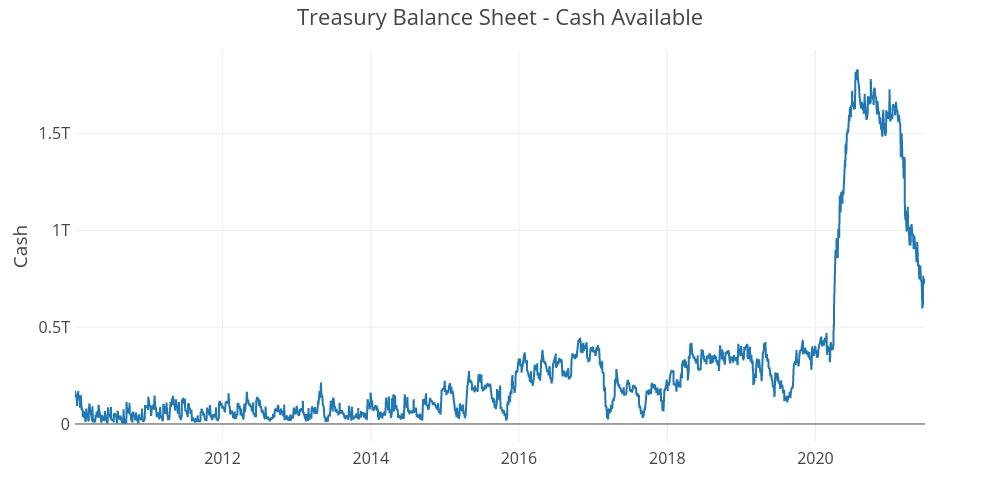
One look at the Treasury Cash Balance sheet in the chart below tells almost the entire story. This was first highlighted by a SchiffGold article published June 16. The chart below shows a massive surge in cash reserves by the treasury last year. Since March of this year, the cash balance has plummeted by over $1T.
Source – Treasurydirect.gov
Inflation Expectations
Why such a massive and sudden drawdown in the cash balance? In truth, there could be lots of reasons, but it does seem extremely sudden. One would think the Treasury, led by Yellen, would be very deliberate and thoughtful about how to use up $1T+ in dry powder. For the past 3 months, the Fed has been shouting from the rooftops that inflation is transitory. At the June FOMC press conference, Powell stood up and explained how long-term inflation expectations remain well-anchored. A proxy for inflation expectations is long-term interest rates.
Had interest rates continued to rise similar to the recent trajectory (climbing from .8% in Nov to 1.7% in March), this would have been a difficult narrative to push. The Fed needs inflation expectations to remain in check or else inflation will be anything but transitory. Thus, the perfect time for the Treasury to pause issuance of long-term debt would be April-June 2021 just as the economy is re-opening and the Fed is forecasting inflation to be at its worst before coming back down.
While this is speculation, it would be a very strategic move from both Powell and Yellen. Regardless of the intention though, the problem is that the Treasury has now spent its large cash balance. It could return to the short-term debt market, but the outstanding balance is still sitting above $4T (see part 1). It needs to be converting that short-term debt to long-term debt while long-term interest rates are still low and the Fed is still buying. But the Fed is simply not buying enough at $80B to convert all that debt!
If inflation persists beyond a few months, then interest rates are going to rise in a hurry as the market demands higher rates. Adding fuel to the fire will be the Treasury debt issuance overwhelming the $80B Fed buying as it did from November to March.
Then what?
Who is absorbing the long-term debt to keep interest rates from returning to the upward trajectory from Aug 2020 – Mar 2021?
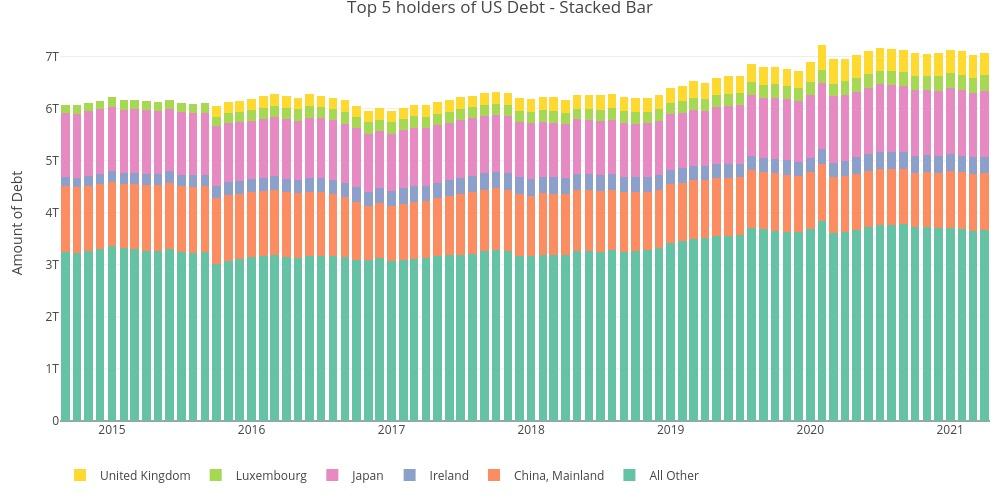
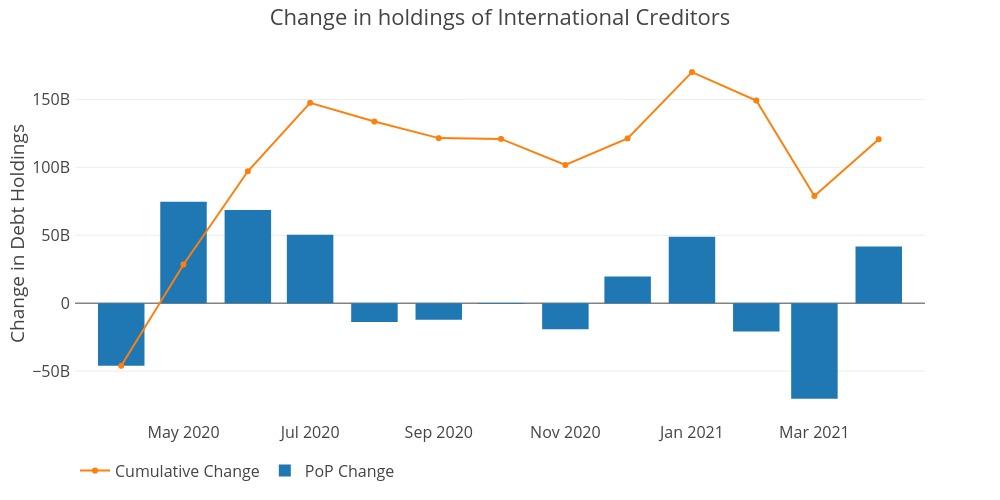
International creditors have had little appetite for US Debt lately. The chart below shows the total outstanding debt held by foreign governments. In the past 15 months, while the Treasury has issued over $4T in new debt, the net amount bought by foreign governments is close to zero.
Source – https://ticdata.treasury.gov/Publish/mfh.txt
To zoom into the exact amount of change since the massive debt issuance, see the chart below. In total, foreign creditors have absorbed $120 billion of $6T+ or less than 2% of total issuance!
Source – https://ticdata.treasury.gov/Publish/mfh.txt
How are rates going to stay low if the Fed keeps the treasury buying cap at $80B? The Treasury will have to issue more than $80B in long-term debt to continue funding all the massive spending. If inflation expectations stay low, maybe the market will have enough firepower to ingest some of the new debt, but not all of it. With the Fed planning to begin tapering at the end of the year, someone will need to fill the $80 billion void. This does not even take into account the possibility of shrinking the Fed balance sheet, which should be considered impossible at this point.
The chart of the international holders above brings to mind the image of the Wiley Coyote running off a cliff. With 10-year interest rates hovering near 1.5%, one could argue there is strong demand for long-term Treasury debt. Unfortunately, foreign creditors have turned off their debt purchases. It took decades for them to accumulate ~$7T in Treasury debt. The Fed alone has accumulated more than half that (~$4.5T) over the last decade. The Fed is making the market seem strong, but as shown above, there might be nothing but air if they were to exit the market. With a thumb on the scale, no one is getting an accurate reading of true demand for US long-term debt.

Source – Warner Brothers
What about short-term debt markets?
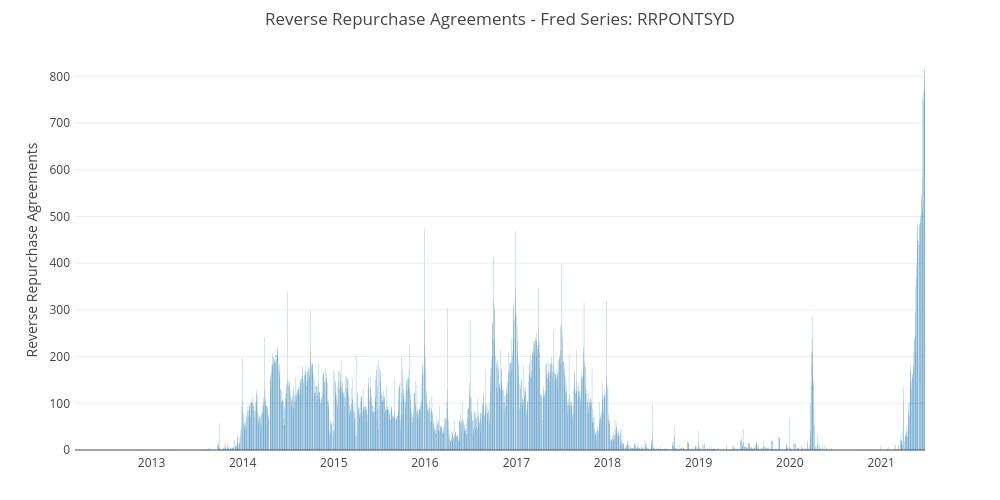
As highlighted several times, the demand for short-term debt seems to remain very strong. This makes sense as T-Bills mature in less than a year, so these investments are perceived as nearly risk-free. In fact, it could be argued that the recent Treasury Bill issuance hiatus (Figure 1 – blue bars turning negative) could be causing stress in the Reverse Repo market. The chart below shows the current Reverse Repo market. Based on past quarter-end data, it’s very possible that Reverse Repos could exceed $1.5T by this coming Wednesday, June 30, before coming back down.
Source – https://fred.stlouisfed.org/series/RRPONTSYD
Many articles have been written to explain this phenomenon, without providing exact clarity on what’s actually going on. The current understanding seems to be that the banks are awash with cash – so much cash, they are hitting the limits in terms of how much cash they can hold on balance overnight. This is cash that should be invested on behalf of money market funds. But with so much cash in the system, if it were to all be invested in short-term debt instruments, it could drive rates negative. To avoid negative rates, the Fed is lending banks assets on its balance sheet overnight in exchange for cash. It is critical to avoid negative rates to insure money market funds never experience a loss and result in breaking the buck.
Maybe this is a leap too far, but it seems another solution to the Fed reverse repurchase activity could be for the Treasury to issue more short-term debt. So, why has the Treasury been drawing down its cash balance and letting short-term debt mature when there seems to be strong demand in the market? The Treasury must recognize the risk of having too much debt in short-term instruments and is trying to lengthen the duration of its debt outstanding. Unfortunately, this abundance of cash in the repo market is in search of low-risk short-term debt so will not provide demand for long-term debt.
If this is the case, it has created quite the pickle for the Treasury. By issuing too much short-term debt, the Treasury is by default putting pressure on the Fed to not raise short-term interest rates. However, by issuing too much long-term debt, the Treasury is by default putting pressure on the Fed to maintain or even increase quantitative easing. To reiterate, this is why it is imperative the market believes inflation is transitory. The Treasury cannot stop issuing debt, which leaves the Fed unable to raise rates or taper QE without wreaking havoc in the bond market. Additionally, if the Fed has to fight inflation, then it’s not just the Treasury facing its Wiley Coyote moment, but the entire US economy.
Wrapping up
With the economy reopening, the Treasury deployed its cash balance at the most opportune time, unless of course inflation numbers continue to increase (which based on all the data, anecdotal evidence, and liquidity in the repo market seems like a strong possibility). Unfortunately for the Fed, the Treasury will have to begin re-issuing debt again. Will it lean towards short-term debt hoping the Fed keeps interest rates low, or long-term debt hoping the Fed will expand QE?
But Fed may be constrained either way because it has its own problem. Powell must be praying that inflation readings come in low AND job numbers disappoint. If both don’t occur, then tough questions will be asked to justify more stimulus. Yellen and Powell may be best buds, but simple coordination will not be enough. They will need magic and luck to keep the course steady heading into 2H 2021 and 2022.
If the Fed is lucky enough to get low inflation readings out of its rigged CPI, it may provide cover to begin tapering. Rising long-term rates won’t have the same compounding effect on inflation expectations in a “low” inflation environment. Unfortunately, long-term rates will not be tenable over the medium term as the government has to finance more and more debt. As the market this year has indicated, when issuance surpasses Fed buying, rates have gone up. So what happens to rates when the Fed leaves the market entirely? Presumably, they go up a lot. How high will the Fed let rates go before re-entering?
Just because something is inevitable (US Debt spiral) does not make it imminent; however, the next six months of data may shine a bright light on all the irresponsibility over the last 12 years if inflation proves not so transitory. Chances are, the only thing transitory will be “talking about talking about” tapering.
US Debt interactive charts and graphs can always be found on the Exploring Finance dashboard: https://exploringfinance.shinyapps.io/USDebt/

Join the community.

McMaken: The Fed’s Inflation Is Behind the Supply-Chain Mess

‘White People, You Are The Problem’: AT&T’s Internal ‘Racial Reeducation Program’ Leaked

Matrix? Misdirection? Cringe? Zuckerberg’s presentation of future life in ‘metaverse’ sparks fear, loathing, marvel and mockery

New York facing streets without cops because of COVID vaccine mandate

The Establishment Is Hiding Mass Resistance To Vaccine Mandates With The “Striketober” Farce
