
Health
5 Ways Americans Could Be “Encouraged” to Get a Covid Vaccine
If we don’t control what goes into our own bodies, how can we consider ourselves free human beings?

Penned by Daisy Luther at The Organic Prepper
As Pfizer and Moderna both rush a vaccine to market to fight the Covid-19 virus, will promises of returning to “normal” be enough to persuade people to take the quickly developed injection?
This article isn’t about persuading you one way or the other about whether you should be vaccinated. That is a matter for you, your family, and your physician to discuss. It’s about the opinions of Americans, the legalities of mandating cooperation, what we know about the vaccine, and the tactics that could be used to “encourage” your cooperation.
It’s expected that the new coronavirus vaccines will be approved any day now. Each vaccine is said to require two shots to confer immunity to the virus. Pfizer requires two doses three weeks apart, and Moderna requires two doses four weeks apart.
About half of Americans are eager to be vaccinated.
According to a poll conducted by Pew Research, 51% of American adults would immediately get a vaccine if it were available. That, of course, means that nearly half of all American adults aren’t convinced this is something that they want to do right now. This number has decreased from the first time the poll was taken. Back in May, 72% of American adults were on board with rolling up their sleeves as soon as possible.
Of course, this poll assumes that people will have a choice whether or not to be inoculated.
While half of the people surveyed want the injection, the other half do not. And that’s where the controversy lies – should we have a choice what medical treatments we undergo? Dr. Ron Paul spoke to The Huffington Post back in 2008 and said something as meaningful today as it was a dozen years ago.
“If we accept this notion that the federal government is going to dictate what we can put into our bodies, then it leads to the next step: that the government is going to regulate everything that is supposedly good for us. That’s where they are. They have an FDA that won’t allow somebody who’s dying to use an experimental drug which might speed up the process of finding out which drugs are good and which drugs are bad and the federal government comes in and dictates that they want complete control over vitamins and nutritional products and I just think the whole principal of government telling us what we can take in or not take in is just a dangerous position to take… it’s related to the drug industry because they’d like to control all of this.” (source)
Here are some of the immediate side effects.
Yasir Batalvi, a 24-year-old from Boston, volunteered to get the vaccine and received the two doses after signing a 22-page consent form. He shared his experience with CNN:
“The actual injection felt, at first, just like a flu shot, which is basically just a little pinch in the side of your arm,” Batalvi said. “Once I left the hospital, that evening, the stiffness got a little bit worse. It was definitely manageable, but you kind of don’t really feel like moving your arm too far above your shoulder. But the side effects are pretty localized. I mean, it’s just in the muscle in your arm. And that’s about it. It doesn’t really affect anything else and you feel fine.”
That was after the first dose. But the second dose was different.
“I actually had some pretty significant symptoms after I got the second dose. Once I got the second dose, I was fine while I was in the hospital. But that evening was rough. I mean, I developed a low-grade fever, and fatigue and chills,” Batalvi said. He said he was out for that day and evening, but he “felt ready to go by the next morning.”He said he called the study doctors to let them know about his symptoms. They weren’t alarmed and told him he shouldn’t be either.Feeling under the weather does not mean that you got Covid-19 from the vaccine — in fact, experts say having this kind of reaction shows that your body is responding the way it should, and it should not deter anyone from getting vaccinated or going back for their second dose. (source)
Doctors have urged the CDC to be transparent about the fact that the side effects of the vaccine are “not a walk in the park.”
Dr. Sandra Fryhofer of the American Medical Association said both Pfizer’s and Moderna’s Covid-19 vaccines require two doses at varying intervals. As a practicing physician, she said she worries whether her patients will come back for a second dose because of the potentially unpleasant side effects they may experience after the first shot.
“We really need to make patients aware that this is not going to be a walk in the park,” Fryhofer said during a virtual meeting with the Advisory Committee on Immunization Practices, or ACIP, an outside group of medical experts that advise the CDC. She is also a liaison to the committee. “They are going to know they had a vaccine. They are probably not going to feel wonderful. But they’ve got to come back for that second dose…
…One North Carolina woman in the Moderna study who is in her 50s said she didn’t experience a fever but suffered a bad migraine that left her drained for a day and unable to focus. She said she woke up the next day feeling better after taking Excedrin but added that Moderna may need to tell people to take a day off after a second dose.
“If this proves to work, people are going to have to toughen up,” she said. “The first dose is no big deal. And then the second dose will definitely put you down for the day for sure. … You will need to take a day off after the second dose.” (source)
These are the immediate side effects but only time will tell if there are long-term side effects.
Does the United States intend to mandate the vaccine?
Joe Biden has said that the vaccine will not be made mandatory on a federal level. The thing is, these decisions are usually made on a state level.
Some government officials are already talking about mandating the vaccine. Virginia State Health Commissioner, Dr. Norman Oliver, is all for mandatory Covid vaccinations.
State Health Commissioner Dr. Norman Oliver told 8News on Friday that he plans to mandate coronavirus vaccinations for Virginians once one is made available to the public.
Virginia state law gives the Commissioner of Health the authority to mandate immediate immunizations during a public health crisis if a vaccine is available. Health officials say an immunization could be released as early as 2021.
Dr. Oliver says that, as long as he is still the Health Commissioner, he intends to mandate the coronavirus vaccine…
…Oliver believes that, in the case of COVID-19, public health takes precedent over choice. He said herd immunity is the state’s best defense to stop the spread. (source)
Despite his health commissioner’s enthusiasm, Virginia Governor Ralph Northam has said he is not planning to mandate the vaccine at this time.
The Virginia health commissioner is not alone in his desire to mandate the vaccination. The New York State Bar has also recommended it be mandatory for residents of the state.
All this being said, there doesn’t seem to be a direct plan to pass laws making people take the vaccine.
Can the government actually make people take a vaccine?
Actually, yes.
But there is legislative precedent dating back to a U.S. Supreme Court case in 1905 called Jacobson v. Massachusetts that allows the government to mandate vaccinations.
In that case, the Supreme Court said that states have under their police powers, which is under the Constitution, the authority to enact reasonable regulations as necessary to protect public health, public safety, and the common good. Vaccination mandates constitute exactly that kind of permissible state action to protect the public’s health. Even though it’s 115 years old, this continues to be the benchmark case on the state’s power to mandate vaccination.
In response to the argument about this individual liberty interest, the court said that sometimes individual interests might have to yield to state laws that endeavor to protect the health of everybody—the “common good.” The court said: “The rights of the individual may at times, under the pressure of great dangers, be subjected to such restraint to be enforced by reasonable regulations as the safety of the general public may demand.”
So, yes: Once COVID vaccines are available, states could elect to require that people who live within that state be vaccinated. (source)
Despite this law being in place, mandating the vaccine will probably not be the first method used by the government.
Will Americans be forced or persuaded?
So what happens during a pandemic when there’s a vaccine that people are hesitant to take? Will we be forcibly immunized against our will?
It’s likely to be a much different approach than a SWAT team breaching your house in the middle of the night, holding down your family members, and stabbing them with syringes. If a widespread push is made to get people to take this vaccine, it will likely be a case of making life difficult for those who opt-out and more pleasant for those who opt-in.
People are desperate to resume some kind of normalcy, which will certainly be part of the campaign for vaccination. As we move into the second round of lockdowns, folks just want to have holidays with their families. Millions have been pushed into poverty. Mental health issues abound from the months of isolation. It’s difficult to connect with others and people want to resume their lives.
And if that’s not enough to persuade them to roll up their sleeve for an injection, following are some of the possibilities that have been mentioned to “encourage” Americans to take the vaccine when it becomes available.
Your kids may have to take it to go to school.
Most states already require that children be vaccinated against polio, diphtheria, tetanus, and pertussis, measles, rumps, and rubella, chickenpox, and hepatitis B unless they hold an exemption that is valid in that state. Exemptions are generally related to medical issues, religious beliefs, or personal philosophy.
It’s likely that a mandatory Covid vaccine for children to attend school would vary from state to state. Children have generally not become very ill with this particular virus and have seemed less likely than adults to contract it. (There have, of course, been some exceptions.) To some, that would indicate children did not need to undergo the risk of taking yet another vaccine. Dr. Christine Turley, M.D., Pediatrics Specialist and vice-chair of research at Atrium Health Levine Children’s Hospital believes it could be beneficial.
However, school-bound children could spread the virus to parents, grandparents, and others with underlying health conditions. Vaccinating children could eliminate one major source of coronavirus spread, possibly increasing the effectiveness of herd immunity (source)
And even if your kids are attending school via Zoom, it may not exempt them. I spoke to one parent whose children are engaged in distance learning in Massachusetts. Although they will not be setting foot on school property, they are still required to have proof that they are up to date on all required vaccinations.
Employers could insist that employees be vaccinated.
You could potentially lose your job if you refuse to take a vaccine that your employer has deemed mandatory. Legal and public health expert Joanne Rosen, a senior lecturer in Health Policy and Management and the Center for Law and the Public’s Health, spoke about the topic of mandatory vaccinations with Public Health On Call podcast host Stephanie Desmon.
An employer has to have a “reasonable basis.” If you worked in retail, I’m not sure a corporate entity could require that. They may want you to and recommend it, but it wouldn’t be reasonably related to the requirements of their job.
But in sectors in which the employees are themselves at greater risk of contracting vaccine-preventable illnesses or who work with populations that are especially vulnerable if they do get sick, like hospital workers, health care workers, and people who work in [long-term care] facilities, employers have required that their staff be vaccinated against the flu each year.
Another thing that states could do, short of a requirement across the board that everybody be vaccinated, is they could begin with a mandate that focuses on those sectors—people who are themselves at greater risk or who work in proximity with vulnerable populations. We don’t want the employees themselves getting sick and being a bridge, or “vector,” to infecting others who are vulnerable. People may object, but some more targeted form of vaccine mandate may make sense and also be possible. (source)
Dorit Reiss, a law professor at the University of California Hastings College of the Law in San Francisco, told TODAY there were a few exceptions:
Employees who are part of a union may be exempt from the vaccine requirement.
Anti-discrimination laws also provide some limits. If you can’t get the vaccine for medical reasons, that could be a disability under the Americans with Disabilities Act, which would require an employer to accommodate you. That could mean requiring you to wear a mask on the job or have limited contact with other people, Reiss said.
The Civil Rights Act of 1964 may protect people who have a religious objection to a vaccine. An employer would have to make a reasonable accommodation as long as it’s not too costly for the business.
These laws apply only to companies with 15 or more employees, so smaller businesses are exempt.
“We think about employers as this huge, amorphous thing, but under the law, they’re also private entities with rights, especially if it’s a small mom and pop shop,” Reiss noted. (source)
Consider how some workplaces require all employees to receive a flu shot – the Covid vaccine could be enforced in a similar manner. Health care workers and those involved in education are most likely to be the first to face such requirements.
Businesses could require patrons to show proof of vaccination.
Even if a state or federal mandate is not in place, privately owned businesses could potentially require patrons to show proof of vaccination before they receive service.
Can airlines, restaurants, stores and stadiums make the vaccine a condition of doing business with you?
Yes, within the anti-discrimination laws mentioned above.
“They can decide to refuse service to you for pretty much any reason,” Reiss said, pointing out a policy most shoppers are already familiar with: no shirt, no shoes, no service.
People who are covered by anti-discrimination laws can’t just demand a business let them do whatever they want. The company just has to give you a reasonable accommodation, so a store might refuse you entry but offer curbside pick-up of groceries. (source)
Private businesses can set their own policies. Ticketmaster, the purveyor of tickets for concerts, plays, and just about any public event, has already “been working on a framework for post-pandemic fan safety” that would use their phones to confirm whether they’ve been vaccinated or had a negative test within the past couple of days. Billboard reports:
Here’s how it would work, if approved: After purchasing a ticket for a concert, fans would need to verify that they have already been vaccinated (which would provide approximately one year of COVID-19 protection) or test negative for coronavirus approximately 24 to 72 hours prior to the concert. The length of coverage a test would provide would be governed by regional health authorities — if attendees of a Friday night concert had to be tested 48 hours in advance, most could start the testing process the day before the event. If it was a 24-hour window, most people would likely be tested the same day of the event at a lab or a health clinic.
Once the test was complete, the fan would instruct the lab to deliver the results to their health pass company, like CLEAR or IBM. If the tests were negative, or the fan was vaccinated, the health pass company would verify the attendee’s COVID-19 status to Ticketmaster, which would then issue the fan the credentials needed to access the event. If a fan tested positive or didn’t take a test to verify their status, they would not be granted access to the event. There are still many details to work out, but the goal of the program is for fans to take care of vaccines and testing prior to the concert and not show up hoping to be tested onsite.
Ticketmaster would not store or have access to fans’ medical records and would only receive verification of whether a fan is cleared to attend an event on a given date. (source)
This isn’t a definite plan but the fact that it’s in the works means the idea could spread to sporting events, shopping centers, movie theaters, or any other venue in which people are in close proximity with one another.
Your eligibility for a $1500 stimulus check could depend on it.
U.S. Rep. John Delaney, a Democrat from Maryland who was an “also-ran” in the recent presidential election, thinks that tying the next stimulus check to vaccination is a good idea.
“We have to create, in my judgment, an incentive for people to really accelerate their thinking about taking the vaccine,” Delaney told CNBC, noting that nobody would be forced to participate if they don’t want to.
Delaney said the program would cost about $380 billion, more than the $270 billion the U.S. spent on the $1,200 coronavirus stimulus checks that went out earlier this year.
“So if you can only spend $400 billion, this is what you should spend it on,” Delaney said. (source)
Given the US’s rather dismal economic situation, $1500 for taking a couple of free injections would probably be tough to pass up for a lot of folks.
You may not be able to travel without it.
Airlines are preparing to launch a digital “Covid Passport” to try and revive the dying travel industry.
The International Air Transport Association, or IATA, on Monday said it plans to introduce this month a mobile phone app that arriving travelers could use to prove that they’ve been vaccinated for the coronavirus that causes Covid-19 and tested negative for it. Conceivably the app, which IATA is calling The Travel Pass, also could become necessary for domestic flights should airlines begin requiring all their passengers to document their Covid-19 vaccination and testing status.
No governments as yet have said they will accept such digital documentation from travelers as a way for them to escape the quarantines currently required by many nations for arriving foreigners…
…But IATA, which represents nearly 300 airlines that collectively carry 82% of all air travelers globally, is acting now so that its member carriers can begin ramping up their international operations as Covid-19 vaccines begin being administered, presumably in a matter of weeks. (source)
For people who travel recreationally, this might not be enough inducement to get the vaccine. But for those who have family members in other countries or who travel for work, it could become a necessity.
What should you know about the Covid vaccine?
The Covid vaccine uses new technology called mRNA. The mRNA vaccine sequences are designed to mimic those produced by mammalian cells. Because of this, mRNA vaccines are much faster (and cheaper) to produce than antigen vaccines. The PHG Organization of the University of Cambridge explains:
Conventional vaccines usually contain inactivated disease-causing organisms or proteins made by the pathogen (antigens), which work by mimicking the infectious agent. They stimulate the body’s immune response, so it is primed to respond more rapidly and effectively if exposed to the infectious agent in the future.
RNA vaccines use a different approach that takes advantage of the process that cells use to make proteins: cells use DNA as the template to make messenger RNA (mRNA) molecules, which are then translated to build proteins. An RNA vaccine consists of an mRNA strand that codes for a disease-specific antigen. Once the mRNA strand in the vaccine is inside the body’s cells, the cells use the genetic information to produce the antigen. This antigen is then displayed on the cell surface, where it is recognised by the immune system. (source)
At this point, there are no licensed mRNA vaccines in the United States. Much of the research on mRNA has been focused on triggering the immune system to target specific cancer cells.
There are innumerable videos and articles about the pros and cons of mRNA vaccinations and I urge you to do your own research when making decisions for your family.
Will you be getting a Covid vaccine?
I’m personally against mandating any type of medical care or procedures. If we don’t control what goes into our own bodies, how can we consider ourselves free human beings? This isn’t to say a particular vaccine or treatment is good or bad. I simply don’t want to be forced or manipulated into making medical decisions. I believe we should all have the right to make our own medical choices.
Approximately half of the Americans surveyed are eager to get a Covid vaccine right away. Others want to wait for a year or so, to see if there are long-term negative side effects. Still others have no interest in the vaccine whatsoever.
What are your thoughts on this vaccine and any possible mandates? Let’s discuss it in the comments.


Health
FDA Committee Members Reviewing Pfizer Vaccine For Children Have Worked For Pfizer, Have Big Pfizer Connections
“The industry defends the attempts to influence committee members as simply efforts to best present their case”
The FDA’s Vaccines and Related Biological Products Advisory Committee is holding a virtual meeting Tuesday October 26 to discuss authorizing a Pfizer-BioNTech Coronavirus vaccine for children between the ages of 5 to 11 years old.
This committee has a lot of sway with the FDA and their findings will be relevant, considering the Biden administration is getting ready to ship vaccines to elementary schools and California has already mandated the vaccine for schoolchildren pending federal authorization.
But the meeting roster shows that numerous members of the committee and temporary voting members have worked for Pfizer or have major connections to Pfizer.
Members include a former vice president of Pfizer Vaccines, a recent Pfizer consultant, a recent Pfizer research grant recipient, a man who mentored a current top Pfizer vaccine executive, a man who runs a center that gives out Pfizer vaccines, the chair of a Pfizer data group, a guy who was proudly photographed taking a Pfizer vaccine, and numerous people who are already on the record supporting Coronavirus vaccines for children. Meanwhile, recent FDA Commissioner Scott Gottlieb is on Pfizer’s board of directors.
HERE’S THE MEETING ROSTER: Vaccines and Related Biological Products Advisory Committee October 26, 2021 Meeting Draft Roster.
Acting Chair Arnold S. Monto was a paid Pfizer consultant as recently as 2018.
Steven Pergam got the Pfizer vaccine: Building trust in safe and effective COVID-19 vaccines (fredhutch.org)
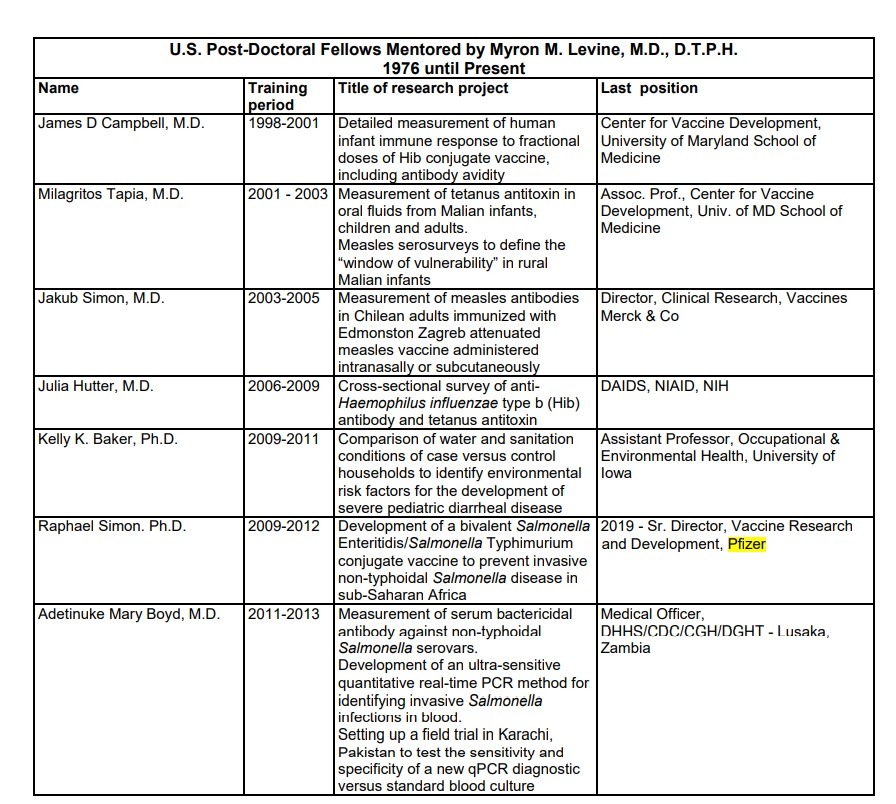
Committee member Archana Chatterjee worked on a research project related to vaccines for infants between 2018-2020, and the research project was sponsored by Pfizer.
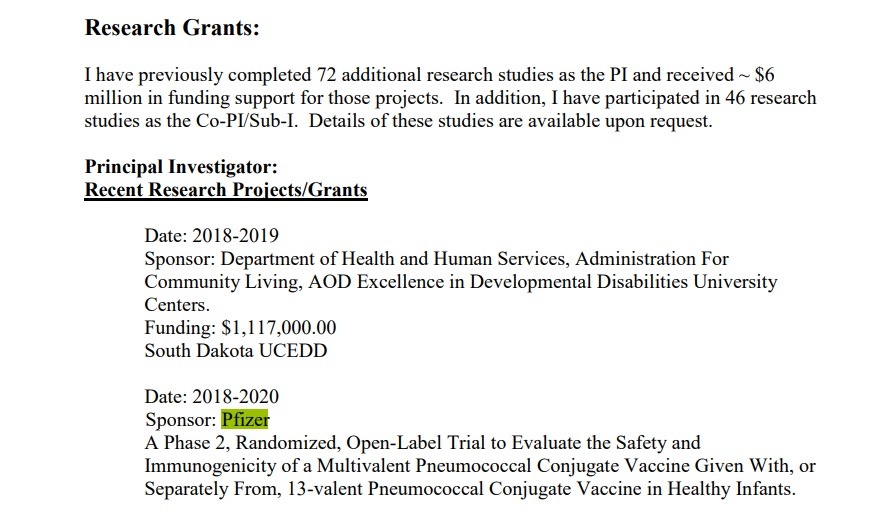
Myron Levine has mentored some U.S. post-doctoral fellows, and one of his proteges happens to be Raphael Simon, the senior director of vaccine research and development at Pfizer.
James Hildreth, temporary voting member, made a financial interest disclosure for this meeting in which he disclosed more than $1.5 million in relevant financial interests, including his work as president of Meharry Medical College, which administers Pfizer Coronavirus vaccines.
Geeta K. Swamy is listed as the chair of the “Independent Data Monitoring Committee for the Pfizer Group B Streptococcus Vaccine Program,” a committee sponsored by Pfizer. Duke University states that “Dr. Swamy serves as a co-investigator for the Pfizer COVID-19 vaccine trial.”

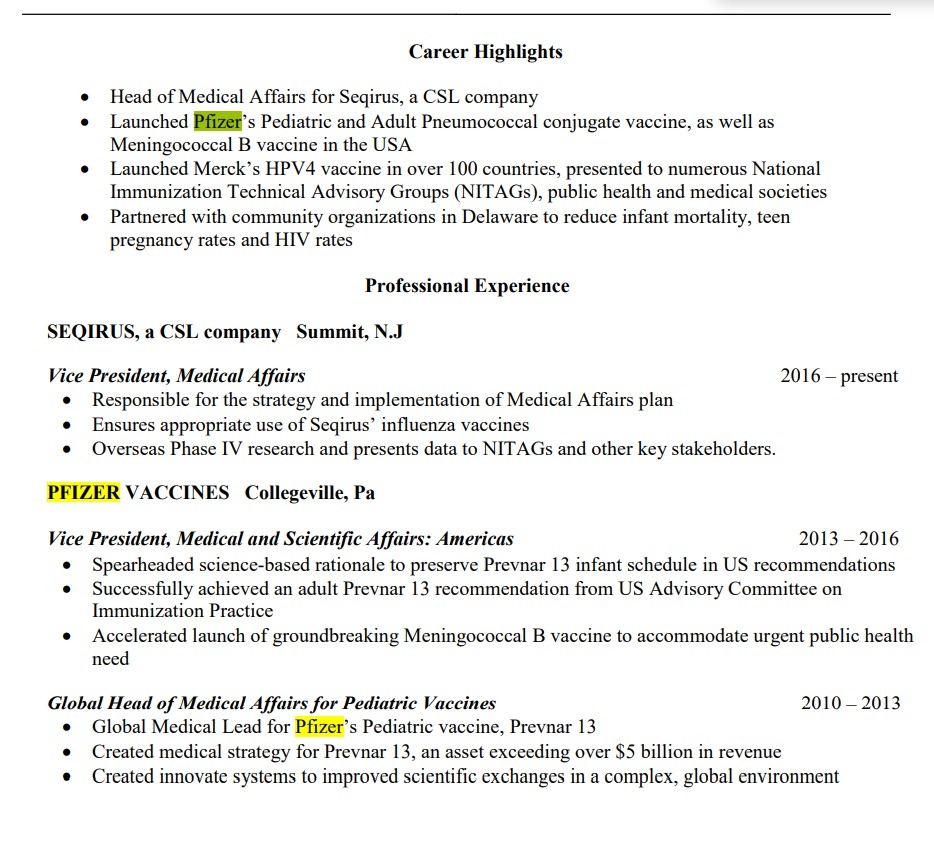
Gregg Sylvester previously served as a vice president for Pfizer Vaccines, where he launched Pfizer vaccines including one for children.
 Among the meeting’s “temporary voting members,” Ofer Levy, Boston Children’s Hospital, is for the Pfizer vaccine for children, Eric Rubin is pro-vaccine for children, Jay Portnoy supports authorizing Coronavirus vaccines for kids, and Melinda Wharton complained over the summer about how orders for the CDC’s “Vaccines For Children” program dropped.
FDANews stated last December: “FDA advisory committee members in the past have frequently been the target of heavy politicking by industry representatives of whatever drug they were considering for a recommendation at in-person meetings. That process has been somewhat altered by the fact that during COVID-19, meetings are being held virtually. But it’s likely that behind-the-scenes pressuring still goes on. The industry defends the attempts to influence committee members as simply efforts to best present their case.”
Health
FDA Panel Backs Pfizer Shot For Kids: “We’re Never Going to Learn About How Safe This Vaccine Is Unless We Start Giving It”
The same FDA panel approved the rollout of boosters earlier this month based off “gut feeling” rather than data.
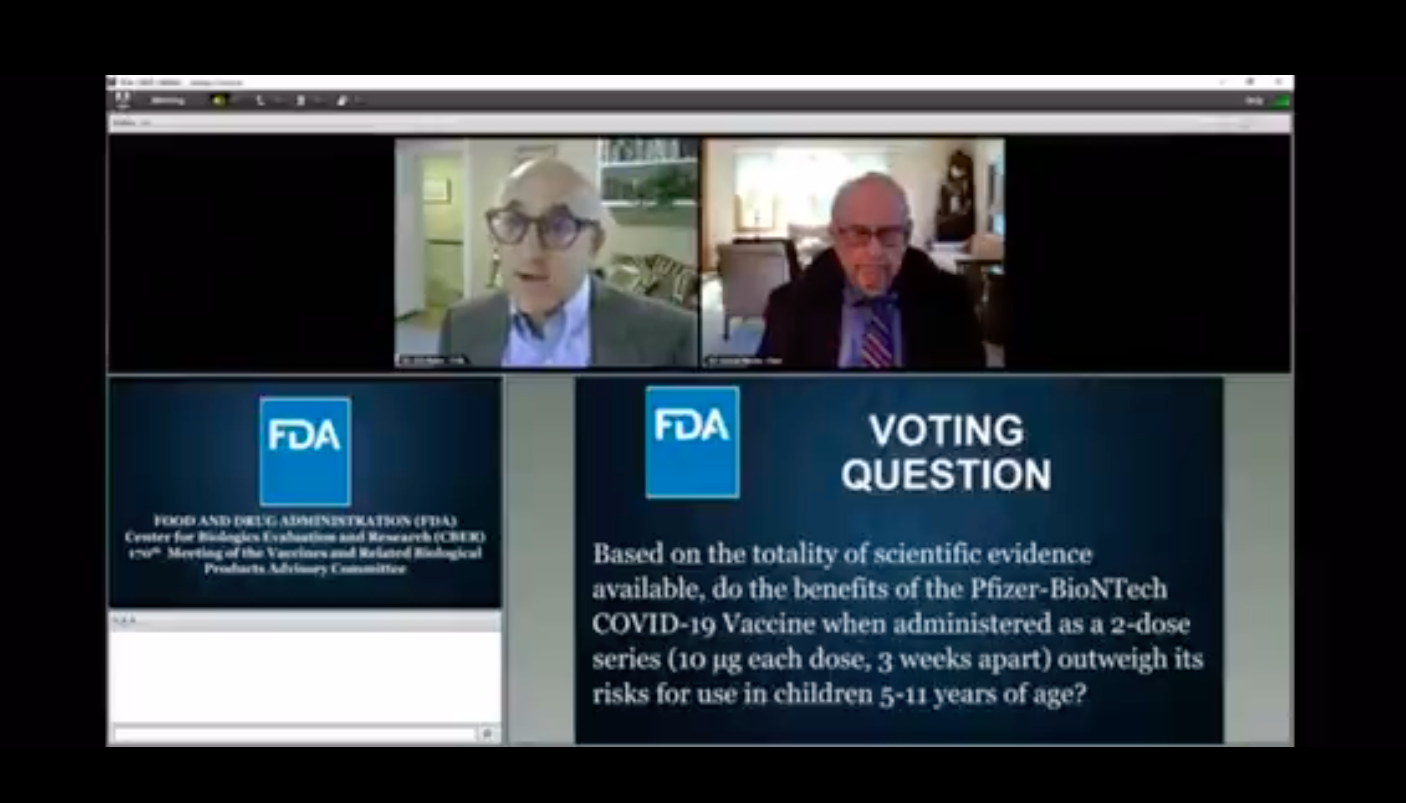
An FDA vaccine advisory panel on Tuesday voted unanimously 17-0 in favor shooting up kids aged 5-11 with Pfizer’s experimental mRNA injection with panelist Dr Eric Rubin stating, “we’re never going to learn about how safe this vaccine is unless we start giving it.”
Full context:
“We’re never going to learn about how safe this vaccine is unless we start giving it,” Dr Rubin said, urging other panelists to vote for it. “That’s just the way it goes.”
The panel voted in favor of experimenting on tens of millions of helpless children with zero long-term data on side effects because 94 children between 5 and 11 have died with COVID-19 (they claimed “of”) and “all have names. All of them had mothers,” to quote the emotional gobbledegook uttered by panelist Patrick S. Moore.
From The Washington Post:
“To me, it seems that it is a hard decision but a clear one,” said Patrick S. Moore, a University of Pittsburgh microbiologist and committee member. He noted that 94 children between 5 and 11 have died of covid-19, and “all have names. All of them had mothers.”
As the WSJ reported:
Members of the FDA’s vaccine-advisory panel supported Moderna’s booster dose even though the evidence for it was from a small study and had mixed results.
“It’s more a gut feeling rather than based on really truly serious data,” said Patrick Moore, a member of the committee and a professor of molecular genetics and biochemistry at the University of Pittsburgh School of Medicine. “The data itself is not strong, but it is certainly going in the direction that is supportive of this vote.”
This is how they “follow the science.”
Health
Governor takes over state’s PRIVATE businesses, mandates vaccines for all
‘His message was crystal clear, obey or lose your job’
The governor of Washington has begun a process that could result in a statewide mandate for all workers to accept the experimental COVID-19 shots in order to be able to get a paycheck.
Across America already, universities, schools and hospitals have COVID vaccination mandates – even though as experimental treatments those actions remain under court challenge in many cases.
President Biden also has ordered the vaccinations for federal workers and the military. And companies with more than 100 employees.
But now Democratic Gov. Jay Inslee in Washington has moved the agenda even further.
A report at the PostMillennial explains under Inslee, the Washington Department of Labor and Industries has proposed an emergency package of rules addressing the “emergency powers” given Inslee to respond to COVID-19.
“This package, which is an extension of current mandates, grants Inslee the ability to enforce COVID vaccine mandates on all private businesses in the state of Washington, according to elected officials,” the report said.
It was a statement from Republicans Jim Walsh and Jesse Young of the legislature that revealed the actions.
“This mandate from L&I demonstrates a complete lack of transparency, which dilutes public trust in our government and fails to show the agency’s good faith in promulgating the rule. The reality is this move by L&I is a blank check for the agency to enforce any of the governor’s mandates or edicts on private employers,” they wrote.
They explained if the state agency wants such a rule, officials should request it in “an open and transparent manner that allows public review and comment.”
“Even if an opportunity for review and comment is not afforded the public, L&I’s website should host the proposed rulemaking to grant easy access to the public,” they said.
They also warned about arbitrary enforcement because of the proposal’s vagueness.
“There is no clear case for ‘good cause’ or ‘the preservation of the public health, safety, or general welfare’ as the governor’s proclamation already addresses these issues, making L&I’s mandate arbitrary and capricious,” they said. “We call on the governor to immediately repeal this mandate. If L&I wants to push this policy, it needs to go through the proper channels and work with the Legislature.”
The report explained Inslee’s recent vaccine mandate was unlike others in that it provided no opt-out for testing instead.
“His message was crystal clear, obey or lose your job,” the report said. “Despite mass protests across the state with thousands of state workers in attendance, Inslee followed through on his orders and terminated thousands that decided not to comply.”
The report warned, “If Inslee follows through on L&I’s emergency rulemaking package, all businesses and employees in the state of Washington will be subjected to submitting proof of vaccination as a condition of employment.”
Real Clear Policy earlier explained that Americans simply don’t like Biden’s orders and mandates.
The article pointed out that health authorities have openly misled the public, including top medical adviser Anthony Fauci’s multiple flip-flops on COVID issues.
He deceived the public, for example, by saying the public didn’t need to wear masks, then again when commenting about “herd immunity.”

Join the community.

McMaken: The Fed’s Inflation Is Behind the Supply-Chain Mess

‘White People, You Are The Problem’: AT&T’s Internal ‘Racial Reeducation Program’ Leaked

Matrix? Misdirection? Cringe? Zuckerberg’s presentation of future life in ‘metaverse’ sparks fear, loathing, marvel and mockery

New York facing streets without cops because of COVID vaccine mandate

The Establishment Is Hiding Mass Resistance To Vaccine Mandates With The “Striketober” Farce
